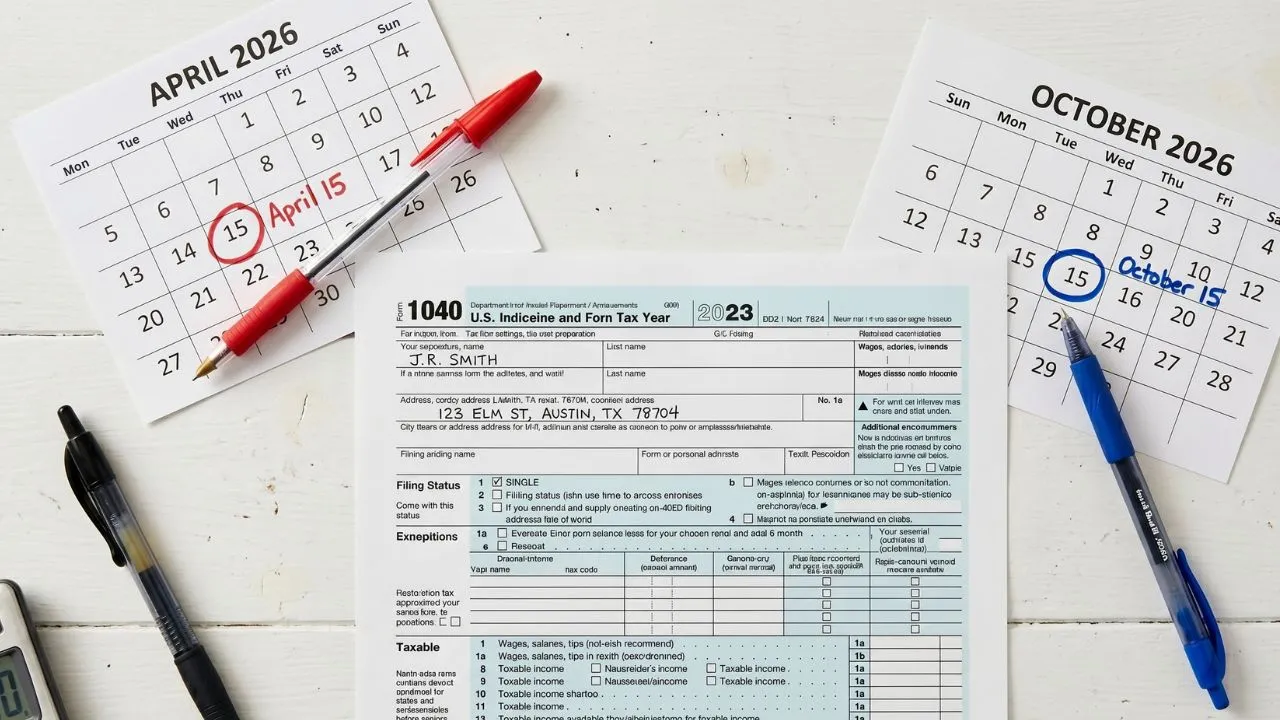


The Internal Revenue Service is urging Americans to begin preparing for the 2027 tax filing season before the end of this year. In a November 16 announcement, the agency encouraged taxpayers to organize financial records, review applicable tax deductions, access their online accounts and prepare for electronic refunds. Several tax provisions could affect how much households owe or receive when they file their 2026 federal income tax returns.
One particularly important change affects Americans who donate to charity without itemizing their deductions. Others involve tipped workers, employees earning overtime, adults aged 65 and older, and taxpayers paying interest on qualifying vehicle loans. The IRS is also continuing its transition away from paper refund checks, making accurate banking information increasingly important.
Here are five things taxpayers should review before the 2027 filing season begins and why some households face different requirements than others.
1. Check which tax deductions you qualify for
The 2027 filing season will reflect several provisions introduced under the federal tax legislation enacted in July 2025. According to the IRS deduction guidance, eligible workers can deduct up to $25,000 in qualified tips, while qualifying overtime deductions can reach $12,500 for individuals or $25,000 for married couples filing jointly. Taxpayers aged 65 and older may qualify for an additional $6,000 deduction per eligible individual, while qualifying vehicle loan interest deductions can reach $10,000.
These deductions are subject to income limits and other eligibility requirements, and they are not automatic payments. For example, the qualified tips deduction does not mean every dollar received in tips is exempt from every federal tax. Similarly, the overtime provision generally applies to the qualifying premium portion of overtime compensation, rather than the worker’s entire overtime paycheck.
Another significant change begins with tax year 2026. Americans who take the standard deduction may now qualify for a charitable contribution deduction of up to $1,000 individually or $2,000 when married and filing jointly. Qualifying cash donations must be made during the applicable tax year, and taxpayers should retain supporting documentation.
Consider two married couples who file jointly and take the standard deduction, each making $2,000 in eligible cash donations during 2026. A couple whose deduction falls entirely within the 12% marginal tax bracket could reduce its federal income tax by $240, while a couple in the 22% bracket could save $440 under otherwise comparable conditions. The deduction is identical, but its financial value differs by $200 because of their respective marginal tax rates.
2. Review your income records and withholding
Americans who changed jobs, started working independently, received investment income or earned additional money through online platforms during 2026 should review their income records carefully. The IRS recommends collecting documents from every relevant income source, including employers, financial institutions and digital payment platforms. Filing before all necessary records arrive could result in an incomplete return.
An important distinction applies to people earning money through payment apps and online marketplaces. Under the IRS filing guidance, the federal reporting threshold for third-party payment networks generally applies when reportable payments exceed both $20,000 and 200 transactions during 2026. However, earning less than that amount does not automatically make the income tax-free.
For example, someone earning $8,000 from freelance services may still have taxable business income even without receiving Form 1099-K. By contrast, someone selling personal furniture for less than its original purchase price generally has no taxable gain from that sale, according to the 1099-K guidance. Keeping purchase receipts and transaction records helps establish the difference.
Taxpayers should also review federal withholding and estimated payments before the year ends. A change in household income, employment or filing status could affect their eventual tax balance. The IRS provides guidance through its annual planning reminder.
3. Confirm where your tax refund will go
The federal government’s transition toward electronic payments is another important consideration for the upcoming filing season. Under Executive Order 14247, the IRS began reducing its reliance on paper refund checks in 2025. Most taxpayers expecting electronic refunds should have accurate bank routing and account numbers ready when they file.
Americans without traditional bank accounts are not automatically excluded from receiving refunds. Certain prepaid debit cards and digital payment services may support direct deposits if they provide appropriate account and routing numbers. Understanding the available payment alternatives could help taxpayers avoid unnecessary complications.
Under the IRS’s current procedures, taxpayers with missing, invalid or rejected banking information may receive a CP53E notice. Recipients have 30 days to provide updated banking details or select an applicable paper-check exception. The agency’s current guidance also says that taxpayers who do not respond will receive a paper check after six weeks.
The transition does not mean taxpayers automatically lose their refunds because they lack a bank account. However, checking account details before submitting a return may help prevent refund deposit problems and avoid additional administrative steps.
4. Review your IRS account and identification details
Taxpayers can access tax transcripts, review available income documents, manage payments and obtain an Identity Protection PIN through their IRS Individual Online Account. Establishing access before filing season gives households time to address identity verification or account-access difficulties. Taxpayers should always reach these services directly through IRS.gov rather than through unsolicited messages.
A separate deadline applies to certain Individual Taxpayer Identification Number holders. According to the ITIN renewal rules, an ITIN that was not used on a federal income tax return for tax years 2023, 2024 or 2025 will expire on December 31, 2026.
An expired ITIN generally needs renewal if it will be used on an upcoming federal tax return. Filing with an expired number could delay processing and affect the taxpayer’s ability to claim certain credits until renewal is completed. People who have obtained a Social Security number should not renew their ITIN, while those who use an expired ITIN only on information returns generally do not need to renew it for that purpose.
5. Check family benefits and refund timing
Changes in family circumstances during 2026 could affect eligibility for federal tax benefits. The IRS says the Child Tax Credit is worth up to $2,200 per qualifying child for tax year 2026, subject to applicable income and eligibility requirements. The maximum Earned Income Tax Credit reaches $8,231 for eligible families with three or more qualifying children, compared with $664 for eligible taxpayers without qualifying children.
However, households claiming the Earned Income Tax Credit or Additional Child Tax Credit face a different refund timetable. The federal PATH Act restrictions prevent the IRS from issuing refunds containing these credits before mid-February, including portions of the refund unrelated to the credits. Filing early does not remove that statutory restriction.
Retirement savers should also distinguish the upcoming filing season from the 2027 tax year. The new Saver’s Match program applies to qualifying contributions for tax year 2027, meaning eligible calendar-year taxpayers would generally claim it when filing in 2028. It is not an additional payment that households can assume they will receive when filing their 2026 returns.
For Americans who need assistance, the IRS announced funding to support free tax preparation during the upcoming filing season. I see the distinction between tax-year eligibility, filing dates and actual refund timing as particularly important for household financial planning. Preparing early can help taxpayers avoid preventable errors, but a potential deduction or credit should never be treated as guaranteed money before eligibility and the final return have been established.
The regular federal deadline for 2026 individual income tax returns is April 15, 2027, subject to applicable exceptions.