
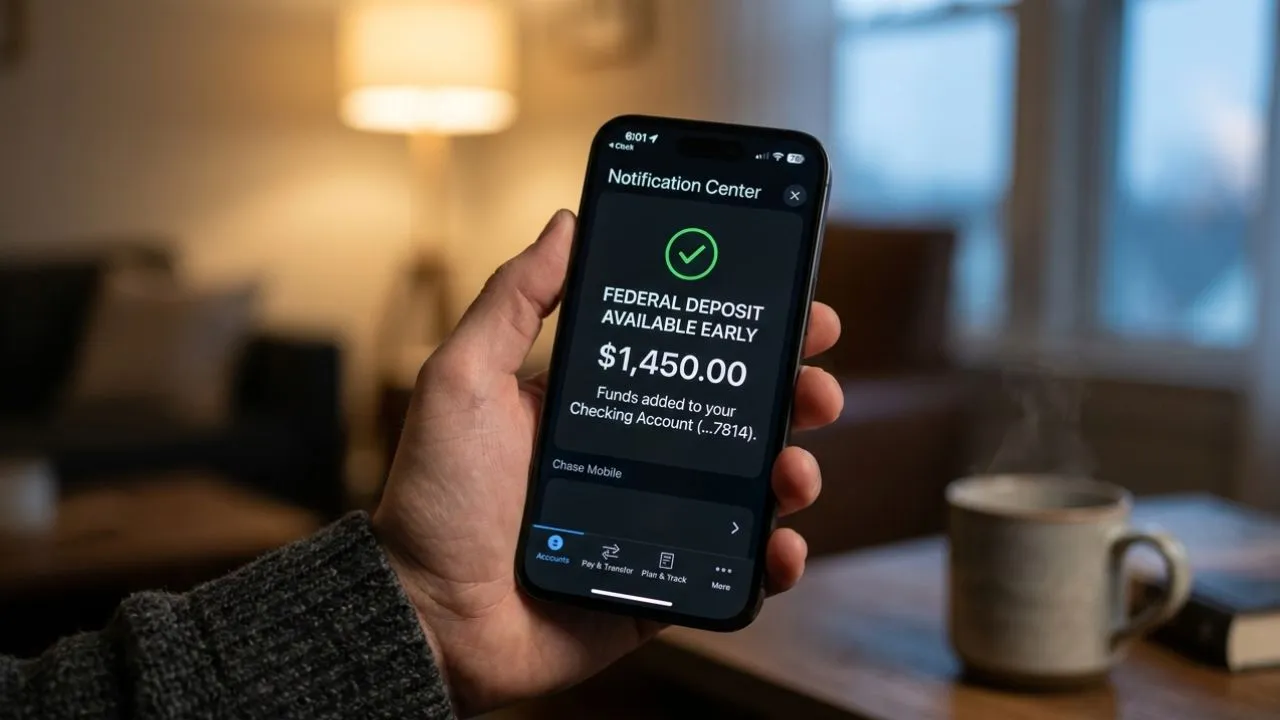
Not every bank treats your federal payment the same way. Some institutions hold your money for the full settlement cycle, collecting the overnight float interest while you wait. A small group of banks and fintech platforms release your funds the moment the government’s payment file arrives, which can be two full business days before your official payday.
This is not a promotional feature. It is a structural decision rooted in how the U.S. Treasury, the Federal Reserve’s FedACH network, and the National Automated Clearing House Association govern the flow of federal payments into American bank accounts.
How the Float Difference Works
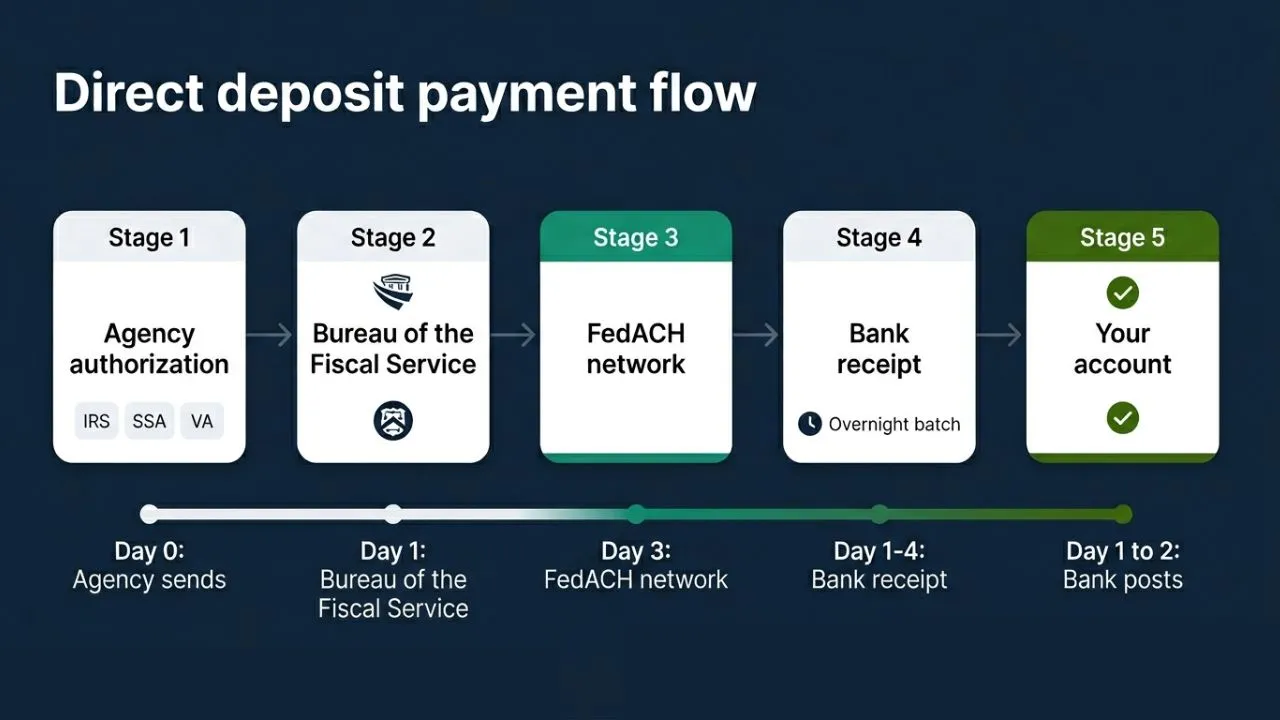
When the U.S. Treasury’s Bureau of the Fiscal Service processes a federal benefit payment, whether that is a Social Security retirement check, an SSI deposit, a VA disability payment, or an IRS tax refund, it transmits a pre-notification ACH file to the Federal Reserve network before the actual settlement date. Traditional financial institutions receive this file, verify its contents, and then hold the funds until the official payment date, earning overnight interest on those balances in the interim.
Early direct deposit institutions operate on a fundamentally different philosophy. The moment they parse the incoming FedACH payment file and confirm the transaction is verified, government-issued, and non-reversible, they immediately credit the consumer’s account. No float. No waiting. The money posts to your ledger balance the instant the pre-authorization clears, not the morning your payday arrives.
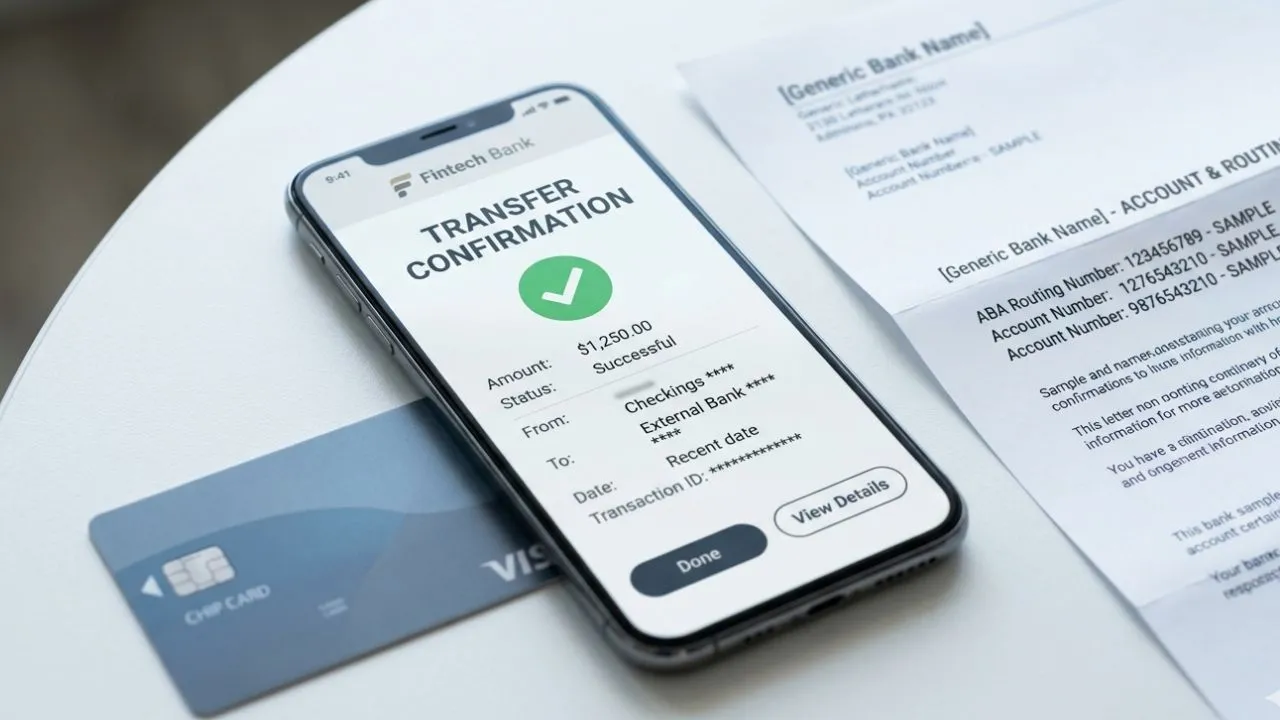

The result is a release window of 24 to 48 hours ahead of standard bank posting, which in practice means recipients frequently see their Social Security deposit, IRS refund, or VA payment post on Wednesday morning instead of the official Friday settlement date.
Understanding the full mechanics of how money moves from a federal agency through the Treasury to your account requires examining the complete U.S. money movement system, which governs every layer of federal payment infrastructure from origination through final settlement.
The Banks That Do This in 2026
The three most prominent institutions offering verifiable early direct deposit on federal payments in 2026 are Chime, Green Dot, and Capital One 360. Each approaches the mechanism differently, but all three share the same foundational commitment: do not collect float at the customer’s expense.
Chime direct deposit is the market leader in this space. Chime’s system monitors incoming ACH pre-notification files from the Bureau of the Fiscal Service in near-real time. When a verified federal payment file arrives showing an authorized government originator, Chime’s processing engine immediately releases provisional credit to the member’s account. For Social Security recipients and IRS refund filers, this routinely results in deposit availability two full business days before the official settlement date.
Green Dot applies a similar pre-notification release protocol, with particular strength for payroll direct deposits alongside federal government payments. Capital One 360 adopted early direct deposit for federal benefits as a competitive response to fintech pressure and now posts eligible government payments up to two days ahead of the official settlement window for customers enrolled in direct deposit.
Several smaller challenger banks and credit unions have adopted comparable policies, including Varo, Axos, and Alliant Credit Union, though the exact timing window varies by institution and payment type.
The NACHA Rules That Make This Legal
Early direct deposit is governed entirely by NACHA Operating Rules, the binding framework that all U.S. financial institutions must follow when processing ACH payments. Under the 2026 updated NACHA standards, Same-Day ACH dollar limits now sit at $1,000,000 per transaction, meaning even large IRS retroactive payments and Social Security back-pay amounts qualify for expedited processing within this framework.
The Bureau of the Fiscal Service processes over 1.3 billion electronic payments annually through this network. Every one of those payments generates a pre-notification file that reaches the destination financial institution before the actual settlement. The only variable is whether that institution chooses to pass the value through to the consumer immediately or retain it until the official settlement date.
Federal Reserve Board Regulation E, codified at 12 CFR Part 1005, provides the consumer protection layer. Once funds are credited to a consumer’s account, the institution bears full liability and the consumer holds immediate legal access to those funds. This regulatory protection is what makes early direct deposit not only operationally feasible but legally standardized.
For a deeper understanding of how ACH settlement windows interact with federal payment timing, the article on ACH and wire payment differences covers the complete mechanics of each payment rail.
What This Means for Federal Benefit Recipients
For Social Security retirement beneficiaries born between the 1st and 10th of the month, the official payment date falls on the second Wednesday of each month. With an early direct deposit institution, that payment commonly arrives on Monday morning instead, providing two full business days of additional access.
SSI recipients, who are scheduled for the 1st of each month, benefit even more dramatically when the 1st falls on a weekend or federal holiday. Standard banks push the payment to the next business day. Early direct deposit institutions release the pre-authorized payment the Friday before, extending the access window by up to three days.
IRS refund recipients see the most variable benefit. The IRS submits refund payment files to the Federal Reserve network one to two business days before the official deposit date listed on the IRS Where’s My Refund portal. Early direct deposit banks process these files and credit accounts the moment the government file arrives, routinely delivering refunds 24 to 48 hours before the date shown in the IRS system.
The federal payment status guide explains exactly how to read the official payment status messages that precede early release, helping you determine whether your specific payment qualifies for the accelerated timeline.
The One Risk to Understand
Early direct deposit is structurally safe for federal government payments because these ACH files carry a verified government originator identification code that institutions can validate before releasing funds. The risk emerges with payroll deposits, where the pre-notification file is generated by a private employer rather than a government agency.
If a private-sector employer cancels payroll, disputes a payment, or transmits an erroneous file after an early direct deposit bank has already credited the funds, that institution must recover the provisional credit. For government payments, this reversal risk is effectively zero because federal ACH files from the Treasury carry institutional-grade authentication that private payroll systems do not replicate.
The article on early direct deposit risk mechanics covers the complete reversal framework and explains which payment types carry zero reversal exposure versus those that carry residual risk.
The EITC and Early Deposit Interaction
One important exception applies to IRS Earned Income Tax Credit refunds. Under the PATH Act, the IRS is prohibited from releasing EITC refunds before mid-February regardless of when the return was filed or processed. No early direct deposit institution can circumvent this statutory hold. The IRS simply does not transmit the ACH payment file until the PATH Act freeze lifts, meaning there is no pre-notification file for any bank to act on until the IRS releases it.
For all other federal payments outside the PATH Act hold window, early direct deposit functions exactly as described above. The payment file arrives, the institution processes it, and the funds post immediately rather than on the official settlement date.
The EITC income limits for 2026 provide the complete eligibility framework and maximum credit amounts, including the interaction between the PATH Act holding period and early deposit bank timelines.