
Updated: June 22, 2026 – When you send money from your bank account, it travels on one of several underlying payment rails. ACH batches your transaction with thousands of others and settles in one to three business days.
A wire transfer moves in real time but costs $15 to $50. Zelle delivers money instantly at no charge, but uses a private overlay network. FedNow is the Federal Reserve’s own instant rail, free to consumers and available every hour of every day.
The U.S. payment system runs on four distinct infrastructure layers, each with different ownership, speed, cost structure, and institutional purpose. For consumers, Zelle and FedNow offer the most immediate experience.
For institutions and large-dollar transfers, Fedwire remains the standard. For recurring payroll, bill payment, and government disbursements, ACH handles the overwhelming majority of U.S. electronic transactions.
Understanding which rail your money travels on explains why some transfers clear in seconds and others take three business days. This guide to the US money movement system provides the foundational framework; this article provides the side-by-side operational comparison.
How ACH Works and When It Is Used
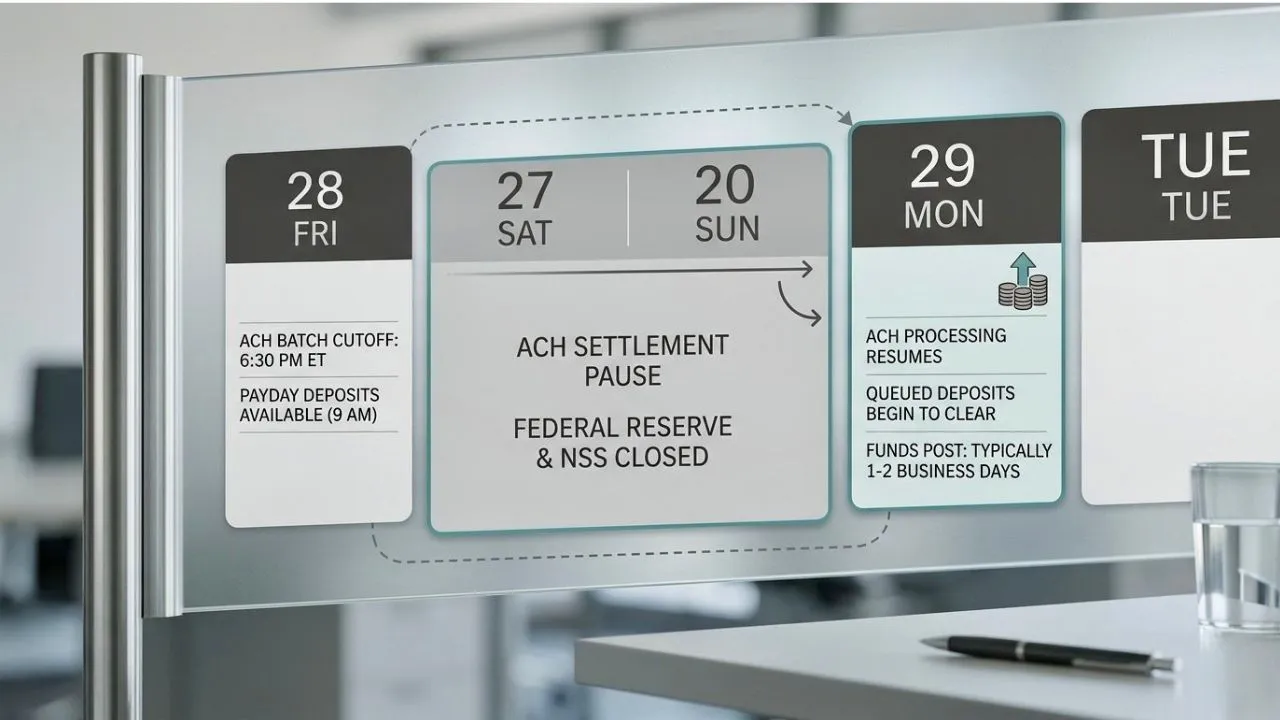
ACH, the Automated Clearing House, is the batch-processing backbone of U.S. consumer banking. The ACH network, governed by NACHA (formerly the National Automated Clearing House Association), moves money by collecting transaction instructions throughout the day, sorting them into files, and submitting those files to the Federal Reserve or the Clearing House for settlement during scheduled processing windows. Standard ACH transactions settle in one to three business days.
Same-Day ACH, available for eligible transactions under $1 million, clears on the same business day if submitted before the applicable cutoff. Most Americans use ACH dozens of times per month without realizing it.
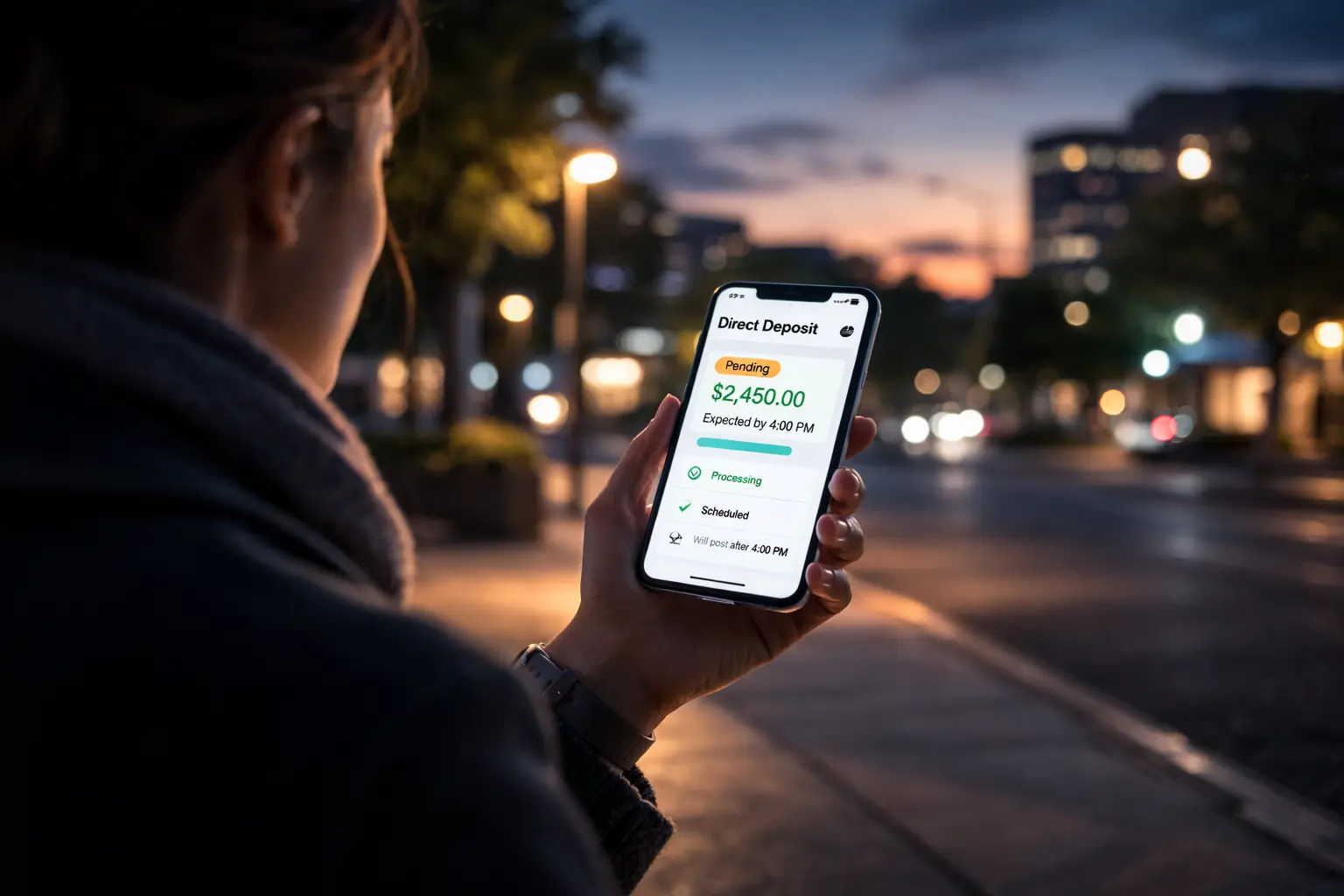
Direct deposit of payroll and federal benefits, automatic bill payment, IRS tax refunds, Social Security disbursements, and peer-to-peer bank transfers all ride the ACH network. The cost to consumers is typically zero.
Businesses pay small per-transaction fees. ACH is not designed for urgency. It is designed for volume, reliability, and low cost across billions of annual transactions. For readers concerned about same-day ACH timing and how it differs from overnight standard processing, that comparison covers the NACHA cutoff windows in detail.
Wire Transfers and Fedwire: Real-Time and Expensive
A wire transfer sends money as an individual, irrevocable transaction in real time. The primary U.S. wire infrastructure is Fedwire, operated by the Federal Reserve. Fedwire processes each wire as a separate gross settlement instruction, crediting the receiving bank’s Federal Reserve account immediately upon execution.
There is no batching, no netting, and no delay between instruction and settlement. This makes wire transfers the standard for real estate closings, large business payments, international transfers, and any situation where immediate finality matters.
The cost reflects the operational structure. Sending a domestic wire typically costs $15 to $50 at most banks. Receiving wires often carry fees of $10 to $25. International wires add currency conversion costs and correspondent bank fees that can total $30 to $80 per transaction.
Fedwire operates during business hours on banking days, meaning a wire submitted after the cutoff or on a weekend does not settle until the next business day.
This operating window limitation is the key structural disadvantage of wire transfers relative to FedNow. For context on how ACH and wire transfer settlement timing affects federal payment cycles, the detailed breakdown of those differences is essential reading for anyone managing time-sensitive transactions.
Zelle: The Private Instant Overlay
Zelle is not a payment rail. It is a private overlay network operated by Early Warning Services, a company jointly owned by seven major U.S. banks including JPMorgan Chase, Bank of America, Wells Fargo, and U.S. Bancorp. Zelle enables instant money movement between enrolled bank accounts by transmitting payment messages between participating banks, with the underlying settlement occurring through the ACH network or interbank book transfers.
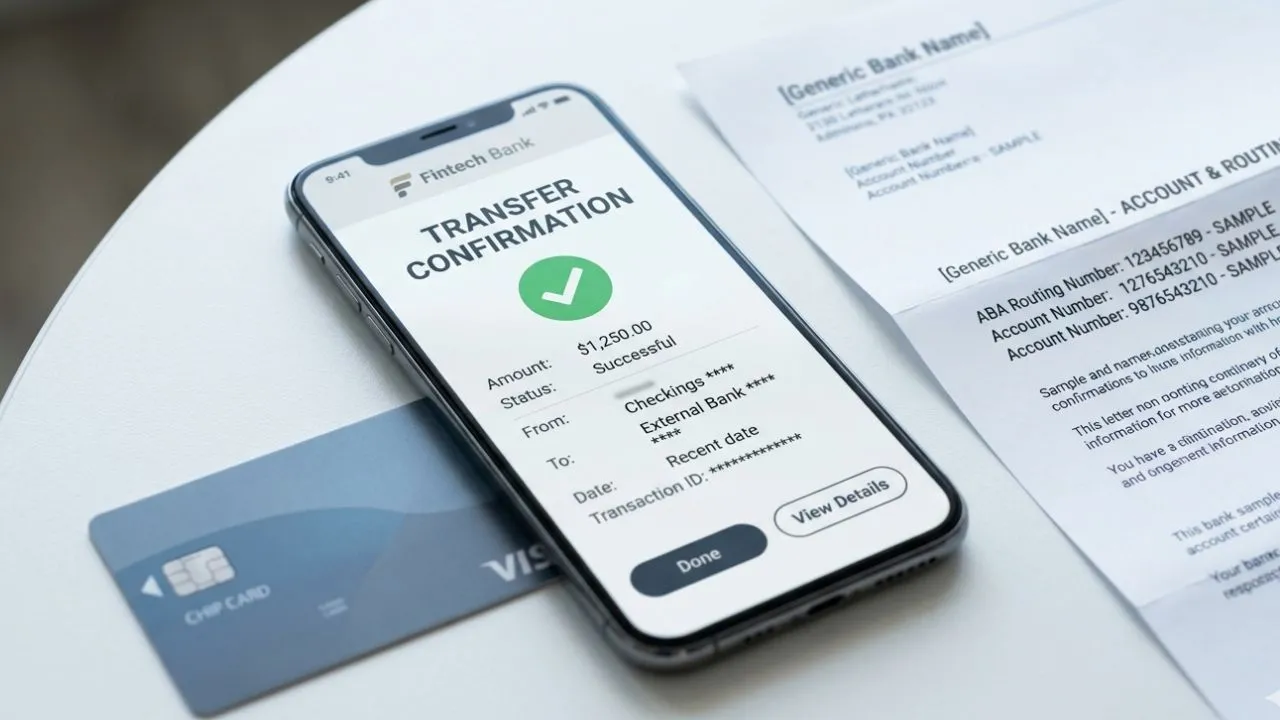
From the consumer’s perspective, Zelle delivers money within seconds or minutes at no cost. From the institutional perspective, Zelle is a message layer that coordinates between banks, with the actual movement of funds settled separately.
This architecture means Zelle’s availability depends on bank participation. Approximately 2,200 financial institutions participate in the Zelle network as of mid-2026. Banks not enrolled in Zelle cannot receive Zelle transfers directly.
Consumers sending to an unenrolled recipient receive a different experience depending on how their bank handles the fallback. Zelle imposes daily and monthly transaction limits that vary by financial institution, typically $500 to $2,500 per day for personal accounts. These limits do not apply to FedNow.
FedNow: The Federal Reserve’s Instant Rail
The FedNow Service, launched by the Federal Reserve in July 2023, is the first new core U.S. payment rail built by a public institution in decades. FedNow enables real-time gross settlement between participating financial institutions, 24 hours a day, seven days a week, 365 days a year, including weekends and federal holidays. Each transaction settles individually and immediately in the Federal Reserve’s books, with no batching and no processing delays.
The public nature of FedNow distinguishes it from Zelle. Any federally regulated financial institution can apply to participate in FedNow directly. The Federal Reserve maintains the FedNow participant roster, which lists all enrolled institutions.
As of June 2026, participation has grown substantially since the launch, with hundreds of banks and credit unions enabled to send and receive FedNow payments. The consumer cost for FedNow transfers, where banks pass through no fee, is zero.
Individual banks set their own fee structures, and some charge for premium instant payment services, but the Federal Reserve’s infrastructure cost is minimal compared to wire transfer pricing.
FedNow is designed to coexist with, not replace, ACH and Fedwire. ACH handles high-volume batch clearing at low cost. Fedwire handles high-value institutional transactions with guaranteed finality.
FedNow fills the gap that previously required consumers to choose between slow-and-free ACH and fast-and-expensive wires. For a detailed view of how FedACH settlement timing interacts with consumer deposit posting, that analysis covers the Federal Reserve’s ACH processing windows alongside FedNow’s real-time model.
| Feature | ACH | Wire (Fedwire) | Zelle | FedNow |
|---|---|---|---|---|
| Settlement Type | Batch clearing | Individual RTGS | Private overlay | Individual RTGS |
| Speed | 1 to 3 business days | Same-day, hours | Instant, seconds | Instant, seconds |
| Operating Hours | Business days, cutoffs | Business days, cutoffs | 24/7/365 | 24/7/365 |
| Consumer Cost | Usually free | $15 to $50 | Free | Usually free |
| Operator | NACHA / Fed | Federal Reserve | Early Warning Services | Federal Reserve |
| Typical Use | Payroll, bills, refunds | Real estate, large business | Person-to-person | Growing consumer and business |
Common Questions About Payment Rails
Which is safer for large amounts, wire or Zelle?
For large amounts, wire transfers through Fedwire provide greater legal finality protections. Zelle transactions are generally irreversible once sent, and consumer fraud protections are more limited than those governing wire transfers under Regulation J. The FTC and CFPB have raised concerns about the liability framework for Zelle fraud. Fedwire transactions carry institutional accountability on both sending and receiving ends.
Can FedNow replace my bank wire?
For domestic transactions at participating institutions, FedNow offers the same speed as Fedwire with a fraction of the cost. However, FedNow does not support international transfers, and not all financial institutions are enrolled. For transactions requiring guaranteed same-day settlement in the millions of dollars, Fedwire remains the institutional standard.
Why does my ACH direct deposit sometimes arrive a day early?
Some banks offer early direct deposit by releasing ACH transactions to consumer accounts as soon as the payment file is received from the originating institution, before official settlement occurs. This is a credit risk decision made by the bank, not a feature of the ACH network itself. The early direct deposit mechanics article explains how banks manage that risk and what it means for consumers.
Does FedNow work on Christmas?
Yes. Unlike Fedwire and ACH, which observe federal holidays, FedNow processes payments every hour of every day including all federal holidays. This makes it the only Federal Reserve payment system with true around-the-clock operation. For how federal holidays affect bank deposits across all rails, that guide covers the holiday processing schedule for each system.
What This Means for Your Money
The payment rail your transaction uses determines when your money arrives and what it costs. For routine transfers between bank accounts where timing is not critical, ACH is free and reliable. For immediate, large-dollar transfers where finality matters, wire transfers through Fedwire carry that certainty at a cost.
For free instant transfers between enrolled participants, Zelle and FedNow both deliver. FedNow’s public infrastructure and around-the-clock operation represent the long-term direction of U.S. payment modernization.
The PACE Act and fintech access to federal payment rails covers the legislative framework expanding FedNow participation to non-bank financial institutions, which will further extend instant payment access across the U.S. economy.