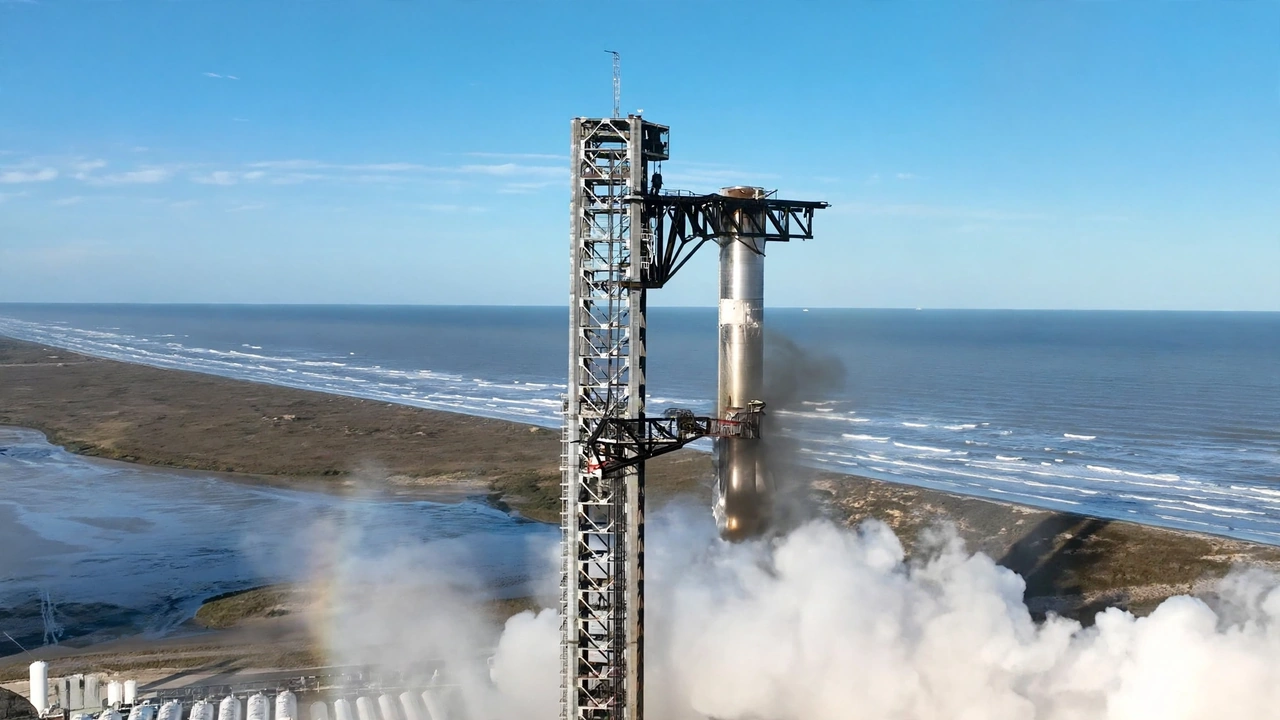
SpaceX achieved a historic breakthrough on Saturday, November 14, catching its Starship spacecraft with the mechanical arms of its launch tower for the first time after a journey around Earth. The extraordinary recovery at Starbase, Texas, came approximately 22 hours after Friday’s launch, marking a major advance in Elon Musk’s ambition to build a fully reusable rocket.
But the mission delivered a costly setback alongside its success: the Super Heavy booster was lost over the Gulf of Mexico after an aborted landing attempt. The result leaves SpaceX closer to recovering both stages of Starship, without yet demonstrating that it can do so on the same flight. The spacecraft, designated Ship 42, completed approximately 14 orbits of Earth during Starship’s 15th test flight and deployed 26 Starlink V3 satellites before returning to its launch site.
Shortly before the catch, it descended through the atmosphere, maneuvered toward the launch tower and performed a controlled landing burn before settling between the enormous mechanical arms nicknamed the “chopsticks.” SpaceX had previously caught Super Heavy boosters, but never the Starship upper stage returning from orbit. That distinction makes Saturday’s achievement a new milestone rather than a repeat of an earlier booster recovery.
Elon Musk celebrated the successful landing with a short message on X: “Congratulations to an incredible team at SpaceX!!!” The SpaceX chief executive later posted another assessment after the recovery: “Ship 42 looks great!” Both remarks were posted on November 14, reflecting his immediate response to a flight that achieved one of the company’s most ambitious technical objectives. Neither statement, however, establishes that the recovered spacecraft is already certified or ready to fly again.
The Catch That Changed Starship’s Future
The most significant achievement was not simply bringing a spacecraft safely back to Earth, but returning an orbital vehicle to its launch infrastructure for potential reuse. Unlike a conventional capsule that splashes down under parachutes, Starship must survive intense atmospheric heating, control its descent and execute a precision maneuver near a massive steel tower.
SpaceX completed that sequence with Ship 42, demonstrating that its recovery architecture can work after an extended orbital mission. The next engineering challenge is determining how much inspection, refurbishment and replacement work the recovered vehicle requires before another flight.
I see an important distinction between recovering a rocket and making it rapidly reusable. Saturday’s catch establishes that Starship can return to the tower under the conditions of this flight, but it does not establish the cost or time required to prepare the same spacecraft for another mission.
A vehicle that requires extensive refurbishment may still represent meaningful progress while falling short of the economic advantages SpaceX ultimately wants. The stronger evidence will come when a recovered Starship flies again and demonstrates comparable reliability with less work between missions.
The mission also tested more than landing precision. SpaceX successfully deployed 26 Starlink V3 satellites, an important payload milestone for a rocket designed to transport much larger spacecraft and satellite systems than the company’s existing Falcon 9 launches.
The satellites are intended to expand the capacity of Starlink’s communications network, although successful deployment should not be confused with completion of all subsequent orbital checkout and service-readiness procedures. SpaceX also used specially equipped satellites to gather images of Starship’s heat shield, adding another source of information for engineers evaluating the spacecraft’s condition.
Why SpaceX Lost the Booster
The failure involving Super Heavy occurred during Friday’s launch, long before Ship 42’s successful return the following afternoon. After separating from Starship, the booster began maneuvering back toward the Texas launch site, where SpaceX had intended to conduct a second tower catch. The planned recovery was automatically abandoned after the booster failed to meet the conditions required for a safe approach. It was diverted toward the Gulf of Mexico and ultimately destroyed rather than recovered for reuse.
SpaceX initially discussed the possibility of a guidance-related problem, but its subsequent explanation made an important distinction between the booster’s landing-abort system and the underlying malfunction. During the company’s November 14 webcast, SpaceX representative Kate Tice said early indications pointed to the boostback burn ending prematurely because of a low-fuel-mass alarm.
The company’s guidance, navigation and control system then responded to the vehicle’s position by rejecting the planned tower catch. The root cause of the premature shutdown remained under investigation, meaning the alarm should not be treated as a complete diagnosis.
That difference matters because an aborted catch can represent a safety system functioning as intended even when the wider mission experiences a serious failure. A rocket approaching the launch tower outside its permitted flight conditions creates risks to equipment, personnel and nearby infrastructure.
The recovery system must therefore demonstrate that it can reject an unsafe approach, not merely execute a successful one. Friday’s booster loss illustrates why SpaceX needs both reliable propulsion and effective automated safeguards before it can routinely recover the entire launch vehicle.
NASA’s own engineering work helps explain the complexity. In July, the agency described Super Heavy testing conducted at NASA Ames Research Center using a 1.2%-scale model of the Version 3 booster to examine aerodynamic forces during flight and reentry.
Manish Mehta, a discipline lead engineer at NASA’s Marshall Space Flight Center, explained: “NASA has a lot of experience with unsteady aerodynamics.” His remarks concerned wind-tunnel research, not the cause of Friday’s failure, but they illustrate the depth of engineering analysis required to develop increasingly complex reusable rockets.
What NASA’s Moon Mission Still Needs
Starship’s successful catch has implications far beyond commercial satellite launches because NASA is working with SpaceX to develop a human landing system for its Artemis lunar program. The agency aims to return astronauts to the Moon’s surface in 2028 and is pursuing landing-system development with both SpaceX and Blue Origin.
However, NASA’s October 23 lander development update makes clear that neither company has been assigned a specific crewed lunar landing mission under the revised arrangements. The selection will depend on technical readiness and NASA’s safety requirements, rather than on one successful Starship test.
NASA Administrator Jared Isaacman also welcomed Saturday’s catch, describing the achievement on X as “almost magic” and linking it to progress toward the Moon. His reaction reflected the importance of recovering a spacecraft after orbital flight, but NASA’s published plans establish a much larger set of milestones before astronauts can rely on a Starship lander.
Those include uncrewed demonstrations, spacecraft integration, docking procedures and the successful operation of systems needed for lunar travel. A dramatic recovery at Starbase does not remove those certification requirements. Under NASA’s revised Artemis III mission, scheduled for 2027, astronauts aboard Orion are expected to conduct demonstrations involving test articles developed by SpaceX and Blue Origin in low Earth orbit.
The planned Starship portion focuses on docking, spacecraft controllability, communications and integrated operations, rather than landing astronauts on the Moon during that mission. NASA also requires uncrewed lunar landing demonstrations before the initial crewed surface missions. These distinctions are essential when evaluating how much Saturday’s achievement actually advances NASA’s schedule.
Another unresolved challenge is orbital refueling, which is central to SpaceX’s proposed lunar transportation architecture. NASA’s October planning documents describe a system in which tanker Starships deliver cryogenic propellant to a depot spacecraft in Earth orbit before the lunar lander begins its journey.
Ship 42’s recovery did not demonstrate that complicated propellant-transfer process, and successful atmospheric reentry does not prove that the full lunar architecture is operational. SpaceX must establish those capabilities independently before a complete lunar mission can be considered ready.
NASA Artemis program manager Jeremy Parsons emphasized the importance of collaboration when discussing the revised contracts in October, saying the agency and its lander providers were “working hand in hand” toward returning astronauts to the Moon by 2028. His statement reflected the industry’s shared development challenge rather than a promise that either contractor would finish first.
I would judge Saturday’s catch as a major positive technical result, while keeping the timeline for crewed lunar operations conditional on the remaining demonstrations. The achievement moves one demanding part of the program forward without settling the entire mission.
The Business Stakes Behind the Catch
For SpaceX, the ultimate commercial value of recovering Starship lies in the possibility of reducing hardware replacement costs and increasing launch frequency. A large spacecraft that can fly repeatedly could eventually support bigger satellite deployments and more frequent missions without manufacturing an entirely new vehicle for every launch.
That potential is relevant to the company’s financial expectations, including the SpaceX IPO and the later stock momentum that followed its market debut. But Saturday’s success alone provides no verified calculation of future launch costs, profit margins or shareholder returns.
The broader commercial space industry faces a similar tension between engineering milestones and financial performance. Rocket Lab, for example, has been developing its Neutron launch vehicle while investors assess the company’s spending, development timetable and future revenue potential.
Those issues were central to its recent rocket development outlook and earnings expectations. The companies operate different vehicles and business models, but both illustrate why successful testing must ultimately translate into reliable service and sustainable economics.
Capital intensity is another important part of the comparison. Large technology infrastructure projects often demand substantial investment before their full commercial benefits become measurable, a tension also visible in the wider AI spending boom.
Meanwhile, the broader U.S. industrial production data include defense and space equipment as a manufacturing category, although those aggregate statistics cannot measure SpaceX’s individual progress. Neither comparison establishes the financial effect of Flight 15; they provide context for why investors should distinguish technical achievements from realized business performance.
Regulatory approval presents an additional challenge to SpaceX’s longer-term ambitions. The Federal Aviation Administration is examining proposals to substantially expand launch and landing operations at Starbase, with the FAA’s project documents describing a first phase of up to 100 annual launches and a second phase involving as many as 456.
Those figures represent proposed operating levels undergoing environmental review, not flight frequencies already approved or achieved. The FAA also identifies public safety, environmental effects and licensing requirements as important considerations in commercial launch operations.
The agency’s current review includes proposed changes to where Starship vehicles may land or be expended, alongside potential increases in launch activity. Public comments on the environmental review are scheduled to remain open through December 7, 2026, while virtual scoping meetings are planned for November 17–19.
These procedures matter because even a technically reusable rocket cannot operate at an unrestricted frequency without the necessary approvals and supporting infrastructure. SpaceX therefore faces two parallel tasks: proving that Starship can fly repeatedly and establishing the regulatory and operational capacity for more frequent missions.
What Happens After Flight 15?
The next important evidence will come from SpaceX’s examination of Ship 42, its investigation into the Super Heavy booster failure and the planning of subsequent flight tests. Engineers will need to assess the spacecraft’s heat shield, engines, structure and landing interfaces to determine what refurbishment is necessary and whether the recovered vehicle can be flown again.
The booster investigation must establish why the boostback maneuver ended early and whether any hardware or procedural changes are required. As of November 15, those unresolved questions prevent a definitive assessment of when SpaceX will demonstrate both stages returning successfully on the same mission.
Saturday’s catch nevertheless represents an achievement that would have been difficult to imagine during the early years of reusable rocket development. SpaceX has now demonstrated tower capture of both types of Starship flight hardware on different missions, even though Flight 15 failed to recover its booster.
The distinction is the central lesson of this flight: the first successful orbital Starship catch is real, but full-system rapid reuse remains unproven. The next meaningful milestone will not simply be another spectacular landing, but evidence that the recovered hardware can reliably fly again.