
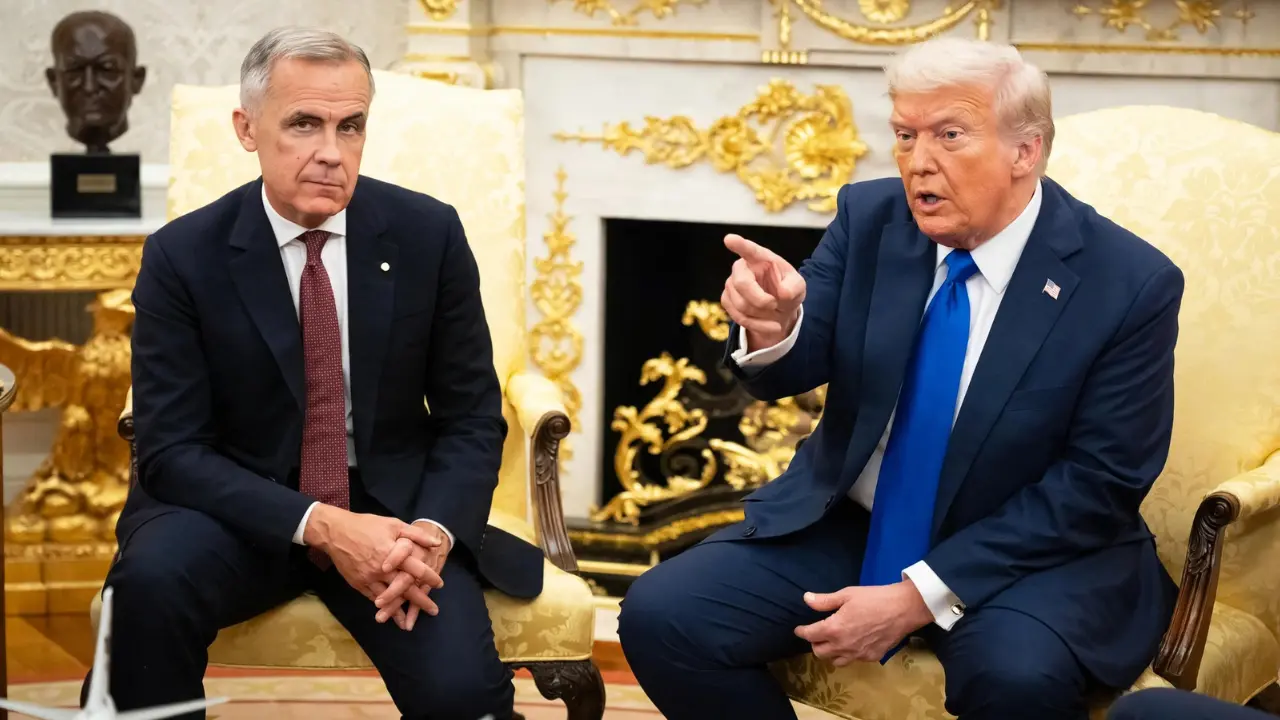
The United States began imposing 50% tariffs on nearly US$20 billion of Canadian imports on Saturday, August 22, after an intense final round of negotiations failed to convert a tentative U.S.-Canada understanding into a completed agreement.
Canada responded by preparing dollar-for-dollar retaliation, with Prime Minister Mark Carney saying Saturday that the new Canadian tariffs will take effect September 8.
The rupture came only days after President Donald Trump declared that Washington and Ottawa had a deal “subject to the finalization of documents.” That qualification proved decisive. No final agreement was signed.
Canada continued negotiating after Trump’s announcement, and Carney’s own August 18 description was substantially more cautious: the prime minister said the countries had made “substantial progress” but that important work remained.
The distinction is documented in the Prime Minister’s August 18 statement on the negotiations and contemporaneous reporting on Trump’s three-day tariff reprieve. By Friday night, the remaining disagreements had become large enough for Canada to walk away.
In his August 21 statement explaining Canada’s negotiating position, Carney said Ottawa had sought to preserve tariff-free U.S. access for the vast majority of Canadian businesses, substantially reduce American tariffs on strategic industries, protect smaller companies and maintain Canada’s economic independence and sovereignty.
He also said changes introduced by the United States late in the process were “unfair” and “uneconomic.” There is no publicly released transcript of the private conversations between Trump and Carney, so an exact reconstruction of what the two leaders told each other cannot be responsibly reported.
Their publicly documented positions, however, show the central divide. Trump presented the negotiations as essentially completed once documents were finalized, while Carney consistently described unresolved work that still had to be completed. Reuters reported that the two leaders had spoken during the negotiating period, but neither government released a full verbatim record of those calls.
The negotiations went well beyond the new 50% duties. Reuters reported that a proposed agreement could have lowered U.S. tariffs on Canadian-made cars and trucks, steel and aluminum, with automotive rules emerging as a particularly difficult issue.
Canadian negotiators were pressing for broader recognition of North American content, while Washington was seeking concessions that would more directly reward U.S.-produced components. Alcohol-market access, dairy rules and other retaliatory trade measures also remained part of the dispute.
The immediate tariff action rests on an unusually powerful and rarely used trade law. The White House’s official Section 338 tariff fact sheet says Trump invoked Section 338 of the Tariff Act of 1930 to impose an additional 50% duty on specified Canadian products.
The administration says Canada discriminated against U.S. commerce in automobiles, alcoholic beverages and dairy products. That legal mechanism is important because it reaches goods that would otherwise qualify for preferential treatment under the U.S.-Mexico-Canada Agreement.
According to the White House, covered products include goods ranging from wine and hockey sticks to cement, while energy, potash, products already subject to Section 232 tariffs and certain goods such as fish and critical minerals are excluded. The U.S. Trade Representative’s official Section 338 statement says the measures cover nearly US$20 billion in imports from Canada.
That U.S.-dollar figure should not be confused with the number used by Ottawa. Carney described the same affected trade as approximately C$28 billion. The figures are expressed in different currencies rather than representing two incompatible estimates.
AP reported that the targeted goods account for roughly 5% of Canada’s annual exports to the United States, making the new tariff wall significant without applying to every product moving across the border.
For American companies, the financial mechanism is straightforward but potentially expensive. U.S. importers are responsible for paying tariffs when covered Canadian goods enter the country.
Companies can absorb that additional cost, pressure suppliers to reduce prices, switch suppliers or pass part of the increase to customers. How much ultimately reaches consumers will vary considerably by product and supply chain rather than automatically equaling the headline 50% tariff rate.
That makes inflation one of the broader U.S. economic risks to watch. Businesses already operating with higher financing and input costs may have less room to absorb additional import expenses.
Investozora’s analysis of July U.S. inflation, gasoline and shelter costs provides the current inflation backdrop, while its examination of how higher interest rates affect borrowing costs explains why another cost shock could matter to households and companies even outside the directly tariffed industries.
The dispute now also intersects with the future of USMCA, the trade framework binding the United States, Canada and Mexico. USTR has already established a series of bilateral negotiating rounds with Mexico connected to the agreement’s joint review, according to its official USMCA negotiating-round announcement. AP reported Saturday that comparable talks with Canada had not been scheduled immediately after the breakdown.
Canada’s response is becoming clearer. Carney initially promised dollar-for-dollar retaliation and, on August 22, said the counter-tariffs would begin September 8, creating a short window before the next escalation.
The precise U.S. products covered, the economic-support measures Ottawa provides to affected industries and any renewed negotiating channel will determine how much further the confrontation spreads.
The central fact is therefore more precise than simply saying a signed trade deal was canceled. Trump announced a tentative agreement that remained subject to final documentation; Canada said unresolved work remained; the final negotiations failed; and the promised U.S. tariffs subsequently took effect.
As of August 22, 50% duties are being applied to nearly US$20 billion of covered Canadian goods, Canada has announced retaliation beginning September 8, and no replacement U.S.-Canada agreement has been completed.