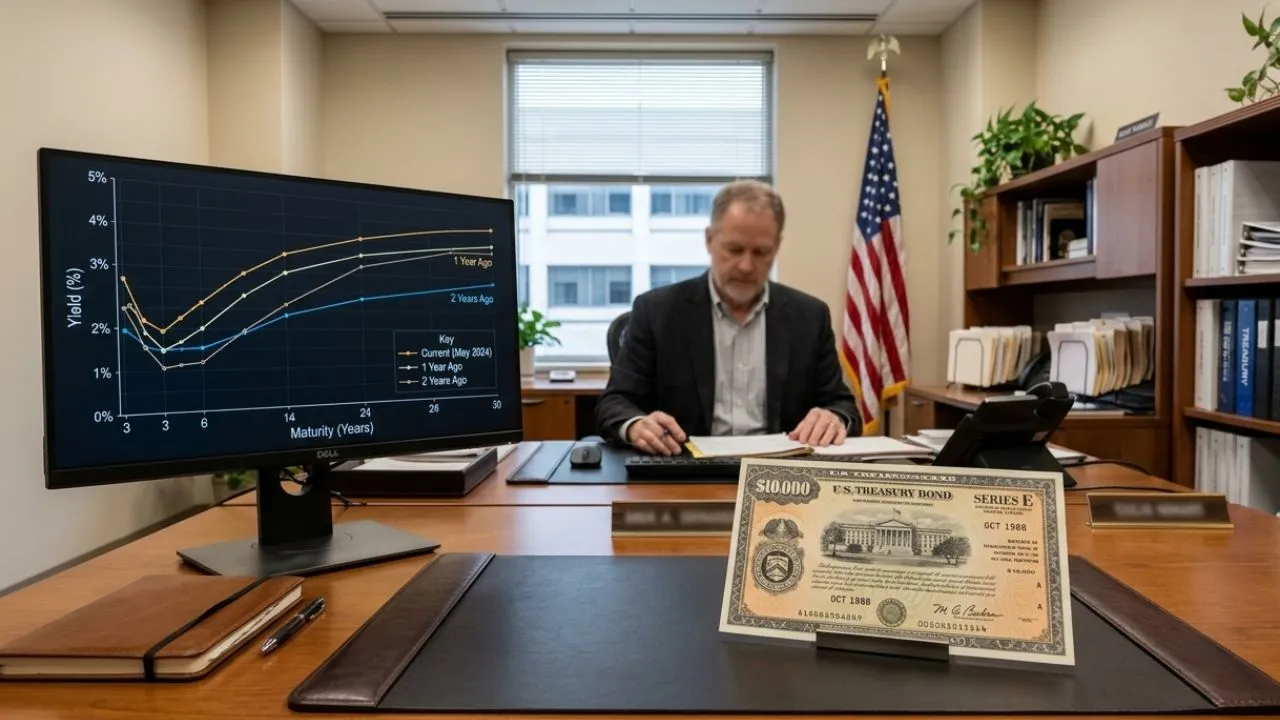


Updated: June 22, 2026 – The US Treasury 10-year note closed June 5, 2026 at 4.55% while the 2-year note settled at 4.17%, with the spread at 38 basis points above zero, per Treasury par yield curve data. The FOMC opened its June 16–17 session under Chair Kevin Warsh today with markets watching whether a hawkish policy bias will push the 2-year note toward the 10-year, narrowing the spread further.
The US bond market is pricing something that Wall Street calls a liquidity trap, and it is directly connected to what Kevin Warsh says at his press conference on Wednesday, June 17, 2026. The 10-year Treasury yield sits at 4.55%. The 2-year note sits at 4.17%. The 38-basis-point spread between them is not comfortable for capital markets.
Every additional signal of rate elevation from Warsh compresses that spread further. A spread that reaches zero, or goes negative again, historically warns of severe economic stress arriving within 12 to 18 months.
This is not abstract financial theory. The Treasury yield curve governs mortgage rates, business borrowing costs, municipal bond financing, and the earnings threshold banks need to justify extending credit.
When the curve flattens or inverts, liquidity contracts across the entire US economy, and the financial impact reaches ordinary Americans through tighter credit, rising mortgage rates, and slowing wage growth. The 10-year treasury yield explained guide provides the foundational mechanics.
The Inverse Mathematics of Bond Prices
The Treasury market operates on one absolute mathematical law: bond prices and yields move in opposite directions. When investors sell bonds, prices fall and Treasury yields 2026 rise. When investors buy bonds, prices rise and yields fall. The Treasury Yield Curve Rates page at Treasury.gov publishes the daily par yield curve that every major financial institution uses to price loans, mortgages, and corporate debt.
The yield on the 10-year note finished June 5, 2026 at 4.55% while the 2-year note ended at 4.17%, its highest level since February 2025. The 2-year note carries specific significance as a policy proxy.
Because the 2-year horizon falls within the typical window over which the Fed’s current rate decisions produce their full economic effect, investors price the 2-year note as a direct forward estimate of where the federal funds rate will be in two years. When the 2-year yield climbs sharply, bond markets are effectively voting for a higher-for-longer rate environment. That is the vote being cast today at 4.17%.
The New York Fed’s System Open Market Account holdings, monitored at NY Fed SOMA, reveal the operational scale of the Federal Reserve’s footprint in the Treasury market. The Fed’s balance sheet strategy under Warsh will determine how aggressively it continues quantitative tightening, which directly affects Treasury market liquidity by reducing the buyer base for new government debt issuance.
The complete mechanics of this process are documented in the quantitative tightening fed balance sheet analysis. How these liquidity flows ultimately reach bank accounts and payment systems runs through the infrastructure explained in the US money movement system.
Why the Spread Matters to Your Money
The 38-basis-point 10-2 spread is functioning as a real-time financial warning system. An inverted yield curve is when longer-term Treasury yields are lower than their shorter-term counterparts. Typically, the spread turns negative for a period before rising again prior to recessions.
The practical consequence for American households runs through mortgage rates. The 30-year fixed mortgage rate is priced as a spread above the 10-year Treasury yield. When the 10-year yield rises toward 4.55% or above, lenders add a spread of approximately 170 basis points, placing the 30-year mortgage rate above 6.20%.
Every 25-basis-point increase in the 10-year Treasury yield adds approximately $35 per month to the payment on a $300,000 mortgage. The bond market yield shifts impact 2026 article quantifies this relationship across different mortgage sizes.
The treasury bills explained guide explains how the short end of the curve, currently offering some of the highest T-bill yields in years, provides an alternative for Americans seeking government-backed returns above savings account rates. 6-month and 12-month T-bills are currently pricing yields above 4.80% based on the Federal Reserve’s rate hold posture, making them a direct competitor to high-yield savings accounts for liquid cash.
What Happens Next
Warsh’s June 17 press conference will determine whether the Treasury yield 2026 curve compresses further or begins to normalize. Three scenarios are in play. If Warsh removes the easing bias and signals a neutral stance, the 2-year note will likely rise toward 4.30% to 4.40%, compressing the spread to approximately 15 to 25 basis points and increasing recession probability signals in the bond market.
If Warsh retains mild easing language, the 2-year may drift back toward 4.00%, allowing the spread to widen and relieving liquidity pressure. If Warsh signals any possibility of rate hikes, which JPMorgan economist Michael Feroli indicated cannot be fully ruled out, the 2-year could briefly pierce the 10-year yield, producing a technical curve inversion and triggering significant market repricing across equities, credit, and currencies.
The Treasury yield curve 2026 page on Investozora tracks daily spread movements and updates immediately after FOMC announcements. The warsh fed treasury yields savings impact analysis maps the specific transmission from Warsh’s communication choices to Treasury yield moves and then to consumer financial products.
What This Means
The US Treasury yield curve is signaling capital market stress ahead of Warsh’s first FOMC press conference. The 10-year at 4.55% and 2-year at 4.17% leave a 38-basis-point buffer before the curve re-inverts, a condition historically associated with economic contraction.
Monitor the Daily Treasury Par Yield Curve Rates at Treasury.gov immediately after Wednesday’s FOMC statement. If you hold Treasury securities, review your position against the curve’s current shape using the treasury yield curve 2026 guide. If you are considering a home purchase or refinance, the 10-year Treasury yield movement on Wednesday afternoon will directly set the direction of mortgage rates for the following 30 to 60 days.