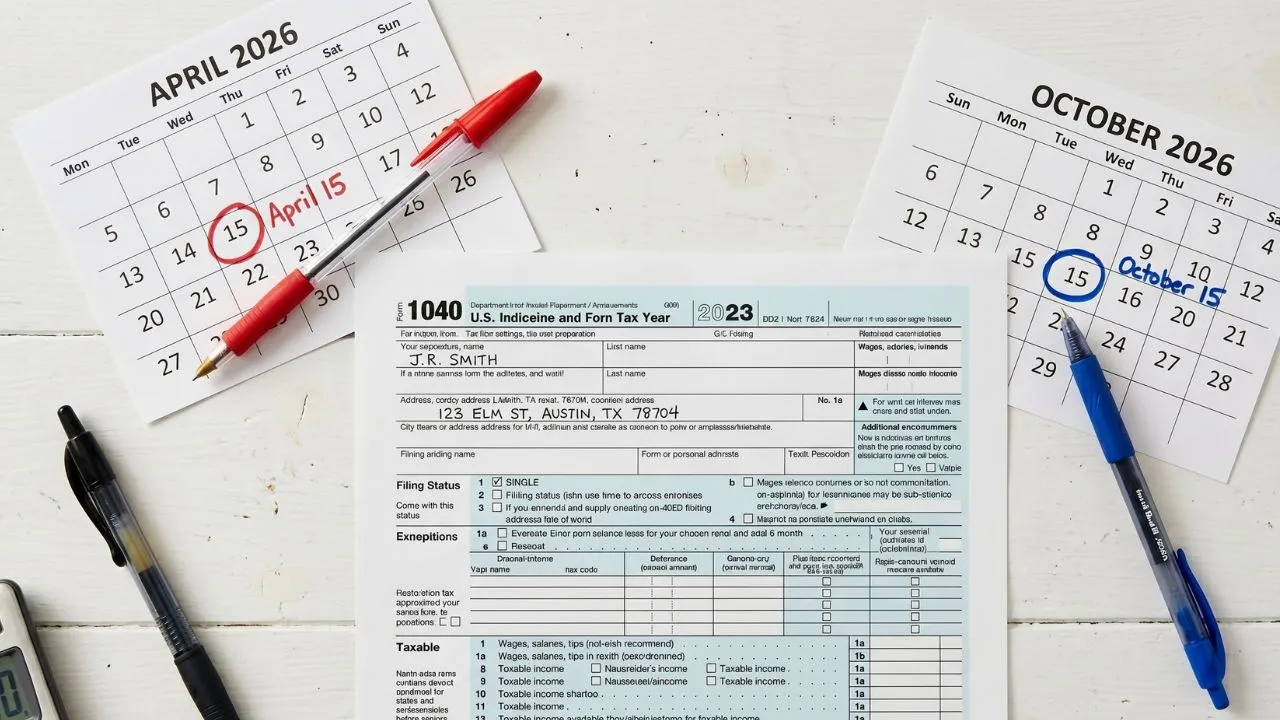


October 15, 2026 is the final deadline for anyone who requested an automatic extension on their 2025 federal tax return. It is also one of the most misunderstood dates on the entire tax calendar, since many filers assume an extension buys them more time to pay, when in reality it only extends the time to file the paperwork itself.
What Is The October 15 Tax Deadline
The October 15 deadline is the extended filing due date for individual taxpayers who submitted Form 4868 by the original April 15 deadline, requesting an automatic six-month extension. This deadline applies to the 2025 tax year return, meaning the return being filed in 2026.
It is a firm cutoff with no further extension available for most individual taxpayers, and it applies only to the filing of the completed return, not to any taxes that were still owed as of the original April deadline.
How The Extension Actually Works
Filing Form 4868, the Application for Automatic Extension of Time to File, moves the filing deadline from April 15 to October 15 automatically. The word automatic matters here: the IRS does not review the request, does not ask for a reason, and does not issue an approval or denial.
As long as the form is submitted correctly and on time, the six-month extension is granted without exception, which is different from many government processes that require a formal review before an extension is confirmed.
This extension applies to several return types beyond the standard Form 1040, including Form 1040-SR for seniors, Form 1040-NR for nonresident filers, and Form 1040-SS.
Why This Extension Does Not Cover Your Payment
The single most important distinction in the entire extension process is that Form 4868 extends the filing deadline only, not the payment deadline. Any tax owed for the 2025 tax year was still due on April 15, 2026, and interest has been accruing daily on any unpaid balance since that date, regardless of whether an extension was filed.
This is the detail that trips up more taxpayers than any other aspect of the extension process, since a six-month grace period on paperwork can easily be mistaken for a six-month grace period on the actual tax bill.
If a filer owed money and paid it in full by April 15 while filing Form 4868, the extension is essentially risk-free, since there is no penalty for filing the completed return later as long as the October 15 deadline is met.
If a filer owed money and did not pay it by April 15, the failure-to-file penalty is avoided by having filed the extension, but the failure-to-pay penalty and interest continue to accrue on the unpaid balance from April 16 forward, regardless of the extension.
Understanding the difference between these two separate penalty categories is essential to understanding what an extension actually protects against. For more detail on how these penalties stack, see Investozora’s guide to IRS late filing penalties.
What Happens If You Owe Money And Miss October 15
Missing the October 15 deadline after already filing an extension triggers the same category of penalty that applies to anyone who misses the original filing deadline without an extension at all.
The failure-to-file penalty runs at 5% of the unpaid tax per month, up to a maximum of 25% of the total unpaid balance, and this penalty is significantly larger than the failure-to-pay penalty, which runs at 0.5% per month, also up to a 25% cap.
Because the failure-to-file penalty is ten times larger on a monthly basis than the failure-to-pay penalty, filing something, even a return with taxes still owed, is almost always better than not filing at all once the extended deadline has passed.
What Happens If You Are Owed A Refund
Taxpayers who are due a refund face essentially no risk from the extension process. There is no penalty for filing after the deadline when the government owes the taxpayer money rather than the other way around, since penalties are calculated as a percentage of unpaid tax, and there is no unpaid tax when a refund is due.
The only real constraint is that a return must be filed within three years of its original due date to claim any refund at all, after which the refund is generally forfeited permanently.
This three-year window gives filers who are owed money considerably more flexibility than filers who owe a balance, though waiting significantly past October 15 still is not advisable given how easily a return can be forgotten once the immediate deadline pressure has passed.
Special Rules For Taxpayers Living Abroad
U.S. citizens and residents living outside the country on April 15 automatically receive a two-month extension to file and pay, pushing their initial deadline to June 15, without needing to file any paperwork to receive it. Interest still accrues on any unpaid tax starting from April 15, but the late-payment penalty is waived through June 15 under this automatic provision.
Filers living abroad who need even more time can file Form 4868 on top of this automatic extension to reach the same October 15 deadline that domestic filers use, effectively combining the two-month automatic extension with the standard six-month extension mechanism, though the total additional time gained is less than simply adding both periods together since they overlap.
How To File Form 4868 Correctly
Form 4868 can be filed online through IRS Free File, through commercial tax software, by mailing a paper form, or by making an estimated payment through IRS Direct Pay or the Electronic Federal Tax Payment System and designating it as an extension payment.
Making a qualifying payment through Direct Pay on or before the original deadline and designating it correctly as an extension payment can itself satisfy the extension requirement without needing to submit a separate paper form.
For step by step guidance on completing the form itself, see Investozora’s dedicated Form 4868 guide, which walks through each section of the form in detail.
Estimating What You Owe Before The Original Deadline
Since the extension does not extend the payment deadline, filers requesting an extension are still expected to estimate their total tax liability accurately and pay a substantial portion of it by April 15 to avoid triggering an underpayment penalty on top of ordinary interest charges.
A reasonable approach is to start from the prior year’s total tax liability and adjust for known changes, such as a raise, a bonus, a major capital gain, or a new dependent, to arrive at a reasonable estimate for the payment accompanying the extension request.
Underestimating significantly and paying too little by the original deadline can result in the failure-to-pay penalty applying to the shortfall even though the extension itself was filed correctly and on time.
Disaster Relief And Other Automatic Extensions
Beyond the standard Form 4868 process, the IRS routinely grants automatic postponements to both filing and payment deadlines for taxpayers in federally declared disaster areas, often extending deadlines by several months beyond the standard schedule.
These extensions apply automatically based on the taxpayer’s address in the affected area, without requiring a separate application, which distinguishes them from the standard extension process that requires proactively filing Form 4868.
Military members serving in a combat zone receive a separate set of automatic extensions tied to their deployment dates rather than the standard calendar deadlines. Taxpayers who believe they may qualify for one of these disaster-related extensions should check current IRS guidance for their specific area rather than assuming the standard October 15 deadline applies to their situation.
What If Your State Return Has A Different Deadline
Filing federal Form 4868 extends only the federal filing deadline and does not automatically extend a state income tax return in every state. Some states conform automatically to the federal extension, while others require a separate state-specific extension form to be filed.
Taxpayers who are extending their federal return should confirm their specific state’s requirements independently rather than assuming the federal extension covers both filings, since a missed state deadline can trigger its own separate set of penalties regardless of the federal extension’s status.
Preparing To File Before October 15
Filers approaching the October deadline should prioritize gathering any outstanding documentation, such as late-arriving 1099 forms, K-1 partnership statements, or corrected W-2s, since these are common reasons taxpayers request an extension in the first place.
It is also worth double-checking that any payment made with the original extension request was properly applied, which can be confirmed through an IRS Individual Online Account.
Filers who are still uncertain about their total liability as October 15 approaches should prioritize filing something close to accurate rather than missing the deadline entirely, since an imperfect return filed on time can typically be corrected later through an amended return, while a missed deadline immediately triggers the larger failure-to-file penalty.
What if I already filed my extension but I’m still not ready by October 15?
Individual taxpayers generally do not have the option to request a second extension beyond October 15 except in narrow circumstances such as federally declared disaster relief or active military service in a combat zone.
If neither of those situations applies, the best course of action is to file the most complete and accurate return possible by the deadline, even if some figures are estimated, rather than missing the date entirely.
A return can always be corrected afterward through an amended filing if better information becomes available, but the failure-to-file penalty, which is significantly larger than the failure-to-pay penalty, only stops accruing once something has actually been filed. Waiting for perfect information at the cost of missing the deadline entirely is almost always the more expensive choice.
Does filing an extension increase my chances of an IRS audit?
There is no public evidence or IRS guidance suggesting that filing Form 4868 increases audit risk, and the extension process itself does not flag a return for additional scrutiny.
The IRS processes millions of extension requests every year, and the form does not require an explanation for why more time is needed, which suggests the agency does not treat the act of requesting an extension as unusual or suspicious.
Audit selection is generally driven by factors within the return itself, such as income discrepancies, unusual deduction patterns, or automated matching against third-party reporting, rather than by whether the return was filed by April or by October. Filers who need more time should not hesitate to request an extension out of a misplaced concern about drawing extra attention.
Can I still make retirement account contributions after the original April deadline if I filed an extension?
Filing Form 4868 does not extend the deadline for prior-year IRA contributions, which generally remains tied to the original April filing deadline regardless of any extension filed for the return itself.
This is an important distinction, since taxpayers sometimes assume that because their filing deadline has moved to October, their contribution deadline has moved along with it.
Certain retirement plans for self-employed individuals, such as a SEP-IRA, do allow contributions up until the extended filing deadline, which creates a genuine planning opportunity for business owners specifically, but this exception does not apply to traditional or Roth IRA contributions for most taxpayers.
Anyone relying on an extension to create more time for retirement contributions should verify the specific rules for their account type before assuming the extended deadline applies.
Is there any cost to filing Form 4868 itself?
Filing Form 4868 is free regardless of income level, and the IRS makes this available to all filers through IRS Free File specifically for extension requests, separate from the income limits that apply to Free File’s full tax preparation service. There is no fee charged by the IRS for requesting or receiving the extension itself.
The only costs associated with the extension process come from unpaid tax accruing interest and potential failure-to-pay penalties if the estimated payment made with the extension was insufficient, not from the act of filing the extension request itself.
Commercial tax software providers may bundle extension filing into a paid product, but a free option through the IRS is always available for this specific purpose.
Related Deadlines Worth Tracking
Filers navigating the extension process often benefit from understanding how it connects to the broader tax calendar, including what happens with a return that has missed the April deadline entirely without an extension on file, and how the extended deadline interacts with refund processing timelines for filers who are owed money rather than filing a balance due.
For the complete picture of how IRS refunds move once a return is filed, whether in April or October, see Investozora’s complete IRS refund guide, and for a broader view of how these processes connect to the federal payment system as a whole, see how U.S. money moves.