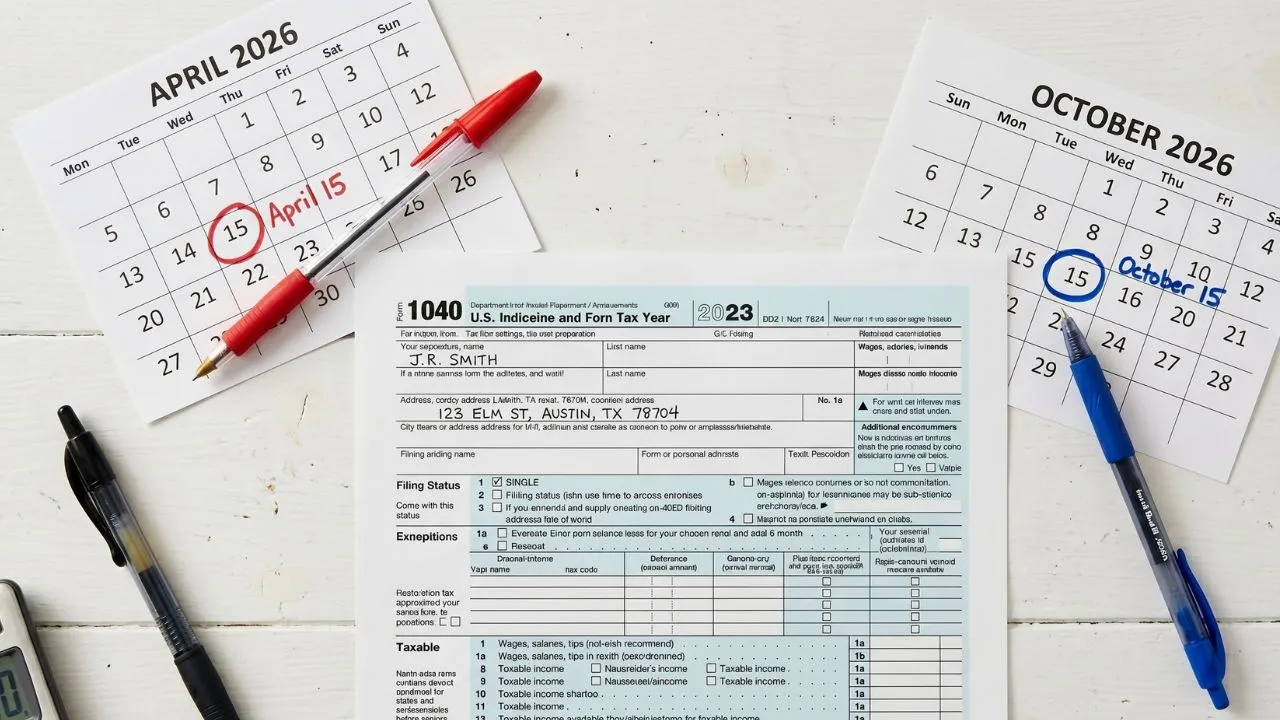


The earned income credit is a federal tax benefit that reduces what you owe the IRS and often results in a refund, even if you paid little or no income tax during the year.
Workers with low to moderate income qualify based on their earnings, family size, and filing status. The maximum credit for 2026 reaches $8,231 for families with three or more qualifying children.
The earned income credit, formally called the Earned Income Tax Credit or EITC, is a refundable tax credit administered by the Internal Revenue Service under Section 32 of the Internal Revenue Code.
Refundable means the credit can reduce your tax bill below zero, and the IRS will issue the remaining balance as a direct refund. For millions of working Americans, the EITC represents the largest single tax benefit they receive in a given year.
Understanding whether you qualify requires checking four independent tests: your earned income, your adjusted gross income, your investment income, and your filing status.
Congress first enacted the EITC in 1975, and it has expanded substantially through bipartisan legislation since then. The credit now serves roughly 23 million households annually according to IRS data, distributing approximately $64 billion in benefits.
For context on how those refund disbursements move from the IRS through the federal payment system into your bank account, the refund pipeline guide explains the full process from IRS authorization to bank deposit.
Earned Income Requirements
The first eligibility test is earned income. You must have earned income from wages, salaries, tips, or net self-employment income during the tax year. Earned income does not include investment returns, rental income, Social Security payments, unemployment compensation, alimony, child support, or pension distributions. If you received only passive or unearned income during 2026, you cannot claim the EITC regardless of your family size or financial need.
The IRS defines earned income precisely in Publication 596. Wages and salaries from W-2 employment are the most straightforward qualifying income. Self-employment income qualifies as well, but you must subtract the deductible portion of self-employment tax before calculating your net earnings.
Statutory employees who receive a W-2 with box 13 checked also qualify. Members of the clergy may include their housing allowance as earned income for EITC purposes in some circumstances.
If you are married and filing jointly, both spouses’ earned income counts toward the total. The IRS evaluates your combined adjusted gross income against the income ceiling for your filing category.
For married filers, those income ceilings are higher than for single or head of household filers, which is one reason why filing status is a critical variable in the eligibility calculation. Understanding how the IRS processes these calculations during its tax cycle connects directly to the IRS processing cycles that govern when your return enters the refund queue.
2026 Income Limits
The IRS sets separate income ceilings for each family category. For 2026, the adjusted gross income and earned income limits are as follows. For workers with no qualifying children, the limit is $19,540 for single filers and $26,820 for married joint filers.
For one qualifying child, the limit rises to $51,593 for single filers and $58,863 for married joint filers. For two qualifying children, the ceiling is $58,629 for single filers and $65,899 for joint filers. For three or more qualifying children, the maximum income allowed is $62,974 for single filers and $70,244 for joint filers.
| Number of Qualifying Children | Single, Head of Household, or Surviving Spouse | Married Filing Jointly |
|---|---|---|
| 0 Children | $19,540 | $26,820 |
| 1 Child | $51,593 | $58,863 |
| 2 Children | $58,629 | $65,899 |
| 3+ Children | $62,974 | $70,244 |
These figures apply to both your earned income and your adjusted gross income. If either number exceeds the applicable ceiling, you are ineligible for the credit. The IRS uses the lower of the two figures to calculate your credit amount, which means that workers with significant non-earned income alongside modest wages may receive a smaller credit than their wage level alone would suggest.
Investment income disqualification is a separate hard cutoff. If your total investment income for 2026 exceeds $12,200, you are automatically ineligible for the EITC regardless of how much you earned from wages or how many children you have.
Investment income for this purpose includes interest, dividends, capital gains, passive income from rental activities, and income from royalties. This limit exists because the EITC is designed to reward active work, not passive capital returns.
Filers who are unsure whether their income composition affects eligibility should also review the IRS tax refund offset guide since prior-year federal debts can intercept your refund even after the EITC is applied. The Treasury Offset Program operates separately from the credit eligibility determination and can reduce or eliminate what you actually receive.
Qualifying Child Rules
The EITC uses a four-part test to determine whether a child qualifies for the purposes of calculating your credit amount. A child does not need to be your biological child to meet the definition, but must satisfy all four criteria simultaneously.
The relationship test requires the child to be your son, daughter, stepchild, foster child, sibling, step-sibling, half-sibling, or a descendant of any of those relatives such as a grandchild or niece. An adopted child legally placed with you meets the relationship requirement.
The age test requires the child to be under age 19 at the end of the tax year, or under age 24 if a full-time student, or permanently and totally disabled with no age restriction. The residency test requires the child to have lived with you in the United States for more than half of the tax year.
Temporary absences for school, vacation, medical care, or military service generally do not break residency. The joint return test requires that the child did not file a joint return with a spouse during the year unless the return was filed only to claim a refund and no tax liability existed.
Only one taxpayer may claim a specific child for EITC purposes in a given tax year. If two taxpayers both claim the same child, the IRS applies tiebreaker rules based on parental status, length of residency with the child, and adjusted gross income. The parent who lived with the child longer generally prevails.
When residency time is equal between parents, the parent with the higher adjusted gross income receives the credit. The earned income credit maximum article details the current benefit amounts and how they phase in and out based on income for each family configuration.
Maximum Credit Amounts for 2026
The credit amount varies based on your number of qualifying children and your income level. The EITC phases in as earned income rises from zero, reaches a flat plateau, and then phases out as income approaches the ceiling.
For 2026, the maximum credit is $664 for workers with no qualifying children. The maximum rises to $4,427 for one qualifying child, $7,316 for two qualifying children, and $8,231 for three or more qualifying children.
| Number of Qualifying Children | Maximum Credit Amount |
|---|---|
| 0 Children | $664 |
| 1 Child | $4,427 |
| 2 Children | $7,316 |
| 3+ Children | $8,231 |
These maximum amounts apply during the plateau range, which is the income band where the credit has fully phased in but has not yet begun declining. Workers who earn slightly more than these amounts do not lose the credit suddenly.
Instead, the credit reduces gradually through the phase-out range until it reaches zero at the income ceiling. This gradual reduction is intentional and prevents a sharp penalty for workers who receive a modest raise.
The EITC is calculated on Schedule EIC, which is attached to your Form 1040. The IRS provides a dedicated online tool called the EITC Assistant that walks through all eligibility questions and computes an estimated credit amount.
Because the PATH Act prohibits the IRS from issuing refunds that include the EITC before February 15 regardless of when you file, early filers who claim the credit must expect their refund to be held until that statutory date passes. The February 15 PATH Act freeze article covers that hold period and what the processing timeline looks like for EITC filers specifically.
Filing Status Restrictions
Not every filing status qualifies for the earned income credit. Married taxpayers must file jointly to claim the EITC. A married taxpayer who files separately is categorically ineligible. Single filers, head of household filers, and qualifying surviving spouses all remain eligible subject to the income limits described above.
There is a narrow exception for married taxpayers who lived apart from their spouse for the last six months of the tax year and who maintained a primary home for a qualifying child. Those taxpayers may file as head of household and claim the EITC as if they were unmarried, but only if they meet all the head of household requirements under Section 2(b) of the Internal Revenue Code.
Nonresident aliens are generally ineligible for the EITC unless they are married to a U.S. citizen or resident and elect to be treated as a U.S. resident for the entire tax year by filing jointly. If you hold an Individual Taxpayer Identification Number rather than a Social Security number, you cannot claim the EITC.
The Social Security number requirement applies to you, your spouse if filing jointly, and each qualifying child listed on Schedule EIC. Numbers issued solely for non-work purposes or marked “not valid for employment” do not satisfy the requirement.
Can I claim the EITC if I have no children?
Yes. Workers without qualifying children can claim the EITC if they are at least age 25 and under age 65 by the end of the tax year, lived in the United States for more than half the year, and are not claimed as a dependent by another taxpayer. The income limit for childless workers is significantly lower than for families, and the maximum credit of $664 is substantially smaller, but the credit remains available and refundable. The minimum age threshold dropped from 25 to 19 for non-student workers under pandemic-era legislation and has since reverted for standard filers.
What disqualifies you from the EITC?
The most common disqualifiers are earned income above the applicable ceiling, investment income above $12,200, filing as married separately, using a taxpayer identification number instead of a Social Security number, being claimed as a dependent, and claiming a qualifying child who does not meet all four qualifying tests. Prior EITC fraud or reckless disregard of the rules can result in a two-year ban from claiming the credit. Fraudulent claims produce a ten-year ban.
Does the EITC affect my refund timing?
Yes. The PATH Act requires the IRS to hold refunds that include the EITC or the Additional Child Tax Credit until after February 15 each year. This applies regardless of when you filed. After February 15, the IRS begins processing these returns and typically issues refunds within 21 days. The IRS 21-day refund clock article explains precisely how that processing window is measured and what delays can extend it.
Can self-employed workers claim the EITC?
Yes, but net self-employment income must be positive after deducting business expenses and the deductible portion of self-employment tax. If your Schedule C shows a net loss, that loss can reduce the total earned income used to calculate your EITC credit amount, potentially reducing the benefit. Self-employed filers should ensure their Schedule SE is accurate before calculating their EITC on Schedule EIC.
What happens if I claim the EITC incorrectly?
The IRS may audit your return, disallow the credit, and assess the taxes originally owed plus interest and penalties. If the IRS determines the error resulted from reckless or intentional disregard of the rules, a two-year ban applies. A fraudulent claim results in a ten-year ban. You can appeal an EITC disallowance through the IRS appeals process or in Tax Court. The IRS refund status guide explains what transcript codes appear when a credit is under review or has been adjusted.
Edge Cases and Escalation
Several edge cases affect EITC eligibility in ways that routine IRS guidance does not always make clear. If you are incarcerated for more than six months during the tax year, you do not meet the residency requirement and cannot claim the credit even if your children lived with your spouse in the same household.
If you received a disability pension from an employer-funded plan before the minimum retirement age, those payments count as earned income until you reach the employer’s defined retirement age, after which they do not qualify. This distinction matters for workers who retired early on disability and are trying to determine whether they still have EITC-eligible income.
If the IRS has previously audited your EITC claim and required you to repay a prior-year credit, you must file Form 8862 to reclaim eligibility before the credit will be processed again. The IRS will not automatically restore your eligibility. Form 8862 must be attached to your return in the first year you reclaim the credit after a disallowance.
The official IRS guidance on the earned income credit is available at the IRS EITC information center, which includes eligibility tables, the EITC Assistant tool, and the current year’s Publication 596.
For workers who believe their EITC was incorrectly denied, the Taxpayer Advocate Service operates independently within the IRS and can intervene when the standard process is causing economic harm or unreasonable delay. The Taxpayer Advocate can be reached at 1-877-777-4778. Formal dispute rights are outlined at the IRS taxpayer rights portal.
What You Should Do Now
- Confirm you have a valid Social Security number and that every qualifying child you plan to list also has one issued before your tax return’s due date.
- Use the IRS EITC Assistant to work through all eligibility questions before filing, since the tool evaluates all four qualification tests simultaneously and flags common disqualifiers.
- Verify that your investment income for 2026 is below $12,200. If you received dividends or sold investments during the year, review your Forms 1099-DIV and 1099-B before filing.
- If you are self-employed, confirm your Schedule C net income is positive and that your Schedule SE deduction is calculated correctly before transferring earned income figures to Schedule EIC.
- File as early as possible after the filing season opens in January 2026. Even though your refund will remain subject to the PATH Act hold until after February 15, filing early helps reduce processing delays.
- Check your refund status after February 15 using the Where’s My Refund tool. If your status does not update within 21 days after February 15, contact the IRS or the Taxpayer Advocate Service. The IRS Where’s My Refund guide explains what each status message means and the appropriate next steps.