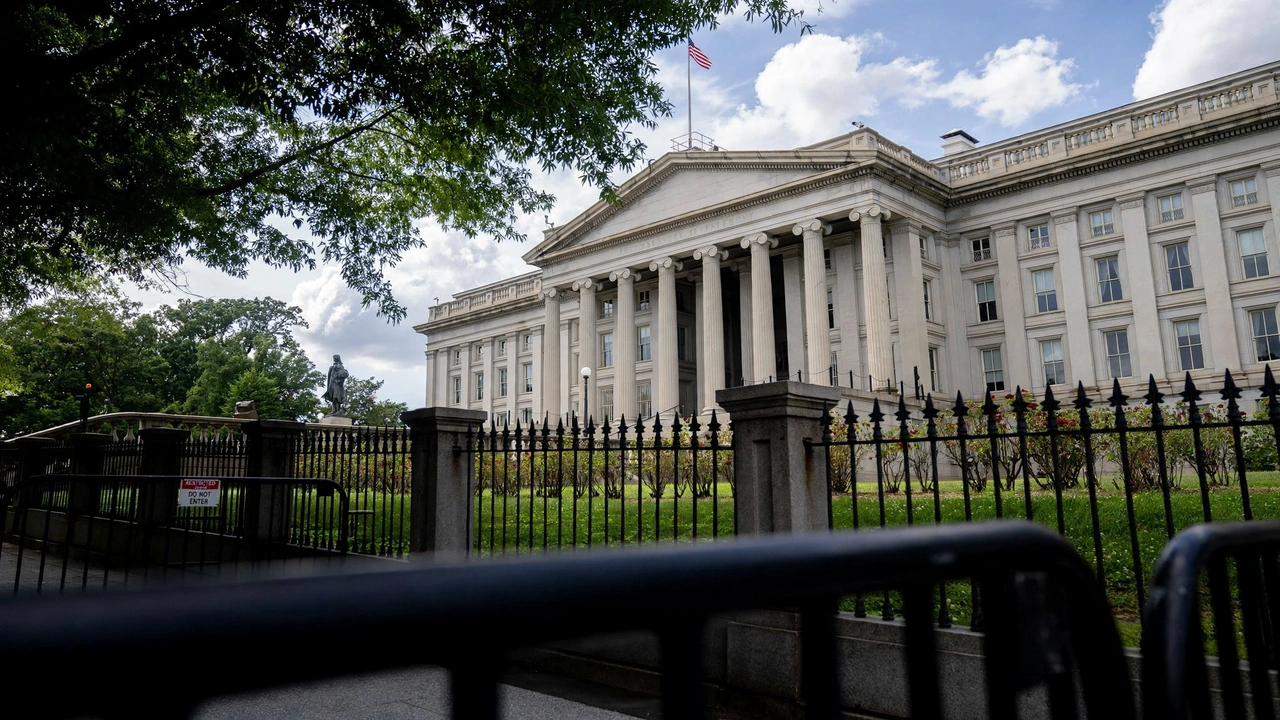
The U.S. Treasury announced a $125 billion debt refunding on Wednesday, November 4, with approximately $97 billion going toward refinancing privately held Treasury notes and bonds maturing in mid-November and the remaining $28 billion expected to raise new cash from private investors.
The November refunding statement, issued by Assistant Secretary for Financial Markets Hunter McMaster, keeps the government’s three-year, 10-year and 30-year auction sizes unchanged from August. Treasury also outlined a change to how seven-year notes will be issued beginning in March 2027, while maintaining its broader expectations for regular note and bond auction sizes.
The distinction matters for investors and anyone following federal borrowing costs. The $125 billion is not entirely new government borrowing. Most of the offering replaces existing securities reaching maturity, while approximately $28 billion represents the additional cash Treasury expects to obtain from private investors.
Auction Details
Treasury plans to sell three securities through auctions scheduled for November 9, 10 and 12. All three auctions are scheduled for 1 p.m. Eastern Time, with settlement on Monday, November 16.
| Security | Offering | Auction Date | Maturity |
|---|---|---|---|
| 3-year note | $58 billion | November 9 | November 15, 2029 |
| 10-year note | $42 billion | November 10 | November 15, 2036 |
| 30-year bond | $25 billion | November 12 | November 15, 2056 |
| Total | $125 billion |
These dates are confirmed by Treasury’s official auction calendar, which also lists the department’s planned bill, note, bond and inflation-protected securities auctions through the coming quarter.
For readers unfamiliar with the instruments, the essential difference between Treasury security types is their maturity structure. Treasury bills are short-term obligations, while notes and bonds allow the government to borrow over longer periods. The November refunding concentrates on three maturities. The $58 billion three-year note is the largest component, representing 46.4% of the total offering.
Treasury will determine the auction-clearing yields through competitive bidding. The announced amounts alone do not establish what investors will demand in interest or what the government will ultimately pay. The auction bidding process explains how these prices and yields are determined.
What Changed
The most useful comparison is with Treasury’s previous quarterly refunding announcement, published on August 5, 2026. That August refunding statement also announced a $125 billion offering, consisting of $58 billion in three-year notes, $42 billion in 10-year notes and $25 billion in 30-year bonds. The difference lies in the amount of maturing debt being refinanced and the resulting new cash.
| Measure | August Refunding | November Refunding |
|---|---|---|
| Total securities offered | $125 billion | $125 billion |
| Privately held maturing securities | About $96.3 billion | About $97 billion |
| New cash raised or expected | About $28.7 billion | About $28 billion |
| Three-year auction | $58 billion | $58 billion |
| 10-year auction | $42 billion | $42 billion |
| 30-year auction | $25 billion | $25 billion |
Comparing the two Treasury statements, November’s expected new cash is approximately $700 million less than August’s, while the amount of privately held debt being refinanced is approximately $700 million greater.
The arithmetic is straightforward: $125 billion minus $97 billion equals $28 billion. These figures are based on Treasury’s rounded announced amounts, not the final auction proceeds.
My reading of this comparison is that Treasury is maintaining its major quarterly refunding sizes rather than introducing an immediate increase in these longer-term offerings. The change in new cash reflects different maturing amounts across the two refunding periods, not a reduction in the $125 billion offering.
This distinction is important within the broader Treasury borrowing process, where refinancing existing obligations and raising additional money are related but different financing activities.
Seven-Year Change
One operational change in the November statement concerns seven-year Treasury notes. Treasury announced plans to move from issuing a new seven-year security every month to issuing a new security quarterly, followed by two monthly reopenings.
Under the new arrangement, original seven-year notes will be issued in March, June, September and December. Each new issue will then be reopened in the following two months. The conversion is scheduled to begin with the March 2027 issue, followed by reopenings in April and May.
The change does not eliminate monthly seven-year auctions. Instead, Treasury will sell additional amounts of an existing security during the reopening months rather than creating a newly dated security every month.
Treasury’s November statement does not identify this restructuring as an increase in the seven-year monthly auction amount. Its published issuance table maintains the expected seven-year auction size at $44 billion for November, December and January. The operational distinction matters because investors must separate changes in the securities’ issuance structure from changes in how much debt the government actually sells.
Borrowing Outlook
The refunding follows Treasury’s separate November 2 financing update, which revised its borrowing expectations for the final quarter of 2026. According to the department’s November borrowing estimates, Treasury expects $618 billion in privately held net marketable borrowing from October through December, assuming an $850 billion cash balance at year-end.
That is $10 billion below its August estimate of $628 billion. Treasury attributed the revision primarily to a higher-than-expected cash balance at the beginning of the quarter, partly offset by weaker projected net cash flows. The department also projects $800 billion in privately held net marketable borrowing during January through March 2027, based on an assumed $1 trillion cash balance at the end of March.
These quarterly figures measure a broader financing requirement than the individual November refunding. The $28 billion in new refunding cash should not be added separately to the $618 billion estimate as though the two represented independent borrowing programs. The estimates are projections, not completed borrowing outcomes. Treasury’s financing reconciliation table provides the underlying quarterly sources, uses and cash-balance assumptions.
Cash and Buybacks
Treasury also outlined how it expects to manage cash balances and securities purchases over the November-to-January refunding quarter. The department estimates that its Treasury General Account could reach approximately $1.025 trillion, plus or minus $50 billion, in late November and again in late January.
Treasury attributed those projected peaks to large anticipated cash outflows around those periods. The Treasury General Account is the federal government’s operating account at the Federal Reserve. Its role in collecting revenue, financing payments and managing balances is explained in the Treasury cash account guide.
The department expects to maintain current benchmark Treasury bill auction sizes into late November, potentially issue a short-dated cash-management bill around month-end, reduce shorter-dated bill auction sizes during December and increase bill issuance across maturities in January. Those are planned responses to seasonal financing needs, not completed transactions.
Treasury is also maintaining its planned auction sizes for inflation-protected securities, including a $19 billion 10-year TIPS reopening in November, a $24 billion five-year reopening in December and a $21 billion new 10-year issue in January. The buyback program is another significant part of the financing statement.
Treasury anticipates purchasing up to $70 billion of older, less actively traded securities for liquidity support and up to $25 billion of securities with remaining maturities between one month and two years for cash management.
The $70 billion liquidity-support ceiling is higher than the $38 billion outlined in August’s initial quarterly plan. Treasury had already expanded the maximum size of certain longer-term operations through its August buyback notice, effective September 9.
The new Treasury buyback schedule identifies planned operations, maturity ranges and maximum purchase amounts. These figures are ceilings, not evidence that Treasury has already purchased the full amounts. The earlier bond buyback expansion helps explain the department’s focus on improving liquidity in older long-term securities.
Buybacks also should not be confused with canceling an equivalent amount of net borrowing. Treasury’s November 2 financing release explains that buybacks are not expected to significantly affect privately held net marketable borrowing because securities purchased are generally replaced through issuance.
Market Implications
For Treasury investors, the immediate questions concern auction demand, clearing yields and whether Treasury eventually changes the mix of shorter- and longer-term securities it issues.
The November statement says current nominal coupon and floating-rate note auction sizes are expected to remain in place for the next several quarters, based on existing projections. Treasury continues to evaluate potential future adjustments as investor demand and financing conditions evolve.
That outlook does not guarantee unchanged issuance indefinitely. Government borrowing costs also matter beyond the Treasury market. Treasury yields provide important benchmarks for corporate borrowing and mortgage markets, although individual lending rates depend on additional factors.
The relationship between longer-term government debt supply and broader borrowing cost risks therefore deserves attention. But Wednesday’s refunding announcement does not, by itself, establish that mortgage rates, savings yields or bond prices have changed.
The auction results will provide more direct evidence of how investors price the announced supply. The statement does not establish future auction yields or any resulting change in household borrowing costs.
What Happens Next
Treasury’s next immediate milestones are the three-year auction on November 9, the 10-year auction on November 10 and the 30-year auction on November 12, with settlement scheduled for November 16.
The government will continue adjusting shorter-term bill issuance according to financing requirements, while its announced seven-year issuance restructuring is scheduled to begin in March 2027. Treasury has scheduled its next quarterly refunding announcement for February 3, 2027.
For now, the confirmed development is clear: the government is preparing another $125 billion refunding, expects approximately $28 billion in new cash, and is keeping its principal note and bond auction sizes unchanged while adjusting how it manages future financing operations.