
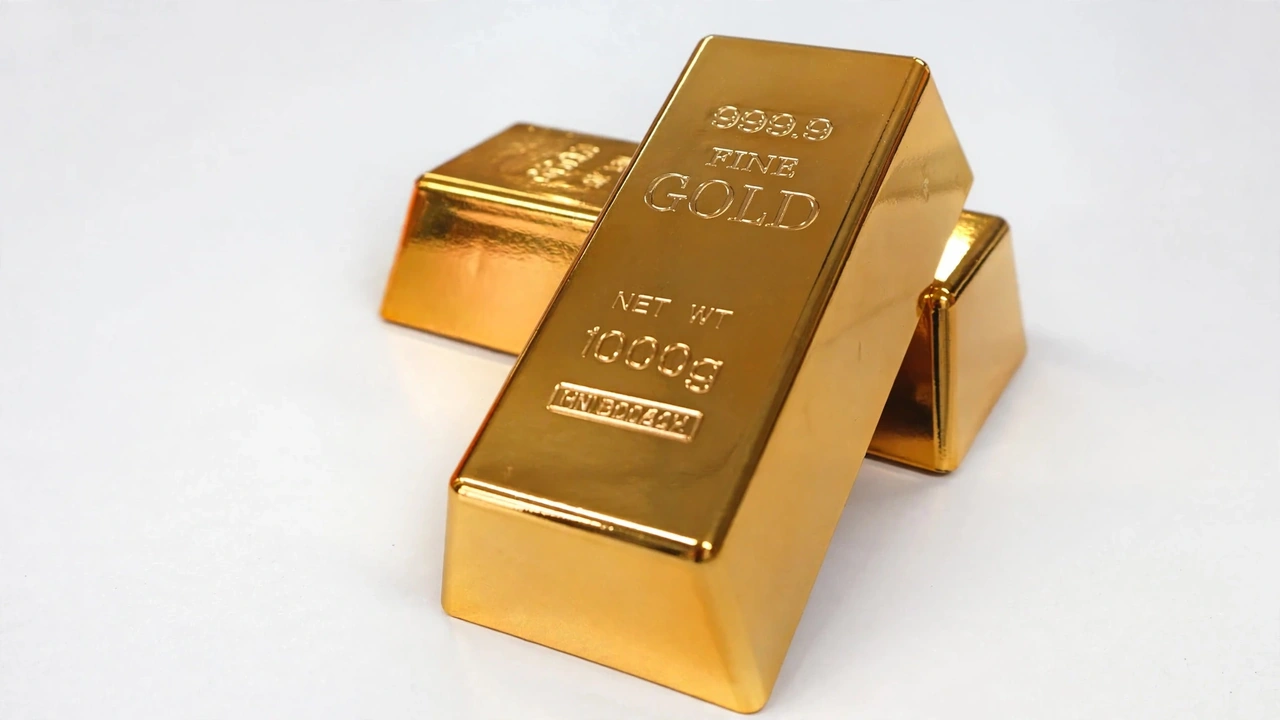
Gold prices fell toward $3,840 per troy ounce on Monday, November 16, 2026, reaching their lowest level in more than a year as a stronger U.S. dollar, elevated Treasury yields and expectations of further Federal Reserve interest-rate increases pressured the precious metal.
Spot gold traded at approximately $3,840.52 an ounce at 6:41 a.m. GMT, or 1:41 a.m. Eastern, down about 1% during the session. December U.S. gold futures also declined, trading near $3,843.60, while bullion’s latest retreat extended a difficult period for investors who had viewed gold as protection against inflation and economic uncertainty.
The decline has implications for investors holding bullion, gold-backed exchange-traded funds and precious-metal-related assets. It also raises a broader question: why is gold falling when inflation remains elevated and financial-market uncertainty has not disappeared?
Gold Falls to a One-Year Low
Monday’s decline took spot gold to its lowest level since October 2025, extending a selloff that accelerated during the previous trading week. The latest move followed a period in which bullion repeatedly struggled to sustain recoveries above $4,000, with gold’s weekly decline already illustrating how quickly the market’s direction had changed.
Gold was quoted near $3,884.20 per ounce on Friday, November 13, compared with approximately $3,840.52 early Monday. Using those two market observations, the difference amounts to $43.68 per ounce, or approximately 1.12%, although the calculation compares observations from different trading sessions rather than official settlement prices.
That distinction matters because a market’s lowest intraday quotation is not necessarily its closing price. Gold can recover or decline further before trading concludes, and the current one-year-low description reflects the market’s observed trading range rather than a confirmed November 16 closing record.
The decline also represents a considerable reversal from the gold price outlook earlier in November, when bullion traded above $4,100. From $4,124 to $3,840.52, the difference is approximately $283.48 per ounce, or 6.9%, although those figures represent different observation times and should not be interpreted as a standardized investment return.
Why Is Gold Falling?
One important source of pressure is the changing outlook for U.S. interest rates. Gold does not generate interest income, meaning the opportunity cost of holding bullion can increase when government bonds and other interest-bearing investments offer higher yields.
The Treasury yield data show the benchmark 10-year U.S. Treasury yield rising from 4.67% on November 9 to 5.15% on November 13. That is an increase of 48 basis points over four business days, strengthening the investment case for interest-bearing government securities relative to assets that provide no periodic income.
The move helps explain why higher Treasury yields have become an important part of the gold-market discussion. However, rising yields alone cannot establish the precise cause or percentage contribution to Monday’s decline, because currency movements, positioning and other market developments can influence bullion simultaneously.
A stronger U.S. dollar adds another possible source of pressure. Gold is generally quoted internationally in dollars, so an appreciation of the currency can make the metal more expensive for buyers using other currencies, although exchange rates and local retail premiums determine the actual cost in individual countries.
Federal Reserve Expectations Pressure Bullion
The Federal Reserve’s interest-rate outlook is central to the latest market reaction. At its October 28 meeting, the central bank maintained the federal funds target range at 3.75% to 4%, while two policymakers preferred an immediate quarter-percentage-point increase.
The official October policy statement also described inflation as elevated, indicating that policymakers remained concerned about bringing price growth sustainably toward the central bank’s 2% objective. That position has kept investors focused on whether additional tightening could follow at the December meeting.
The possibility of another increase helps explain why Federal Reserve policy remains important for precious-metal investors. But expectations of an increase are not the same as an announced decision, and changes in market-implied probabilities do not guarantee how individual policymakers will vote.
The next scheduled Federal Open Market Committee meeting is December 8–9, according to the Fed’s official meeting calendar. Until then, inflation figures, employment developments and policymakers’ public statements may influence interest-rate expectations and gold prices.
What the Decline Means for Investors
For an investor holding physical bullion, Monday’s decline reduces the U.S.-dollar market value of gold relative to an earlier, higher quotation. For example, a hypothetical holding of 10 troy ounces would have a spot-market reference value of approximately $38,405.20 at $3,840.52 per ounce, compared with $38,842 at $3,884.20.
That represents a difference of $436.80, before dealer spreads, transaction expenses, storage costs or taxes. The calculation illustrates exposure to a changing market quotation; it does not establish the realized profit or loss of any investor, which depends on the purchase price and whether the gold is sold.
The impact can also differ across investment instruments. Physical gold holders face premiums and dealer buyback spreads, gold-backed funds reflect their own market pricing and expenses, while gold-mining company shares depend on operating costs, production, debt and broader equity-market conditions.
Investors evaluating whether gold remains attractive should therefore distinguish the spot price from the performance of individual securities. A lower bullion quotation may reduce mining revenue expectations, but it does not establish how every gold-related stock or fund will perform.
Is Gold Still a Safe-Haven Asset?
Gold’s latest decline demonstrates an important limitation of its safe-haven reputation: the precious metal does not necessarily rise whenever inflation, geopolitical uncertainty or financial-market volatility increases. Its short-term performance can depend heavily on interest rates, the dollar, market liquidity and investors’ willingness to hold assets without income.
The recent weakness is particularly notable because inflation concerns, which can support demand for precious metals over some periods, are also contributing to expectations of tighter monetary policy. This creates competing forces: the potential desire to hold gold as protection against currency purchasing-power erosion and the increasing appeal of interest-bearing assets.
That tension has appeared repeatedly during previous bouts of gold market weakness, when Treasury yields remained elevated despite wider economic uncertainty. It also helps explain why gold’s longer-term investment characteristics cannot be judged from a single session or a short period of falling prices.
Gold may still serve a diversification role in some portfolios, but diversification does not eliminate losses. Its suitability depends on an investor’s financial position, investment horizon, risk tolerance and the other assets already held.
What Happens to Gold Prices Next?
The immediate question is whether gold can stabilize after reaching a one-year low or whether selling pressure will continue as markets reassess U.S. interest-rate expectations. The latest quotation does not establish that either outcome will occur, and historical price levels should not be treated as guarantees of support or future recovery.
Investors will be watching Treasury yields, dollar movements and Federal Reserve communications for evidence of any meaningful change in the conditions affecting bullion. The contrast with an earlier gold price rebound illustrates how rapidly investor expectations and market prices can shift.
The forthcoming October Federal Reserve meeting minutes, alongside subsequent economic releases and policymakers’ statements, may provide additional information about the monetary-policy outlook. These records can help investors assess policy discussions, although neither the minutes nor any single economic statistic determines gold’s next price movement.
For now, the verified development is that gold has fallen toward $3,840 and reached its lowest intraday level in more than a year. Whether that becomes the beginning of a sustained decline or a temporary episode of selling will depend on subsequent market observations, rather than the one-year-low milestone itself.