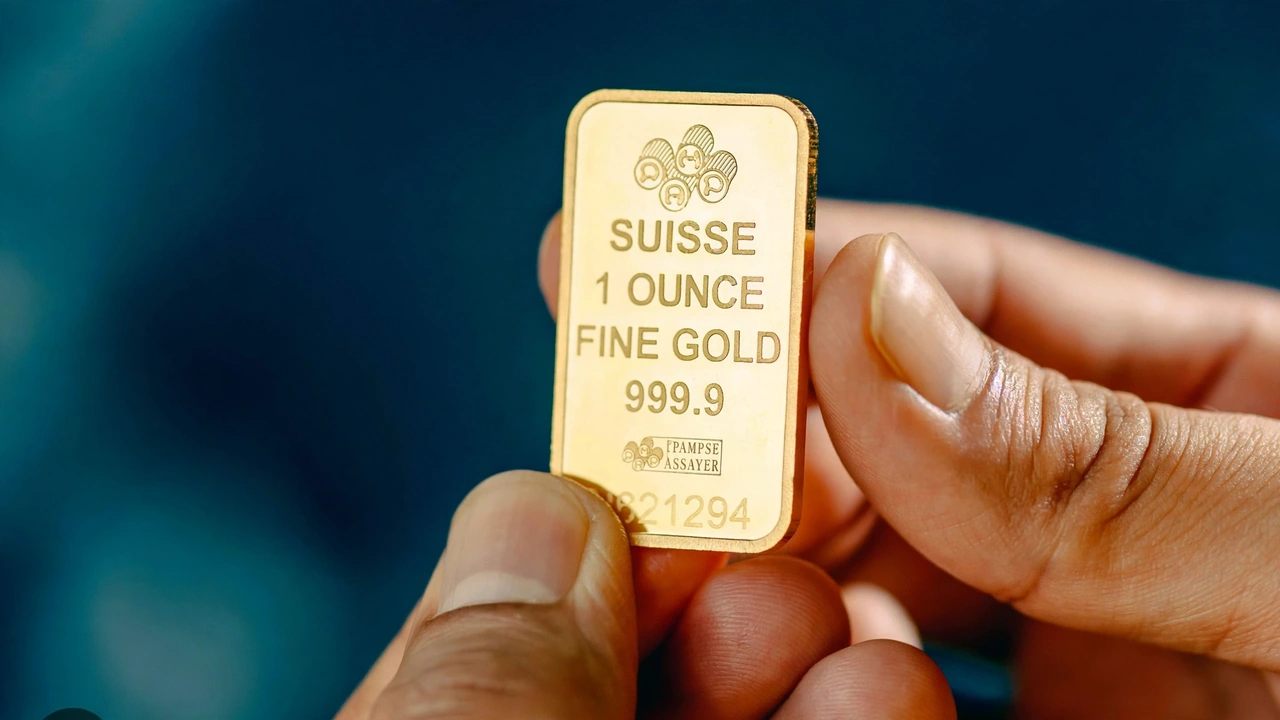
Gold prices are approaching a critical U.S. inflation report after a weekly rally of more than 5%, even as stronger employment data renewed pressure on the precious metal. Spot gold traded at $4,074.36 per troy ounce at 1:54 p.m. Eastern Time on Friday, November 6, down 0.3% during the session but up 5.2% for the week, according to Reuters.
The next major test comes Tuesday, November 10, when the Bureau of Labor Statistics releases October’s Consumer Price Index. The figures reflect Friday’s trading, not a new quotation for Sunday, November 8. The approaching inflation report matters to investors holding gold, households considering bullion purchases and traders assessing the Federal Reserve’s next interest-rate decision.
A stronger-than-expected inflation reading could reinforce expectations of tighter monetary policy, potentially weighing on an asset that pays no interest. A softer reading could ease that pressure, although gold also responds to currency movements, geopolitical developments and physical demand. Neither outcome guarantees that the previous week’s rally will continue or reverse.
A Volatile Rebound
Gold’s recovery gathered strength during the first week of November as investors reassessed interest rates and financial-market risks. On Thursday, November 5, spot bullion reached $4,146.63 an ounce during the session, according to Reuters, extending the Thursday gold advance as the dollar weakened and Treasury yields declined. The move followed a difficult October in which gold repeatedly struggled to maintain its position above $4,000. The rebound suggested renewed buying interest, but it did not establish that the earlier decline had ended.
Friday delivered a reminder of how quickly that picture could change. Gold dropped to an intraday low of $4,033.29 after the U.S. employment report before recovering to $4,074.36 by Reuters’ afternoon observation. That represented a $41.07 recovery from the session low, approximately 1.02% based on those two quotations, even though the metal remained lower on the day. The earlier Friday gold decline illustrated how changing expectations about interest rates can interrupt a substantial weekly advance.
The distinction between a weekly gain and a daily reversal is important because each measures a different period of market behavior. Gold could finish the week substantially higher while still falling after the newest economic announcement, and neither observation alone identifies the trend that will dominate next week.
Earlier September gold weakness provides historical context for the market’s sensitivity to Treasury yields and the dollar. Investors should not treat a recovery over several sessions as proof that prices have reached a durable floor. Market quotations also require careful interpretation.
Friday’s $4,074.36 spot-gold observation was recorded at a specific time rather than representing an official daily closing auction, while U.S. gold futures for December delivery settled at $4,074.90, according to Reuters. The two prices represent different instruments and observation times, so their small numerical difference is not a reliable measure of a trading premium. A weekend reference price likewise cannot establish what gold will trade at when the next active market session begins.
The Inflation Test
The next major U.S. economic release arrives Tuesday, November 10, at 8:30 a.m. Eastern Time, according to the BLS official CPI calendar. The report will measure consumer-price changes during October, giving investors another reading on inflation before the Federal Reserve’s December policy meeting. As of November 8, the October results have not been released, and their direction cannot be stated as fact. Gold investors will be watching both the headline inflation figure and the measure excluding food and energy.
The latest available September CPI report showed consumer prices increasing 0.6% on a seasonally adjusted monthly basis and 3.7% over the preceding 12 months. Core consumer prices, excluding food and energy, increased 0.3% during the month and 2.6% from a year earlier. Energy prices increased 20.4% over the year, highlighting how strongly that category contributed to the difference between headline and core inflation. These figures describe September’s price changes, not the October results due Tuesday.
That distinction matters because a decline in headline inflation does not necessarily mean underlying price pressures have eased at the same pace. The BLS calculates the consumer-price measures using different expenditure categories and adjustments, as explained in the broader CPI measurement guide. Investors will therefore need to examine which categories drive October’s result rather than rely exclusively on one headline percentage. The Federal Reserve also considers broader inflation measures, including the Personal Consumption Expenditures price index, when assessing progress toward its 2% inflation objective.
A hotter-than-anticipated CPI report could encourage investors to expect interest rates to remain elevated or rise further, potentially supporting Treasury yields and the dollar. A weaker report could instead reduce some of those concerns, creating a more favorable environment for gold if other market forces remain unchanged.
Those are conditional scenarios rather than predictions, and no specific economist-consensus forecast has been independently established here. Gold’s actual response will depend on how the released figures compare with the expectations already reflected in market prices.
Rates Versus Gold
Friday’s employment report helps explain why the inflation data have become particularly important. The BLS October jobs report, released November 6, showed nonfarm payrolls increasing by 165,000 while the unemployment rate stood at 4.1%. October’s payroll increase exceeded the average monthly gain of 48,000 recorded over the preceding 12 months, while revisions added a combined 84,000 jobs to previously published August and September estimates. Those revisions improved the historical employment picture but did not represent additional jobs created during October.
The Federal Reserve had already signaled concern about persistent inflation when it held interest rates on October 28. Its official policy statement maintained the federal funds target range at 3.75%–4.00%, with two policymakers preferring a quarter-point increase. The combination of elevated inflation and resilient employment gives policymakers competing information to weigh against the risk of unnecessarily restricting economic activity. However, disagreement within the committee does not establish the outcome of its next meeting.
Official Treasury data provide a more detailed view of Friday’s interest-rate pressure. The two-year Treasury par yield increased from 4.46% on November 5 to 4.51% on November 6, while the 10-year yield rose from 4.84% to 4.86%, according to the Treasury’s daily yield records. Those changes equal five basis points for the two-year maturity and two basis points for the 10-year maturity, an original calculation from comparable official daily observations.
The difference between the two yields consequently narrowed from 38 to 35 basis points, showing a stronger daily rise at the shorter maturity. The comparison adds an important qualification to gold’s weekly performance. The 10-year yield was still below its 4.91% reading from Monday, November 2, even after Friday’s increase, meaning the latest upward movement did not reverse the entire week’s decline.
Investors examining Treasury yield mechanics should distinguish that broader weekly change from the immediate reaction to employment data. The Treasury’s par yields are derived from market quotations and are not synchronized with every reported gold transaction, so these observations do not prove that changing yields caused gold’s specific price movements.
Gold faces an opportunity-cost disadvantage when interest-bearing assets offer more attractive returns, but that mechanism is not the entire explanation for its performance. Dollar movements, expectations of future inflation, central-bank demand, political uncertainty and changes in investor positioning can also affect prices. The earlier October gold reaction demonstrated how sensitive bullion trading can become around major Federal Reserve announcements. The effect of any single factor is difficult to isolate without more detailed market evidence.
What Buyers Face
For households holding physical gold, a market rally changes the indicative value of their metal but does not guarantee an equivalent selling price. At Friday afternoon’s reported spot quotation, five troy ounces would have an underlying metal value of approximately $20,371.80, excluding dealer charges and other adjustments. A subsequent $100-per-ounce change would alter that indicative value by $500 for the same quantity, before transaction costs. These calculations illustrate exposure to price changes rather than a forecast or a guaranteed resale amount.
The distinction becomes especially important for people purchasing coins, bars or jewelry after a sharp rally. The U.S. Mint’s bullion buying guidance explains that buyers should consider premiums in addition to prevailing metal prices and examine dealer practices before making a purchase. Currency exchange rates, local taxes and product-specific charges can make the final price substantially different from the international spot quotation. A decline in wholesale gold prices therefore does not necessarily translate into an identical percentage reduction at a retail counter.
Investors using futures contracts face another form of exposure because contracts can represent much larger quantities of gold than a household typically holds. For a standard 100-troy-ounce gold futures contract, a $100-per-ounce price movement corresponds to a $10,000 change in the contract’s underlying value, before fees and other costs.
The Commodity Futures Trading Commission’s gold investment warning explains that leverage can magnify losses and create substantial financial obligations. Gold-backed funds and mining-company shares have their own fee structures, operating risks and tracking differences, meaning their returns should not automatically be equated with spot bullion.
The Next Test
The immediate focus is Tuesday’s October CPI report, followed by the October Producer Price Index release scheduled for Friday, November 13. The Federal Reserve’s next scheduled policy meeting follows on December 8–9, according to its meeting calendar. Investors can follow those dates through the economic calendar, while keeping official published results separate from forecasts and market interpretations. None of those scheduled events guarantees a particular interest-rate decision or gold-price outcome.
The central question is whether gold can maintain its substantial weekly recovery as investors receive fresh evidence about inflation and monetary policy. Friday’s decline showed that stronger economic data can renew selling pressure, while the broader rally demonstrated that gold’s performance cannot be explained by a single announcement.
Tuesday’s CPI release may change the market’s expectations, but its importance will become clear only after the actual figures and subsequent trading are observed. Until then, the established facts are a roughly 5% weekly rally, a Friday reversal and an unresolved inflation test.