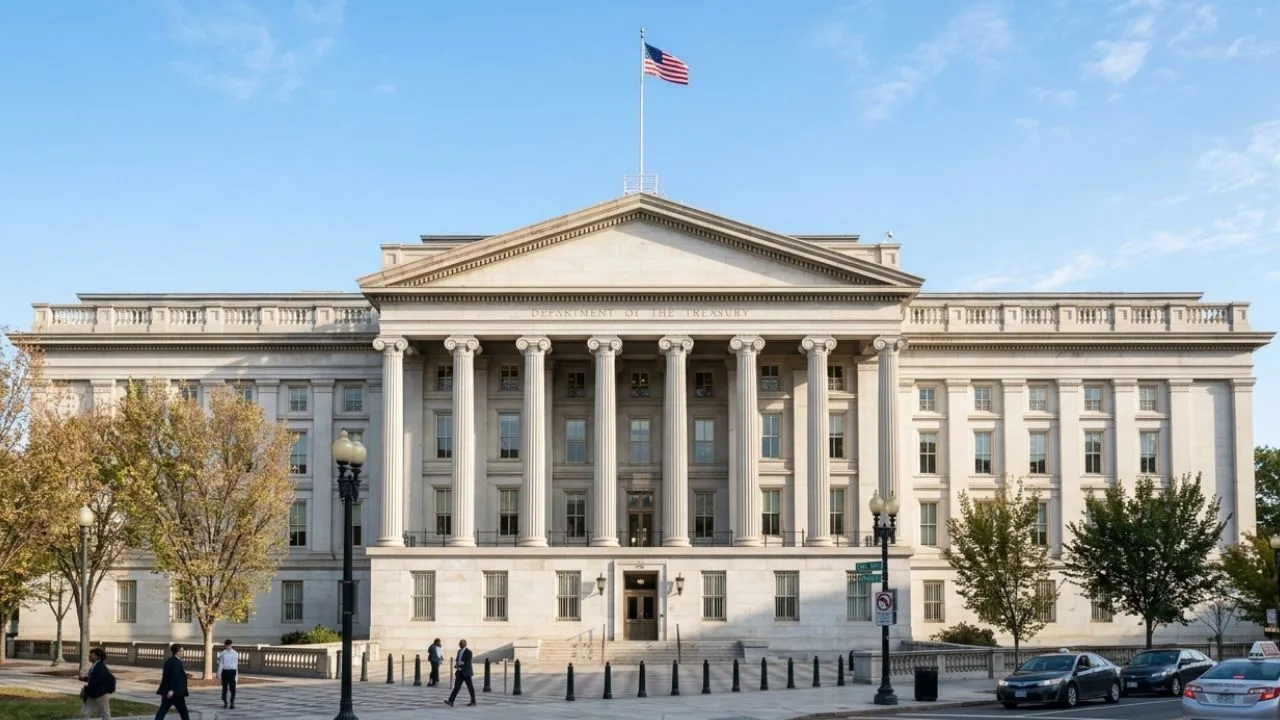
The U.S. Treasury Department is scheduled to publish updated federal borrowing estimates on Monday, November 2, giving investors a fresh look at the government’s financing requirements ahead of Wednesday’s quarterly refunding announcement, which will provide further details on Treasury securities issuance.
The new estimates are expected to update Treasury’s financing outlook for October through December 2026 and provide an initial projection for January through March 2027. According to the department’s refunding calendar, the borrowing estimates are scheduled for Monday, with the next refunding announcement set for November 4.
The last official borrowing estimates, released August 3, projected $628 billion in privately held net marketable borrowing during the October–December quarter, assuming a Treasury cash balance of $850 billion at year-end.
That $628 billion projection provides the principal benchmark for Monday’s update. A higher or lower estimate would indicate that Treasury’s anticipated financing requirements have changed, although the significance would depend partly on revisions to its cash-balance assumptions.
Treasury also projected $739 billion in borrowing for July through September, an increase of $68 billion from its May estimate of $671 billion. The department attributed that revision primarily to weaker projected net cash flows, partially offset by a higher-than-assumed opening cash balance.
The comparison illustrates why changes in borrowing projections cannot automatically be interpreted as equivalent changes in the federal budget deficit.
Treasury’s quarterly estimates measure privately held net marketable borrowing, rather than the overall increase in outstanding federal debt. They reflect the government’s financing requirements after accounting for projected cash flows, cash balances and relevant securities transactions.
Investors can track related changes in the government’s operating cash position through the Daily Treasury Statement. Treasury’s cash account also matters for financial-system liquidity, a relationship examined in Investozora’s coverage of bank reserves and Treasury cash.
Wednesday’s refunding announcement will provide the more detailed financing picture, including information about upcoming Treasury note and bond auctions. In its August refunding statement, Treasury outlined plans for government securities issuance and discussed the financing outlook alongside its cash-management requirements.
The department also said its Treasury General Account could reach approximately $1.05 trillion, plus or minus $50 billion, in late October because of anticipated seasonal cash outflows. That projection was separate from the $850 billion year-end cash assumption used in August’s fourth-quarter borrowing estimate.
The distinction is important because a temporary increase in Treasury’s cash holdings can raise near-term financing needs without necessarily indicating an equivalent deterioration in the underlying fiscal outlook. Investors will also examine whether Wednesday’s announcement changes Treasury’s approach to longer-term debt issuance and securities buybacks.
In an August announcement, Treasury said it would at least double the maximum size of certain longer-dated bond buyback operations, from $2 billion to at least $4 billion, effective September 9. The department said additional information about future buyback sizes would be provided at the November refunding.
Buybacks are intended in part to support liquidity in existing Treasury securities. They should not be confused with a straightforward reduction in government borrowing because Treasury generally issues other securities to finance the purchases.
Changes in Treasury issuance plans can matter to investors worldwide because U.S. government securities serve as benchmarks across sovereign debt, corporate credit and other financial markets. Investozora has previously examined how Treasury yields are determined, the connection between borrowing costs and interest rates, and the effects of shifting bond market yields.
However, a change in borrowing estimates does not establish that Treasury yields, mortgage rates or other financing costs will move in a particular direction. Those outcomes also depend on investor demand, inflation expectations, Federal Reserve policy and broader market conditions.
The immediate question is how much Treasury revises its previously projected $628 billion fourth-quarter borrowing requirement and what it expects to borrow during the first three months of 2027. Wednesday’s refunding announcement will then help establish how the government intends to meet those financing needs through its securities issuance program.