

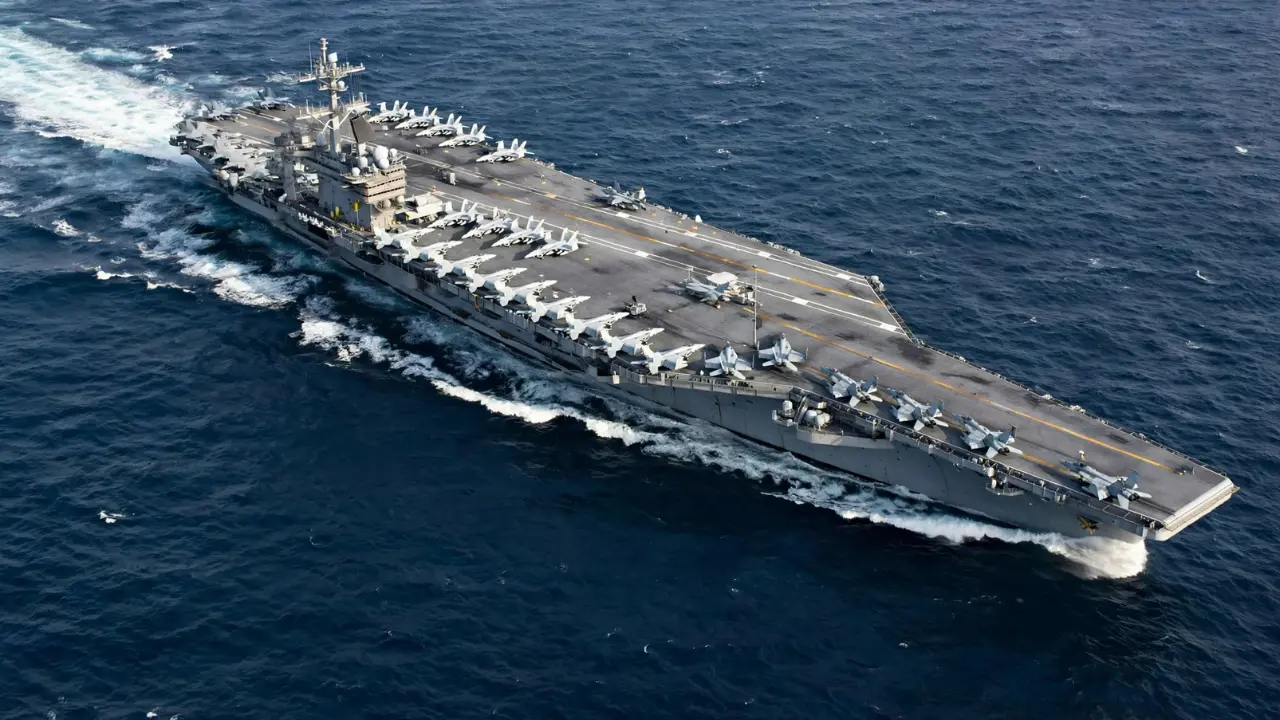
The USS Abraham Lincoln is finally preparing to come home after one of the most demanding deployments in the carrier’s recent history. Acting Secretary of the Navy Hung Cao said Friday, Aug. 14, that the aircraft carrier “will return home soon” as part of a planned rotation, confirming that its deployment had reached 266 days.
The Navy has not yet announced an exact date for the ship’s arrival back in San Diego. The Navy’s official statement said the carrier had spent 200 days in a combat zone, conducted more than 10,000 sorties and dropped 1.5 million pounds of ordnance during the deployment.
The return will give thousands of sailors and Marines aboard the Lincoln a path home after months of combat operations, disrupted routines and growing scrutiny over living conditions and mental health.
But the relief also raises a larger question for the Navy: how long can the United States keep aircraft carriers at this operational tempo without creating new readiness, maintenance and spending pressures elsewhere in the fleet?
What happened to the USS Abraham Lincoln?
The Lincoln left San Diego on Nov. 21, 2025, initially operating in the Indo-Pacific before being redirected toward the Middle East. It reached the U.S. Central Command region in January as tensions with Iran escalated. Its original deployment schedule was later extended because of combat requirements.
By Aug. 14, the Navy counted 266 days deployed. That does not mean the ship had spent all 266 days continuously at sea. Associated Press reporting puts its uninterrupted stretch at sea at more than 240 days, while the Navy says 200 deployment days were spent in a combat zone.
Those distinctions matter. The deployment clock measures the total time sailors have been away from their homeport, while consecutive time at sea measures how long they have gone without the type of port break that can provide rest, maintenance opportunities, resupply and a temporary change from shipboard life.
The length is striking when compared with the Lincoln’s own recent history. The carrier returned from a seven-month deployment in 2022 and completed a five-month deployment in December 2024. The current deployment has now stretched to nearly nine months.
Why the 266 days have become a sailor-welfare issue
The Navy acknowledges that the crew has been under unusual pressure. In its Aug. 14 statement, Navy leadership said fresh resupply was not always available, forcing meal plans to be adjusted.
It said no meals were missed and that phone calls home were restricted when operational security required it. The Navy also said a small number of mental-health cases had been treated and there had been no loss of life.
Those are the Navy’s official claims. They do not resolve all of the questions raised by sailors’ families and lawmakers. Sen. Richard Blumenthal, a member of the Senate Armed Services Committee, sent Defense Secretary Pete Hegseth and Cao a letter seeking answers about conditions aboard the Lincoln.
His questions cited reports involving shortages, plumbing problems, water concerns, disrupted mail and deteriorating mental health, and asked the Navy for data on fatigue, morale, medical issues and safety incidents.
The Navy has disputed portrayals that conditions aboard the carrier broadly collapsed. AP reported that officials said they had not observed an increase in suicidal ideation or attempts, while also noting that officials declined to release supporting mental-health data because of privacy and operational-security concerns.
That makes the careful conclusion narrower than some accounts circulating around the deployment: the crew has clearly endured an unusually long and demanding combat deployment, serious concerns have been raised, and Congress is seeking more information, but some of the most serious claims remain disputed or lack publicly released Navy data.
USS George Washington is being moved in to relieve the Lincoln
The Navy is not simply removing a carrier from the Middle East. The USS George Washington is expected to take the Lincoln’s place. AP reported that the Japan-based carrier began moving west from the Pacific, passing toward the Indian Ocean as it headed for the Middle East. President Donald Trump also said Friday that the Lincoln was moving or would move shortly and was being replaced by another carrier.
That rotation allows the Lincoln to begin returning home while maintaining U.S. carrier capability around the Middle East. But it creates another strategic tradeoff. The George Washington is the Navy’s forward-deployed carrier in Japan. Its movement toward the Middle East is expected to temporarily leave the western Pacific without a U.S. aircraft carrier until another carrier fills the gap, according to AP.
That does not mean the United States has withdrawn its military presence from the Indo-Pacific. Submarines, destroyers, aircraft, Marines, bases and allied forces remain throughout the region. But carriers are among the Navy’s most visible tools for rapidly concentrating air power, and moving one from Asia to relieve another in the Middle East illustrates the finite nature of the carrier force.
What the Lincoln deployment says about U.S. Navy readiness
This is where the 266-day deployment becomes more than a story about one ship. Aircraft carriers cannot remain on deployment indefinitely and then immediately become available for another major mission.
Aircraft, propulsion systems, weapons, sensors and thousands of shipboard systems accumulate operating hours and maintenance requirements. Crews also need recovery, training and personnel turnover.
Long deployments can therefore create a readiness bill that has to be paid later, even when a carrier performs successfully during the mission itself. A March 2026 Government Accountability Office review of military readiness found that the overall sailor-led maintenance backlog for aircraft carriers and surface ships had declined in the period it examined, but mission-limiting maintenance actions had worsened in fiscal 2023.
GAO also said the Navy needed better information about how many assigned sailors were actually available for maintenance work and how much personnel, time and training particular maintenance tasks required.
That GAO finding does not establish that the Lincoln deployment has caused a new carrier-maintenance crisis. It does show that the Navy entered this period of intense operations with existing readiness and maintenance-management challenges.
The Lincoln’s extension may now become an important real-world test of how quickly the Navy can return a heavily used carrier and its air wing to the readiness cycle after prolonged combat operations.
Why this matters for U.S. defense spending
There is no publicly released official figure showing exactly how much the Lincoln’s extended deployment has cost taxpayers. That number should not be invented by multiplying a generic daily operating estimate by 266 days.
Carrier costs are spread across personnel, ship operations, aviation, fuel, logistics, munitions, maintenance and other accounts, while many costs would have existed even under the carrier’s original deployment plan.
What can be documented is the scale of the Navy accounts responsible for sustaining this type of operational tempo. The Department of the Navy’s fiscal 2027 budget request totals $377.5 billion, including $150 billion for operations and maintenance.
The Navy said that money is intended to support deployment costs, training, flying hours, sustainment and its goal of moving toward an 80% combat-surge-ready posture. The Navy’s FY2027 budget announcement makes readiness one of the central reasons for that spending.
More specifically, Navy budget officials said the request includes $7.4 billion for ship operations and $17 billion for ship maintenance, along with $12.2 billion for flight operations and $2.4 billion for aviation maintenance.
Those figures are not the cost of the Lincoln deployment, and the deployment should not be presented as the cause of the FY2027 request. The budget was developed on a much broader basis.
Instead, the connection is structural: keeping carriers and aircraft operating at high tempo uses the same operations, maintenance, aviation and logistics systems those budget accounts are designed to support.
And a presidential budget request is not the same thing as money ultimately appropriated by Congress. Readers following that distinction can see our explanation of how the federal budget process works.
The bigger problem is carrier availability, not simply deployment length
The Lincoln can come home because another carrier is taking its place. That solves the immediate rotation problem. It does not eliminate the underlying demand.
Moving the George Washington from the Indo-Pacific to the Middle East shows what happens when several global commitments compete for a limited number of high-end ships. Maintaining one carrier on station can require another to travel toward the theater, while still others are training, undergoing maintenance or preparing for future deployments.
This is the central readiness question raised by the Lincoln’s 266 days: can the Navy repeatedly generate enough carrier presence for prolonged combat operations without pushing personnel, maintenance schedules and other geographic commitments beyond sustainable limits?
Blumenthal has formally asked Navy leadership essentially that question, including whether current demand exceeds what the existing carrier force and deployment model can sustainably generate.
The Navy has not publicly concluded that its carrier force is unsustainable. Its current budget strategy instead calls for substantially higher spending on operations, maintenance and future fleet capacity.
What happens next for the USS Abraham Lincoln?
The most important fact still missing is the exact homecoming date. The Navy has confirmed that the Lincoln will return home soon, but operational details of the rotation have not yet been released.
Four developments now matter: when the George Washington formally assumes the Lincoln’s Middle East role; when the Lincoln begins and completes its transit to San Diego; what maintenance and recovery period follows the deployment; and whether the Navy releases additional information responding to congressional questions about sailor welfare and long-term carrier readiness.
For the sailors and families waiting in San Diego, the immediate story is simpler: after 266 days deployed as of Aug. 14, the Navy has finally confirmed that the Lincoln is coming home.
For military planners and Congress, however, the deployment leaves a harder question behind. The carrier accomplished its combat mission, but sustaining that level of presence required keeping one crew away for nearly nine months and moving another carrier out of the Pacific to replace it.
The Lincoln’s return ends one extraordinary deployment. It does not end the Navy’s problem of deciding how much global carrier presence the current fleet and the people operating it, can sustainably provide.