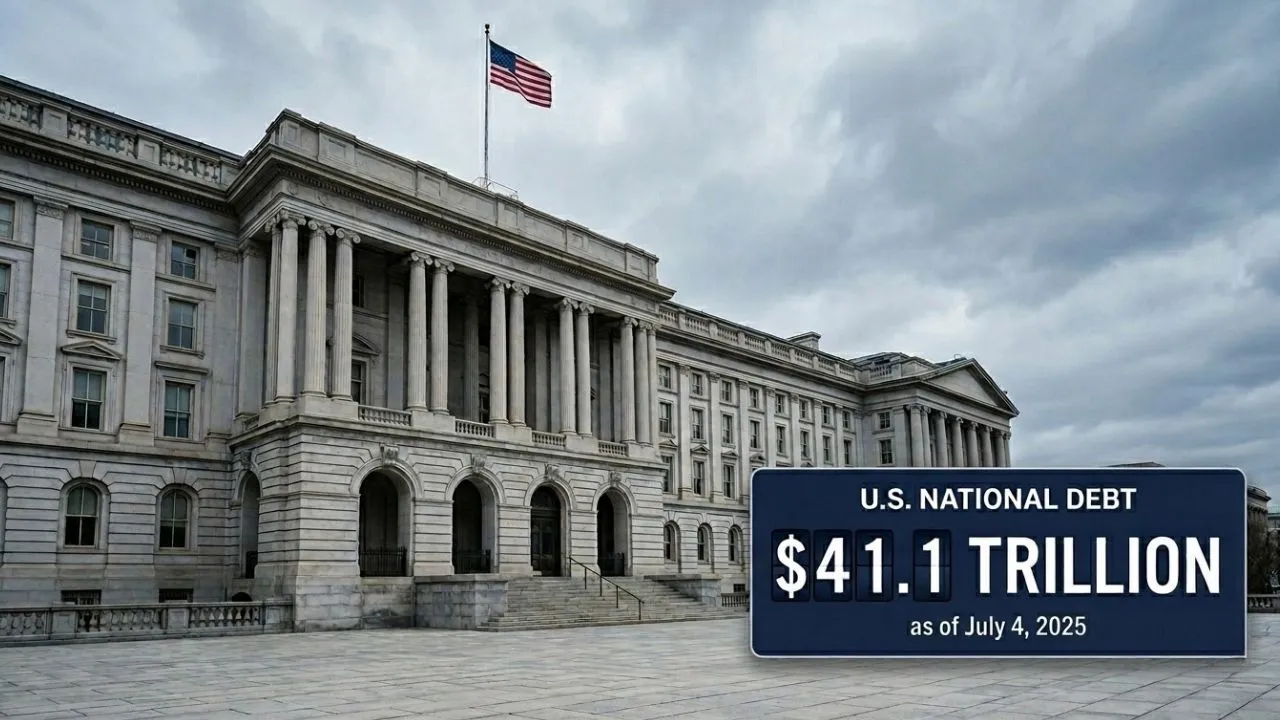


The U.S. dollar hovered near multi-month lows Monday, August 24, as investors weighed a fresh surge in concern over America’s $40 trillion debt burden, unusually high long-term Treasury yields and the government’s decision to expand bond buybacks.
According to Reuters’ August 24 currency-market report, the euro traded around $1.1665, close to last week’s three-month high, while sterling remained near a six-month peak. The dollar had also posted its largest weekly fall against bitcoin in roughly three-and-a-half years, underscoring how quickly confidence in the greenback has become tied to the bond-market debate.
The immediate catalyst is not simply the size of the national debt. It is the combination of record borrowing and a Treasury market demanding higher yields to absorb long-dated government securities. Thirty-year Treasury yields recently climbed to their highest levels in nearly two decades before easing Monday.
That has sharpened scrutiny of Washington’s financing strategy and revived questions about whether fiscal pressure is beginning to spill from the bond market into the currency market. Investozora has separately explained how the dollar index can respond to changing Federal Reserve rate expectations and why currency moves cannot be separated from the interest-rate outlook.
The debt milestone itself is now official. Treasury data cited by Reuters showed total public debt outstanding reached about $40.047 trillion on August 18, including roughly $32.266 trillion held by the public and $7.782 trillion in intragovernmental holdings.
Treasury’s Debt to the Penny dataset defines total public debt outstanding as the combination of those two components. For markets, however, the more consequential question is how much additional debt must be sold and at what interest cost rather than the $40 trillion headline alone.
That is where Treasury’s latest intervention becomes important. In its August 19 long-end buyback announcement, the department said it would at least double the maximum size of liquidity-support buybacks in the 10-to-20-year and 20-to-30-year sectors, from $2 billion to at least $4 billion per operation beginning September 9.
The program is designed to improve liquidity in older, less actively traded securities. Investozora previously examined why Treasury bond buybacks matter as debt approaches $40 trillion and how a Treasury-market shift can raise borrowing costs across America.
But the buybacks should not be confused with debt reduction. Treasury said in its August marketable borrowing estimates that buybacks are not expected to significantly affect privately held net marketable borrowing because new issuance replaces securities that are repurchased.
In other words, Treasury can improve market functioning by buying older bonds without meaningfully shrinking the government’s overall financing requirement. That distinction matters because investors are reacting to two different risks at once: market liquidity and the underlying fiscal trajectory.
The financing requirement remains substantial. Treasury estimated on August 3 that it would borrow $739 billion in privately held net marketable debt during the July-through-September quarter, $68 billion more than projected in May, assuming a $950 billion end-of-September cash balance.
It projected another $628 billion of borrowing for October through December. Those figures help explain why long-term yields remain sensitive even when Treasury acts to support trading conditions. Investozora’s guide to how the U.S. Treasury borrows money explains how bills, notes and bonds are used to finance federal operations.
There is also an important counterweight to the most bearish interpretation. The Treasury’s latest Treasury International Capital report showed a $133.5 billion net inflow into the United States in June, while foreign residents recorded $207.1 billion in net purchases of long-term U.S. securities.
Those figures do not prove foreign investors are unconcerned about U.S. debt, and the long-term-security measure covers assets beyond Treasuries. But they do show that the dollar’s current weakness should not automatically be interpreted as a wholesale international exit from U.S. assets.
By Monday morning in the United States, the dollar had recovered modestly, with the DXY index near 99.00, while the 10-year Treasury yield was around 4.71% and the 30-year yield near 5.25%.
The rebound did not erase the broader pressure: the greenback remained close to recent lows as investors debated whether Treasury actions can stabilize long-term yields without creating the impression that policymakers are attempting to suppress market rates.
The next tests arrive quickly. The Federal Reserve’s August calendar shows Chair Kevin Warsh is scheduled to deliver keynote remarks at the Jackson Hole Economic Policy Symposium on August 28.
Before that, the Bureau of Economic Analysis will release July Personal Income and Outlays data on August 26 at 8:30 a.m. EDT. The latest official data show the PCE price index was still 3.7% higher than a year earlier in June, keeping inflation and therefore the path of interest rates at the center of the bond and dollar outlook.
For dollar holders, borrowers and investors, the central question is therefore not whether the United States can service its debt today. It is whether markets continue demanding a larger premium to hold long-dated Treasuries as federal borrowing grows. If yields stay elevated while fiscal concerns deepen, the dollar could remain vulnerable even alongside relatively firm economic data.
If inflation cools, borrowing expectations improve or Treasury-market liquidity stabilizes, part of the recent pressure could reverse. For now, the $40 trillion debt milestone has transformed a slow-moving fiscal debate into an immediate variable for the dollar, Treasury yields and global markets.