Updated: June 23, 2026 – When the U.S. government needs to borrow money, it sells debt instruments to investors through the Treasury Department. Treasury bills, notes, and bonds all represent loans made to the federal government.
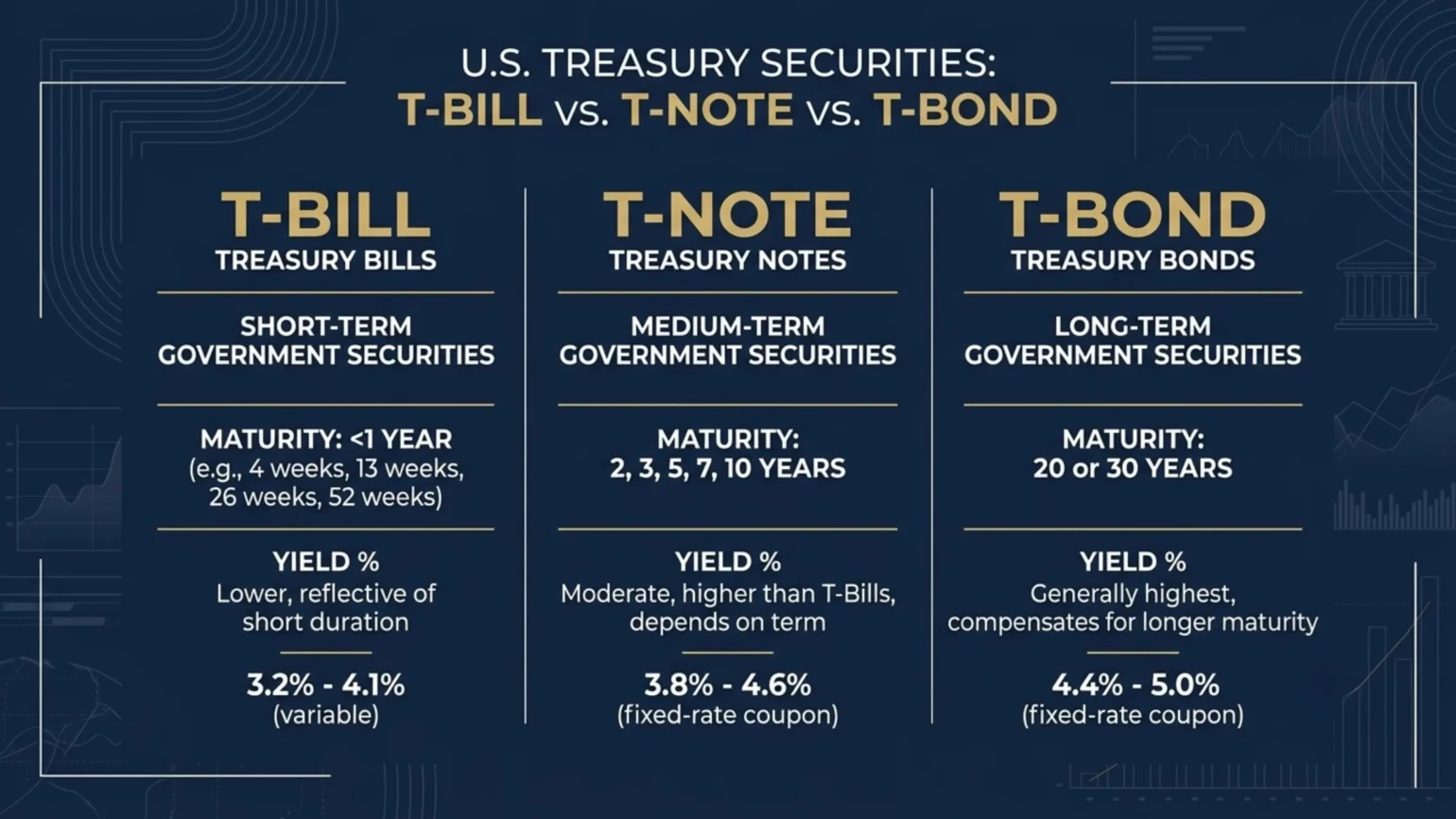
The key differences are how long the government holds your money and how you receive interest. Bills mature in days to one year. Notes mature in two to ten years. Bonds mature in twenty to thirty years.
Treasury securities are the closest thing to a risk-free investment in global finance. The federal government has never defaulted on its debt obligations. Understanding how each instrument works helps you decide which maturity profile matches your financial timeline.
The U.S. Treasury Department issues all three through its Bureau of the Fiscal Service, operating in partnership with the Federal Reserve as the government’s fiscal agent. You can purchase them directly through TreasuryDirect or through a brokerage. The secondary market for all three instruments is among the most liquid in the world.
What Treasury Bills Are
Treasury bills are short-term federal debt instruments that mature in four, eight, thirteen, twenty-six, or fifty-two weeks. The government sells them at a discount to face value and pays you the full face value at maturity. The difference between what you paid and what you receive is your return.
A $10,000 Treasury bill sold at $9,820 pays you $10,000 at maturity. Your $180 return is the equivalent of interest, though the IRS classifies it as interest income rather than a capital gain. Bills do not pay periodic coupon interest. Your entire return comes at maturity.
This structure makes T-bills particularly useful for cash management. Corporations, money market funds, and institutional investors use them to park short-term capital safely. Individual investors use them as a higher-yielding alternative to savings accounts when short-term rates are elevated. The yield curve dynamics for bills respond most directly to Federal Reserve interest rate policy, making them sensitive to FOMC decisions.
The auction cycle for T-bills runs weekly. The Treasury announces each auction in advance through its auction calendar. Competitive bidders specify the yield they will accept. Non-competitive bidders accept whatever yield the auction establishes. Most individual investors bid non-competitively and receive the full allocation they requested.
In 2026, with the Federal Reserve under Chair Kevin Warsh navigating an elevated rate environment, short-term T-bill yields have remained above what most online savings accounts offer. The Treasury auction process allocates securities to the highest-yield non-competitive bidders first, then works through competitive bids. Excess demand at auctions pushes yields lower, reflecting the premium investors place on safety.
What Treasury Notes Are
Treasury notes are medium-term federal debt instruments with maturities of two, three, five, seven, or ten years. Unlike bills, notes pay a fixed coupon interest rate every six months for the life of the instrument. At maturity, you receive your original principal back.
The coupon rate is set at auction and remains fixed for the note’s entire life. If you buy a five-year note with a 4.2% coupon, you receive coupon payments every six months regardless of what interest rates do after your purchase. This predictability makes notes the foundation of fixed-income portfolio construction for individual and institutional investors alike.
The 10-year Treasury yield is the most widely watched benchmark in global finance. Mortgage rates, corporate borrowing costs, auto loan rates, and international capital flows all reference the ten-year note yield. When the Fed raises rates, short-term yields rise first and most sharply. The ten-year yield responds to longer-term growth and inflation expectations rather than to overnight rate policy alone.
Treasury notes trade actively in the secondary market. If you buy a five-year note and need your money in two years, you can sell it. The price you receive depends on how current market yields compare to your note’s coupon rate. If rates rose after your purchase, your note is worth less than face value because newer notes offer higher coupons. If rates fell, your note is worth more.
The bond market yield shifts of 2026 have reflected the unusual combination of a new Federal Reserve chair, a large fiscal package under OBBBA, and persistent inflation above the Fed’s 2% target. Notes in the two-to-five-year range have seen significant price volatility as markets attempt to price in the path of the federal funds rate over the next several years. Understanding how the U.S. money movement system connects Treasury operations to broader liquidity provides essential context for interpreting these movements.
What Treasury Bonds Are
Treasury bonds are long-term federal debt instruments with maturities of twenty or thirty years. Like notes, they pay a fixed semi-annual coupon. At maturity, the full principal is returned. The thirty-year bond is the longest maturity instrument the Treasury regularly issues.
Long-term bonds carry the most interest rate risk of the three instrument types. A small change in long-term yields produces a large change in bond price because the fixed coupon payments stretch across decades. A one-percentage-point rise in the thirty-year yield can reduce a bond’s market price by fifteen to twenty percent. This price sensitivity, measured as duration, is why institutional investors use long-term bonds for specific liability-matching purposes rather than as general savings vehicles.
Pension funds and insurance companies are the largest holders of long-term Treasury bonds. They hold liabilities that will be paid decades into the future and need assets with matching duration. Individual investors who purchase long-term bonds typically do so inside tax-advantaged retirement accounts where the time horizon justifies the duration exposure.
The yield curve liquidity dynamics that have played out in 2026 demonstrate why long-term bonds can behave differently from short-term bills even when the Fed is actively managing overnight rates. The curve shape reflects market consensus about where growth, inflation, and fiscal policy will stand over a twenty-to-thirty-year horizon, a judgment the Fed influences but does not control.
Thirty-year bond auctions generate significant market attention because demand signals from primary dealers and foreign central banks reveal institutional appetite for long-duration U.S. government exposure. Weak demand at a thirty-year auction can push long-term yields higher and send ripple effects through mortgage markets within hours. The Treasury General Account level influences auction timing and Treasury cash management decisions.
How Yields Actually Work
Yield and price move in opposite directions for all three instruments. This is the central mechanical fact that confuses most new buyers of government debt. When more investors want a specific Treasury security, they bid up its price, which pushes its yield down. When investors sell, prices fall and yields rise.
For bills, which are zero-coupon instruments, yield is calculated as the annualized return from the purchase discount. A thirteen-week bill purchased at $99.25 for a $100 face value has a discount rate calculated on the $0.75 gain over ninety-one days. The Treasury bills maturity yield guide explains the precise discount rate versus equivalent yield calculation that the Treasury publishes for each auction result.
For notes and bonds, yield to maturity is a more complex calculation incorporating the coupon payments, the time remaining to maturity, and the difference between the current market price and the face value that will be paid at maturity. A note trading above face value has a yield to maturity below its coupon rate. A note trading below face value has a yield to maturity above its coupon rate.
The I-bond rate for 2026 reflects a separate but related federal savings instrument where the yield is explicitly linked to the CPI-U inflation index rather than set by market auction. I-bonds serve a different purpose than marketable Treasuries and are not traded in the secondary market. Comparing I-bond yields to marketable Treasury yields helps investors understand the market’s current inflation expectations embedded in nominal yields.
Comparing the Three Instruments
The three instruments serve different investor needs, tax situations, and risk tolerances. Treasury interest income is subject to federal income tax but exempt from state and local income tax, an advantage that is worth more to investors in high-tax states.
Bills work best for capital you need within one year. They are simple to understand, carry no coupon reinvestment risk, and provide yields tied closely to current short-term interest rates. The risk is that when rates fall, you must reinvest at lower yields at maturity.
Notes work best for capital you can commit for two to ten years. The semi-annual coupon provides regular income and locks in the current yield for the note’s full term. The ten-year note is particularly useful as a benchmark for understanding where mortgage rates and corporate bond yields will settle. Treasury extraordinary measures and debt ceiling dynamics can temporarily distort note yields near maturity dates when cash management pressures peak.
Bonds work best for very long-horizon investors or liability-matching institutional portfolios. Individual investors should understand the duration risk before buying long-term bonds outside of a diversified fund structure. The debt ceiling strategy and Treasury issuance decisions directly affect supply and demand in the long-term bond market.
The daily Treasury statement provides real-time visibility into Treasury cash flows, issuance, and redemptions, offering institutional investors the data they need to anticipate supply changes across the maturity spectrum.
Frequently Asked Questions
Which Treasury security pays the highest yield right now?
In a normal, upward-sloping yield curve environment, longer-maturity instruments pay higher yields to compensate investors for committing capital for more time and accepting more price volatility. In an inverted yield curve environment, which the United States has experienced periodically since 2022, short-term bills can pay more than long-term bonds. The current shape of the yield curve determines which maturity offers the highest nominal yield at any given moment. Check TreasuryDirect or your brokerage for current auction results.
Can I lose money on a Treasury security?
If you hold to maturity, no. The federal government pays the full face value at maturity for all three instruments. If you sell before maturity, you may receive less than face value if market yields rose after your purchase. There is no credit default risk. The only risk to individual investors holding to maturity is purchasing power risk, meaning inflation can erode the real value of your fixed payments.
How do I buy Treasury securities without a broker?
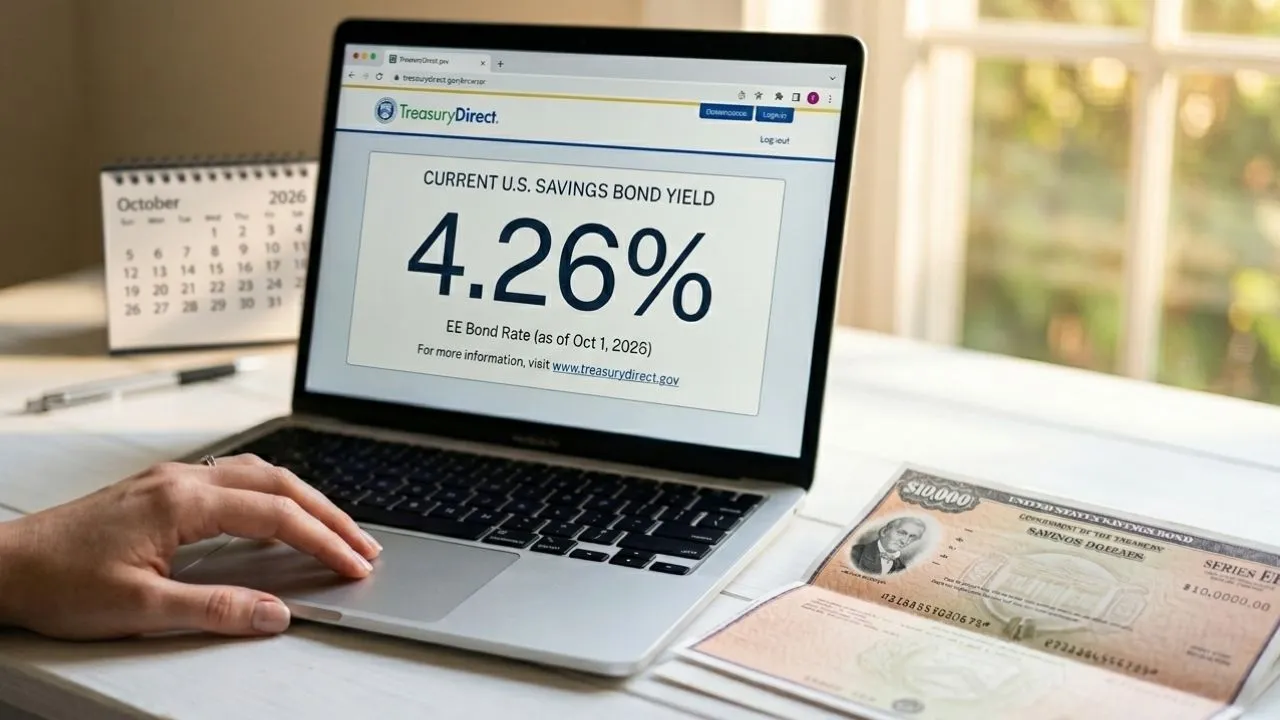
TreasuryDirect.gov is the U.S. Treasury’s direct purchase platform. You can buy bills, notes, bonds, I-bonds, and TIPS directly without commission. The minimum purchase is $100. You link a bank account and receive payments directly to that account. Auctions for bills run weekly. Note and bond auctions run monthly. The federal budget mechanics explain the broader context of how Treasury issuance decisions are made.
Are Treasury securities appropriate for emergency funds?
Four-week and thirteen-week bills offer a reasonable alternative to savings accounts for emergency fund management, provided you maintain a cash reserve separately for immediate needs. The liquidation timeline for bills, even with same-day secondary market sales, involves settlement periods of one business day. Emergency access requires planning rather than the instantaneous access of a checking account.
What You Should Do Now
- Visit TreasuryDirect and create an account using your Social Security number and bank routing information.
- Check the current auction schedule for the Treasury maturity that best matches your investment timeline.
- Determine whether you prefer Treasury bill simplicity, Treasury note income predictability, or Treasury bond duration exposure.
- Compare the current Treasury yield for your selected maturity against your bank’s savings account rate, while factoring in the state income tax exemption available on Treasury interest.
- Place a non-competitive bid at the next scheduled auction for your chosen Treasury security and receive the market-determined yield automatically.
Treasury securities represent the foundational instrument of the American financial system. Whether you choose a bill maturing in four weeks or a bond maturing in thirty years, you are lending to the same borrower and receiving the same federal guarantee.