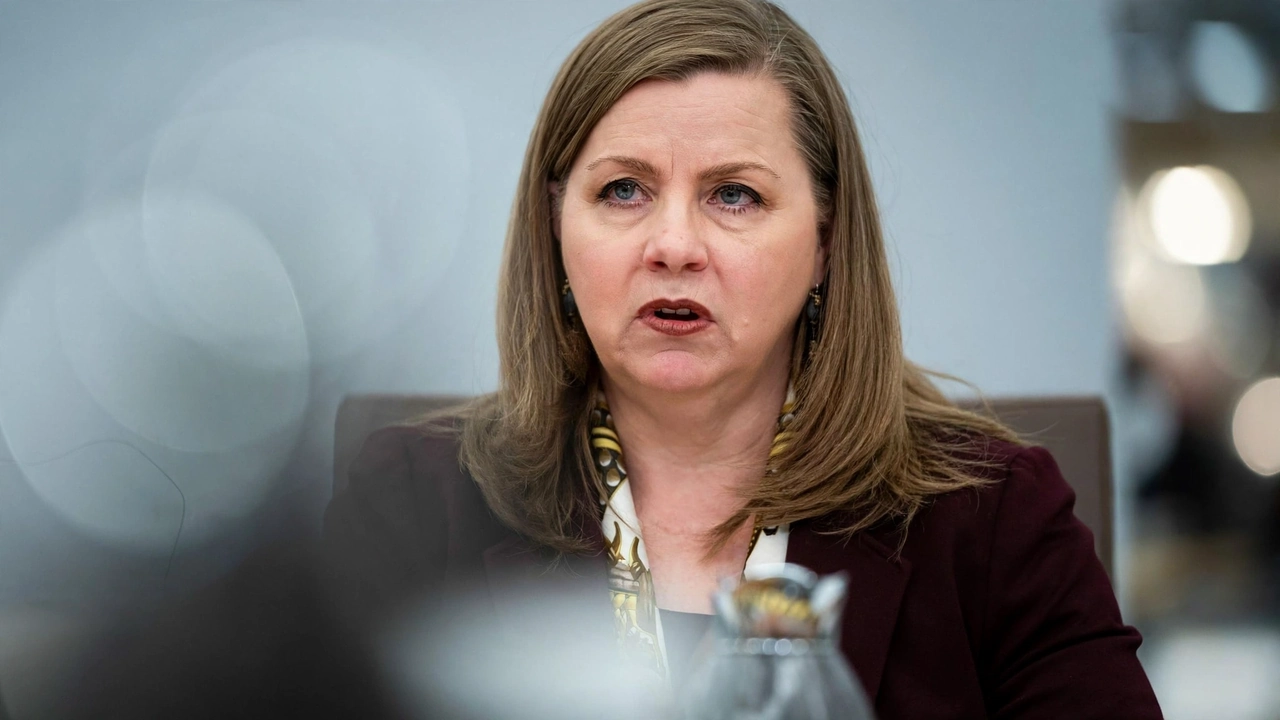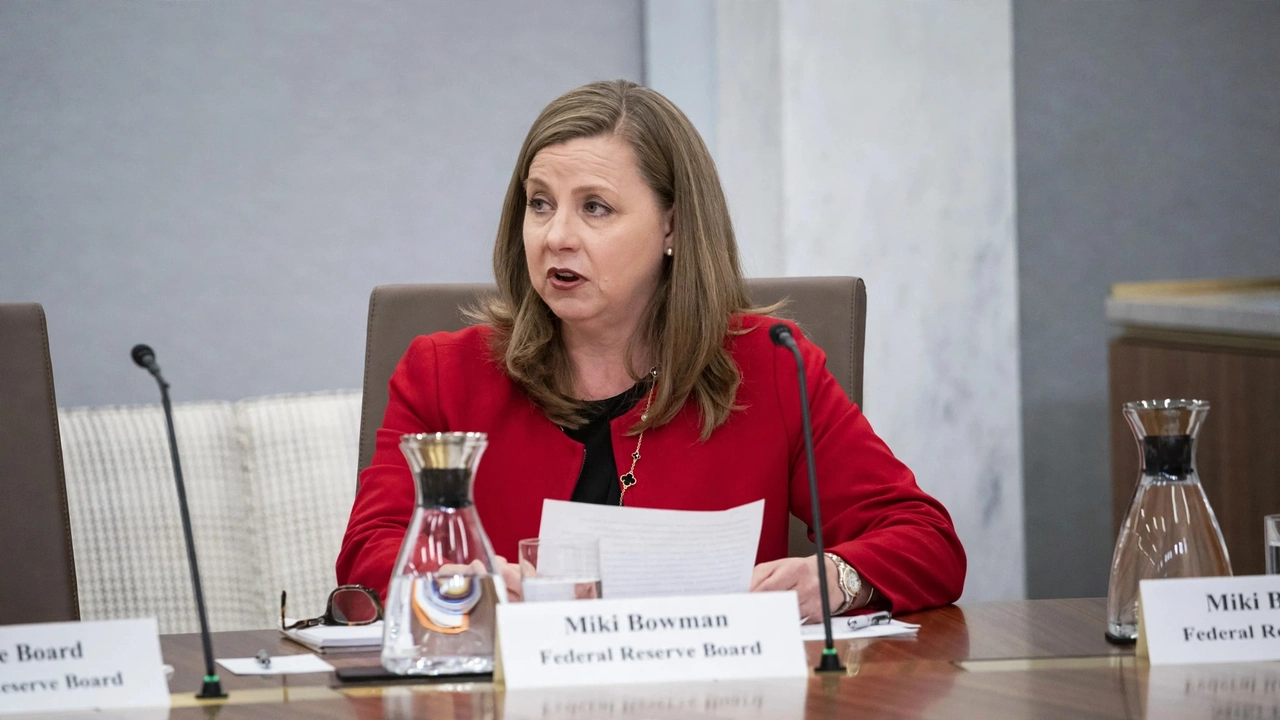

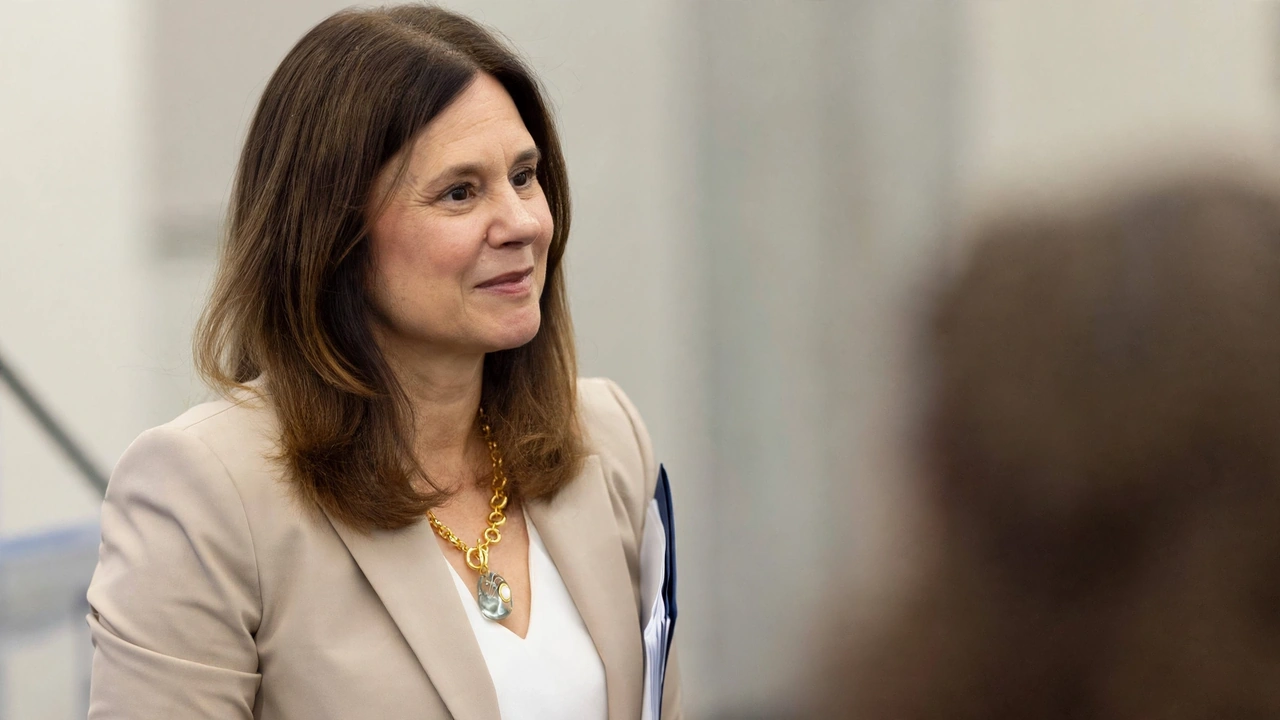
Dallas Federal Reserve President Lorie Logan said the Federal Reserve needs at least two additional quarter-point interest rate increases to control inflation, reaffirming her preference for tighter monetary policy just two days after voting to keep borrowing costs unchanged.
Speaking at Davidson College in North Carolina on Friday, October 30, Logan argued that the Fed’s decision to pause in October should not be confused with abandoning further tightening. Her official remarks outline a path toward higher interest rates followed by a reassessment of economic conditions.
“It remains clear to me, given the current outlook, that the FOMC needs to implement at least two more 25-basis-point rate increases,” Logan said. Her comments followed the Federal Open Market Committee’s October 28 decision to maintain the benchmark federal funds rate at 3.75%–4.00%.
That decision passed by a 10–2 vote, with Governors Lisa Cook and Beth Hammack favoring an immediate quarter-point increase. Logan supported holding rates steady. Yet her speech made clear that she still considers the existing policy setting insufficiently restrictive to return inflation sustainably to the Fed’s 2% target.
I consider that distinction central to understanding her remarks: she is advocating additional tightening, not announcing a decision by the Federal Reserve or committing the committee to a particular schedule.
Logan’s position also was not entirely new. In her October 1 remarks, she estimated that rates needed to increase another 50 basis points or more. Friday’s speech reaffirmed that assessment after the October meeting and explained why she believes gradual increases can be preferable to raising rates at every meeting.
The distinction is significant because the Fed had already raised rates in September. Logan’s latest argument suggests that policymakers could continue toward higher rates while allowing more time between adjustments.
In her assessment, the current federal funds target range remains at least half a percentage point below the level that would make monetary policy modestly restrictive. Two additional 25-basis-point increases would bring the range to 4.25%–4.50%, assuming no intervening rate changes.
That calculation represents the minimum additional tightening Logan currently favors, not an official FOMC forecast or commitment. The inflation figures help explain her position. According to the Bureau of Economic Analysis’ September PCE report, core personal consumption expenditures inflation reached 3.1% over the preceding 12 months. Overall PCE inflation stood at 3.6%.
Both measures remained above the Fed’s 2% objective. The September report was published on October 29, one day after the committee’s decision, although Logan said policymakers had reasonably accurate estimates available during the meeting.
I see the underlying inflation trend as the critical economic question. Logan’s concern is not confined to temporary increases in energy prices or tariff-sensitive goods. Her speech describes broader price pressures across goods and services, suggesting that waiting indefinitely could prolong inflation above target.
The Dallas Fed president also characterized the labor market as broadly balanced, with unemployment slightly above 4%. She acknowledged that employers have become cautious about hiring, creating particular difficulties for graduates and other job seekers, but argued that monetary policy cannot resolve every structural problem affecting employment.
That assessment helps explain why she places greater emphasis on inflation risks than on the need for immediate interest rate relief. Investozora’s earlier analysis of inflation pressures and the Fed’s policy outlook provides additional context for why persistent price growth remains central to the debate over future increases. One of Logan’s more consequential arguments concerned the timing of rate adjustments.
She said volatile financial markets, changing technology investment expectations and geopolitical uncertainty support a more gradual approach. Slower adjustments could give businesses and households time to adapt while reducing the risk of an unnecessarily sharp economic slowdown.
However, she maintained that delaying an increase does not necessarily change the interest rate level the economy ultimately requires. This separates the pace of monetary tightening from its intended destination.
It also gives investors a reason to examine the committee’s longer-term intentions rather than interpreting an unchanged rate at one meeting as a definitive end to tightening. For borrowers, the distinction matters because mortgage rates, business financing costs and many other lending rates depend on longer-term market interest rates, not simply the current federal funds target.
Logan argued that longer-term Treasury yields have increased substantially during 2026 partly because investors anticipate stronger economic growth and higher neutral interest rates. She did not characterize the entire increase as an independent drag on economic activity.
That interpretation is relevant to the relationship between Treasury yields and mortgage costs. Additional central bank tightening could influence borrowing conditions, but mortgage rates do not move mechanically by the same amount as the federal funds rate.
The implications also extend to credit card rates and savings yields, although actual changes depend on lender and deposit institution pricing decisions. Crucially, Logan left room for her outlook to change if economic conditions or risks shift. She suggested that policymakers could reassess conditions after implementing the additional increases she currently considers necessary.
The next scheduled FOMC meeting is December 8–9, according to the Fed’s official calendar. Logan’s remarks do not establish that either proposed increase will occur at that meeting. The October decision also demonstrated that policymakers differ over timing. Cook and Hammack preferred an immediate increase, while Logan supported waiting despite favoring a higher eventual rate.
My reading is that Logan’s speech reinforces the case for further tightening without establishing a new committee consensus. The unresolved question is whether forthcoming inflation, employment and financial conditions will persuade enough FOMC participants to support additional increases.
For investors and households, the most consequential development will be an actual committee decision—not any individual official’s preferred interest rate path.