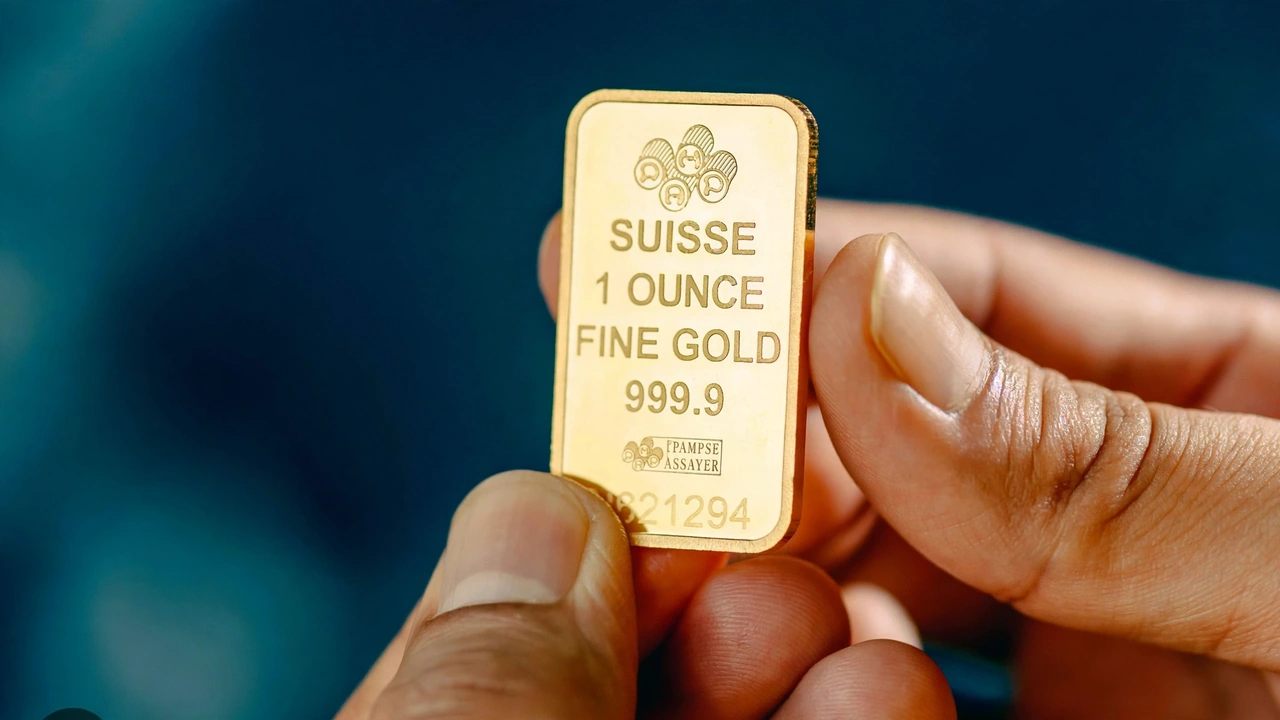

Gold prices recovered on Friday, November 27, after falling to their lowest level in 15 months earlier in the week, offering some relief to investors following a difficult November. But the recovery faces a significant risk that has not disappeared: the prospect of higher U.S. interest rates. Government data show that inflation-adjusted Treasury yields actually increased during the latter part of gold’s recovery, suggesting that the financial conditions pressuring the precious metal remain in place.
Spot gold climbed 2.1% to $3,639.61 per troy ounce by 2:01 p.m. Eastern Time on Friday, according to Reuters market reporting, after gaining more than 3% earlier in the session. The recovery followed Wednesday’s sharp decline, which pushed bullion to its lowest level since September 2025. However, the latest advance comes after several temporary recoveries that failed to establish a sustained upward trend.
The most important development for gold investors may be taking place outside the precious metals market. According to the U.S. Treasury’s real yield data, the inflation-adjusted 10-year Treasury yield increased from 2.73% on November 25 to 2.79% on November 27. That represents an increase of six basis points, based on an Investozora calculation using the two official observations.
The increase was not limited to the 10-year maturity. Over the same period, five-year real yields increased from 2.52% to 2.58%, while 30-year real yields climbed from 3.13% to 3.19%. The rise across these maturities shows that the upward movement in inflation-adjusted borrowing costs extended beyond a single part of the Treasury market, even as gold prices recovered.
Understanding the difference between real and nominal yields helps explain why this matters. Gold does not pay interest, whereas Treasury Inflation-Protected Securities, commonly known as TIPS, provide interest payments and adjust their principal according to inflation. As explained by TreasuryDirect, this structure allows investors to obtain a degree of protection against changes in consumer prices while earning interest.
Consider an investor comparing $10,000 worth of physical gold with a hypothetical inflation-protected investment offering an annual real return of 2.79%. The latter represents approximately $279 in annual purchasing-power-adjusted return on a simplified basis, while physical gold generates no annual income. Gold would need to appreciate sufficiently to compensate for that difference and any additional ownership costs, although actual bond returns depend on purchase prices, inflation adjustments, taxes and holding periods.
This does not mean that Treasury securities will necessarily outperform gold, or that bullion must decline whenever yields rise. During periods of financial uncertainty, investors may value gold’s diversification properties more than the income available from bonds. Friday’s simultaneous increase in gold prices and real yields illustrates why the relationship should not be treated as a fixed rule.
The broader inflation picture, however, remains challenging. The Bureau of Economic Analysis reported on November 25 that the PCE price index increased 3.8% in October compared with a year earlier, while inflation excluding food and energy reached 3.3%. Both measures increased 0.3% from September, and overall inflation remains considerably above the Federal Reserve’s target of 2%.
Gold’s traditional reputation as an inflation hedge makes this situation particularly interesting. Persistent inflation can encourage investors to seek assets that may preserve purchasing power, but it can also prompt central banks to maintain higher interest rates. When the second effect dominates, gold can struggle even during a period of elevated inflation.
The Federal Reserve’s October meeting minutes provide further context for that risk. Policymakers maintained the federal funds target range at 3.75% to 4%, but two voting members preferred an additional quarter-percentage-point increase. The disagreement demonstrates that further monetary tightening remains a possibility, although no December rate increase has been confirmed.
There is also the question of U.S. dollar strength, which can influence international demand for gold. Because bullion is internationally quoted in dollars, a stronger American currency can make it more expensive for buyers using other currencies, assuming other factors remain unchanged. Consequently, a recovery in dollar-denominated gold prices may produce different results for investors in different countries.
The recent market history provides another reason for caution. Gold experienced a substantial weekly decline during the week ending November 20, despite a decline in benchmark nominal Treasury yields over the same period. That earlier divergence, together with Friday’s recovery alongside rising real yields, indicates that interest rates alone cannot explain every movement in the precious metals market.
For households holding gold as part of their long-term savings, the distinction between a price recovery and a change in underlying financial conditions is important. Physical gold buyers must also consider dealer premiums, storage expenses and the difference between purchase and resale prices. Meanwhile, the effects of higher interest rates on savings products provide another useful comparison when evaluating the role of gold within a diversified portfolio.
The next major event is the Federal Reserve’s December 8–9 policy meeting, according to its official meeting calendar. Investors following financial markets will need to pay attention not only to the rate decision but also to policymakers’ updated economic projections and the subsequent movement in inflation-adjusted Treasury yields.
A sustained decline in real yields would weaken one of the principal arguments against gold’s recovery, particularly if bullion continues to rise without immediately surrendering its gains. Conversely, further increases in real yields could make the recovery more difficult to sustain. Gold has recovered from its recent low, but the competition it faces from interest-bearing assets has not gone away.