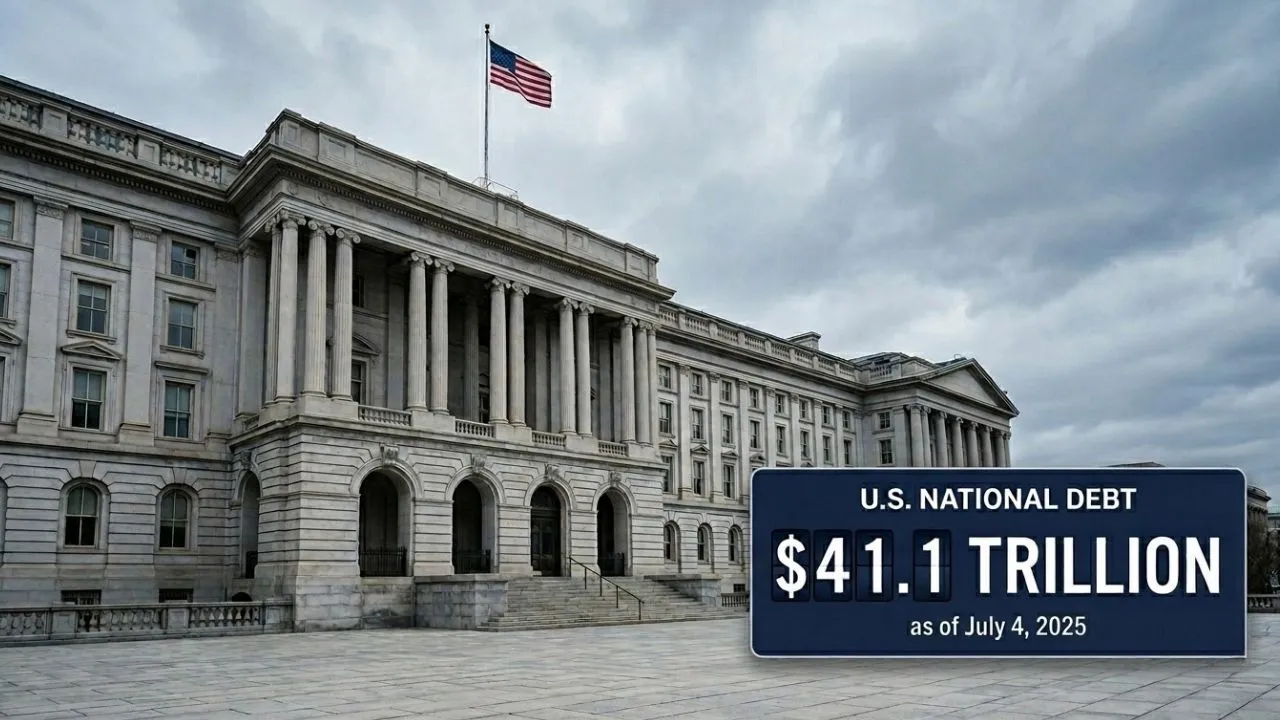
This guide reflects the debt limit status confirmed as of July 2026, following the One Big Beautiful Bill Act’s July 2025 increase of the statutory debt limit to $41.1 trillion.
Analysts currently expect the next X-date pressure point in mid-to-late 2027, though this depends on future deficits and will be updated as new Treasury and Congressional Budget Office estimates are released.
The Treasury X-date is the specific point at which the U.S. Department of the Treasury can no longer meet all of the federal government’s payment obligations in full and on time, because the statutory debt limit has been reached and the Treasury has exhausted its cash and its accounting tools for delaying default.
It is not a fixed calendar date. It shifts based on tax revenue, federal spending, and how much room the Treasury still has under the legal borrowing limit set by Congress.
What the debt limit actually is
The debt limit, also called the debt ceiling, is a cap set by Congress on the total amount of federal debt the government is legally allowed to carry. It applies to nearly all federal borrowing, including debt held by the public through Treasury bills, notes, and bonds, and debt the government owes to its own trust funds, such as Social Security and Medicare.
This second category exists because trust fund surpluses are invested in special Treasury securities, which count toward the same statutory limit even though the money is owed internally rather than to outside investors.
The limit does not control how much Congress spends. Spending and revenue decisions are made separately, through the annual budget and appropriations process. The debt limit only controls whether the Treasury is legally allowed to borrow the money needed to cover spending that Congress has already approved.
This distinction matters because reaching the X-date does not represent a new spending decision, it represents a legal borrowing restriction colliding with spending commitments already in effect.
How the current debt limit was set
In July 2025, President Trump signed the One Big Beautiful Bill Act, which raised the debt limit by $5 trillion, from $36.1 trillion to $41.1 trillion. This approach, a fixed dollar increase rather than a suspension, differs from several previous debt limit resolutions, including the Fiscal Responsibility Act of 2023, which suspended the limit entirely for a set period rather than raising it by a specific number.
A suspension and a fixed increase behave differently in practice. Under a suspension, the Treasury can borrow freely until the suspension period ends, at which point the limit resets to whatever the total debt happens to be on that date.
Under a fixed increase, the Treasury can borrow up to the new number and no further, meaning the X-date becomes a function of how quickly the government’s total debt approaches that ceiling.
As of May 2026, total federal debt held by the public was estimated near $31 trillion, with intragovernmental debt owed to trust funds bringing total debt subject to the limit closer to $39 trillion, leaving headroom under the $41.1 trillion ceiling.
Based on current deficit trajectories, budget analysts expect that headroom to be exhausted sometime in mid-to-late 2027, though this estimate depends heavily on economic growth, tax receipts, and any new legislation Congress passes in the meantime.
Extraordinary measures, explained
When the Treasury approaches the debt limit but Congress has not yet acted, it does not simply stop functioning. It relies on a set of accounting tools known as extraordinary measures. These are legally authorized maneuvers, not accounting tricks in a loose sense, that allow the Treasury to temporarily create room under the limit without exceeding it.
Common extraordinary measures include suspending reinvestment of the Civil Service Retirement and Disability Fund and the Postal Service Retiree Health Benefits Fund, and pausing daily reinvestment of the Government Securities Investment Fund, a retirement savings vehicle for federal employees.
These funds are made whole later, with interest, once the debt limit issue is resolved. Extraordinary measures do not create new spending capacity. They only shift the timing of certain internal government transactions so that headroom exists under the statutory cap.
These measures buy time, typically a few months, but they are finite. Once they are exhausted and the Treasury’s cash balance, tracked daily through the Daily Treasury Statement, runs too low to cover obligations, the X-date arrives.
Where the X-date fits in the broader money movement system
The debt limit is one piece of a much larger federal financial infrastructure that most people only think about when something breaks. Understanding the X-date makes more sense in context of the full money movement system that carries tax refunds, Social Security payments, federal salaries, and Treasury interest payments through the same underlying rails. The debt limit does not create this system, but it can constrain how the Treasury manages the cash flowing through it.
The Federal Reserve, whose seven-member board is discussed in our companion piece on Federal Reserve governors, does not set or vote on the debt limit, since that authority belongs to Congress alone.
But the Fed does manage the payment settlement systems the Treasury relies on to move money once Congress authorizes it, and Fed officials have periodically testified about the operational risks a genuine X-date breach would create for financial markets.
Similarly, Social Security’s own financing picture, including the payroll tax cap that funds the program, is a separate fiscal issue from the debt limit, but the two are often discussed together because Social Security payments are among the obligations that draw from the same Treasury cash pool the debt limit constrains.
A debt limit crisis and a Social Security trust fund shortfall are different problems with different timelines, but both ultimately affect whether beneficiaries receive full, on-time payments.
What actually happens at the X-date
If the X-date is reached without Congressional action, the Treasury would no longer be able to pay every obligation in full and on time. This does not mean every payment stops simultaneously.
The Treasury and Federal Reserve process payments through the federal government’s settlement systems, and if incoming cash is insufficient to cover everything due on a given day, the Treasury would have to make choices about which obligations to prioritize, delay, or pay partially.
Historically, this scenario has never actually occurred, because Congress has always raised or suspended the debt limit before the X-date arrived, sometimes with very little time to spare.
But the mechanics matter for understanding the risk: Social Security payments, federal employee salaries, Medicare payments, interest on Treasury securities, and other obligations all draw from the same general operating cash managed through the Treasury General Account.
A cash shortfall at the X-date would force prioritization among these categories, a scenario Treasury officials have historically described as operationally complex and something the Treasury’s payment systems were not originally designed to handle cleanly.
Why the X-date estimate keeps shifting
The X-date is not a single fixed calculation because it depends on real-time federal cash flow, which changes with the economy. Higher than expected tax receipts, such as a strong April filing season, can push the X-date later by giving the Treasury more cash on hand.
Unexpected spending increases, weaker tax revenue, or a slower economy can pull the X-date earlier. This is why organizations like the Congressional Budget Office and the Bipartisan Policy Center regularly update their X-date estimates throughout the year rather than publishing one static forecast.
The current mid-to-late 2027 estimate for the next debt limit pressure point reflects the $5 trillion cushion created by the OBBBA increase, combined with projected annual deficits. If deficits run higher than projected, that timeline could move earlier. If revenue outperforms expectations, it could extend further.
How the X-date connects to federal payment timing
For everyday readers, the debt limit debate can feel abstract until it intersects with the timing of payments they actually receive. Social Security benefits, federal salaries, tax refunds, and veterans’ benefits all move through the same federal payment infrastructure, including the Fedwire and ACH systems that settle payments between the Treasury and the banking system.
In a genuine X-date scenario, delays or prioritization decisions would ripple through this shared plumbing, which is part of why the debt limit is treated as a systemic risk rather than purely a fiscal policy dispute.
This is also why the debt limit is frequently discussed alongside the Treasury General Account balance, since a low TGA balance combined with an exhausted debt limit is the specific combination that produces genuine payment risk, rather than the debt limit alone.
The history of debt limit resolutions
Congress has raised, suspended, or otherwise revised the debt limit more than 100 times since it was first established in 1917, when Congress gave the Treasury authority to issue war bonds up to a specified total rather than approving each individual bond issuance. Over the following century, the mechanism evolved from a wartime financing tool into the general-purpose statutory cap used today.
In recent history, Congress has increasingly used temporary suspensions rather than fixed dollar increases, including suspensions tied to the Bipartisan Budget Act of 2019 and the Fiscal Responsibility Act of 2023.
The 2025 OBBBA increase marked a return to the fixed-dollar-amount approach, which creates a more predictable near-term ceiling but requires Congress to revisit the issue again once that fixed amount of headroom is used up.
Comparing recent debt limit resolutions
The table below highlights how Congress has addressed the federal debt limit through recent major legislative actions. While some laws temporarily suspended the borrowing cap, others increased it by a specific dollar amount, resulting in different fiscal and political outcomes.
Understanding these approaches helps explain why the current $41.1 trillion debt ceiling functions differently from the suspensions used in 2019 and 2023. It also provides context for why policymakers and market analysts continue to monitor when the new borrowing limit could once again become binding.
| Resolution | Year | Mechanism | Amount / duration |
|---|---|---|---|
| Budget Control Act | 2011 | Fixed increase in stages | $2.1 trillion combined increase |
| Bipartisan Budget Act | 2019 | Suspension | Suspended for 2 years |
| Fiscal Responsibility Act | 2023 | Suspension | Suspended through January 1, 2025 |
| One Big Beautiful Bill Act | 2025 | Fixed increase | $5 trillion increase, to $41.1 trillion |
This comparison shows why the current debt limit situation behaves differently than the two resolutions immediately before it. A suspension effectively removes the ceiling as a live constraint until its end date, while a fixed increase, like the current $41.1 trillion ceiling, becomes a live constraint again as soon as total federal debt approaches that number.
This is part of why analysts are already projecting a mid-to-late 2027 pressure point rather than treating the debt limit as a settled issue for years to come.
Why the debt limit remains politically contentious
The debt limit vote has become a recurring point of political leverage precisely because it requires an affirmative Congressional action to avoid a default, rather than requiring action to prevent new borrowing.
This asymmetry means that whichever party does not control the votes needed to pass an increase can use the approaching X-date as negotiating leverage for unrelated spending or policy priorities.
Economists across the political spectrum have noted that this dynamic creates avoidable uncertainty in Treasury bill markets and can raise short-term borrowing costs even when Congress ultimately acts before default, since investors price in some probability of disruption as the X-date approaches.
What investors and consumers actually watch
Financial markets do not wait for the actual X-date to react. Yields on Treasury bills maturing near a projected X-date have historically moved higher in the weeks before a resolution, reflecting investor demand for compensation against even a small risk of delayed payment.
Consumers are typically insulated from this volatility unless a resolution genuinely fails to materialize, since bank deposits, mortgage rates, and most day-to-day financial products are affected only indirectly, through broader interest rate and market conditions tied to Treasury yields rather than through any direct payment disruption.
Money market funds, which hold large quantities of short-term Treasury bills, are another area analysts watch closely as a projected X-date approaches.
Fund managers typically avoid holding bills that mature during the highest-risk window around an unresolved X-date, which can temporarily distort short-term Treasury bill demand and pricing even without an actual default occurring. This is a normal, well-documented market behavior during past debt limit standoffs, and it tends to normalize quickly once Congress passes a resolution.
What to watch for going forward
Because the current debt limit was set by a fixed dollar increase rather than an open-ended suspension, the most useful indicators to track over the next year are the pace of federal deficits reported in the Daily Treasury Statement, the results of scheduled Treasury auctions, and periodic updates from the Congressional Budget Office on projected headroom remaining under the $41.1 trillion ceiling.
A material acceleration in deficit spending, an economic downturn that reduces tax receipts, or new legislation authorizing additional spending without offsetting revenue could all move the X-date earlier than the current mid-to-late 2027 estimate.
Has the U.S. Ever Defaulted?
No. The United States has never defaulted on its federal debt because Congress has always acted to raise, suspend, or revise the debt limit before the Treasury exhausted its borrowing authority.
However, lawmakers have occasionally waited until the final days before the projected X-date, creating uncertainty in financial markets and prompting warnings from the Treasury Department.
These last-minute agreements have become more common in recent decades but have always prevented an actual default. As a result, the U.S. has maintained its record of meeting all of its debt obligations on time.
Does Raising the Limit Add Spending?
No. Raising the debt limit does not authorize new government spending or create new federal programs. Instead, it allows the Treasury to borrow the funds needed to pay obligations that Congress has already approved through previous budget, tax, and appropriations laws.
These obligations include Social Security benefits, Medicare payments, military salaries, interest on Treasury securities, and payments to federal contractors. In other words, the debt limit concerns financing existing commitments rather than approving future spending.
Suspension vs. Debt Increase
A debt limit suspension temporarily removes the borrowing cap, allowing the Treasury to issue debt without a specific numerical limit until the suspension expires. When the suspension ends, the debt limit automatically resets to reflect the total amount of outstanding federal debt at that time.
A fixed debt limit increase, by contrast, raises the ceiling to a specific dollar amount that cannot be exceeded without additional congressional action. The One Big Beautiful Bill Act of 2025 followed this second approach by increasing the statutory debt limit by $5 trillion to $41.1 trillion.
Would Social Security Stop?
Not necessarily, but payments could face delays if the Treasury reached the X-date without additional borrowing authority. Social Security benefits are paid from Treasury accounts that rely on the government’s overall cash management system, even though the program has dedicated trust funds.
If the Treasury could no longer borrow and available cash became insufficient, officials might have to delay or prioritize certain federal payments. However, this scenario has never occurred because Congress has always acted before the Treasury exhausted its borrowing capacity.
Debt Limit vs. Shutdown
A debt limit dispute and a government shutdown are two separate fiscal issues, although they are often confused. A government shutdown happens when Congress fails to pass appropriations or temporary funding legislation, causing many federal agencies to suspend nonessential operations.
The debt limit, on the other hand, restricts the Treasury’s ability to borrow money needed to pay obligations that already exist. It is possible for the government to experience a shutdown without reaching the debt limit, or to face debt limit pressures while the government remains fully funded, making the two issues legally and operationally distinct.
The bottom line
The Treasury X-date is the point at which legally authorized federal borrowing runs out relative to spending already approved by Congress. The current debt limit, set at $41.1 trillion by the 2025 One Big Beautiful Bill Act, gives the Treasury meaningful headroom, with the next X-date pressure point currently projected for mid-to-late 2027 based on existing deficit trends.
Extraordinary measures can buy several additional months once the limit is approached, but they are finite tools, not a permanent solution. Readers who want to track this issue going forward should watch the Daily Treasury Statement, upcoming Treasury auction results, and periodic Congressional Budget Office estimates rather than a single fixed deadline, since the actual date moves with real federal cash flow.
Methodology: Debt and headroom figures reflect Treasury and Congressional Budget Office data as published through mid-2026. Because federal deficits and receipts change monthly, the projected 2027 X-date window will be reviewed and updated as new government data is released.