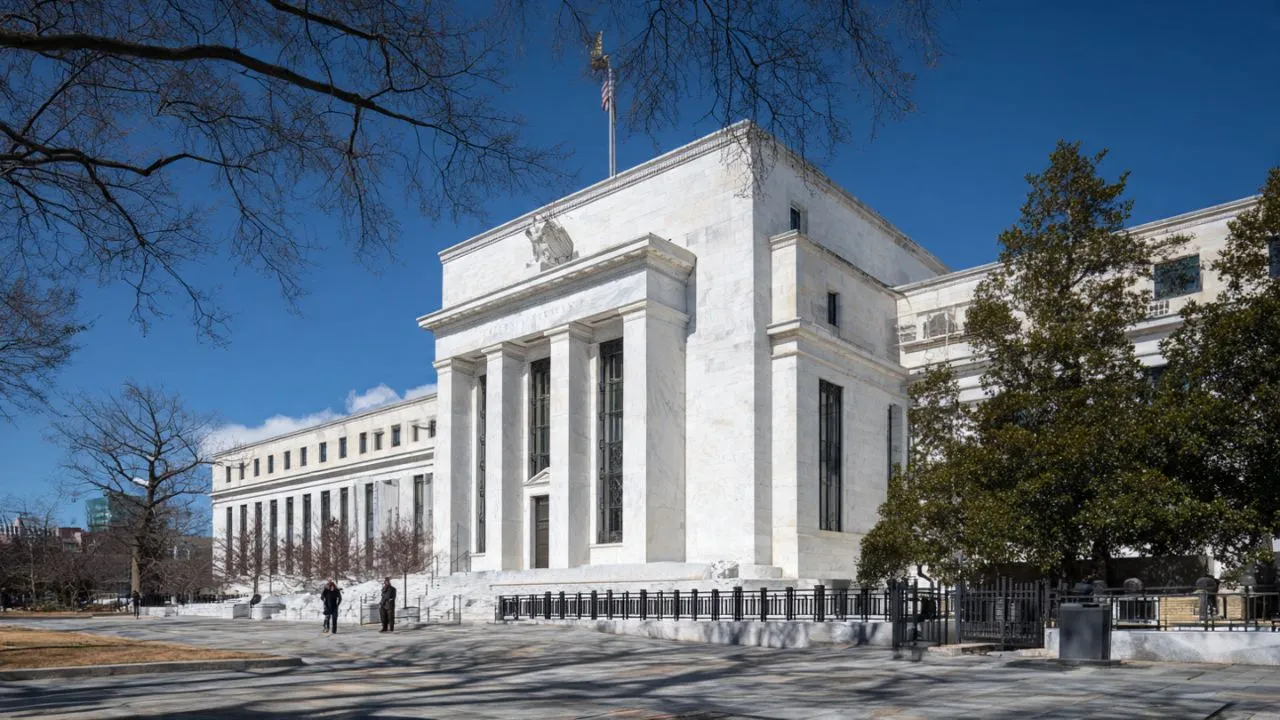

Updated: August 18, 2026 • 8:52 AM ET – The Federal Reserve is scheduled to release the minutes from its July 28–29 Federal Open Market Committee meeting on Wednesday, August 19, at 2:00 p.m. ET. The timing appears on the Fed’s official August 2026 calendar.
As of August 18, the minutes have not been released. Wednesday’s document will provide a more detailed account of the discussion behind the Fed’s July decision and could help investors understand how policymakers were thinking about inflation, employment and the path of interest rates before their next meeting in September.
At the July meeting, the FOMC held the federal funds target range at 3.50%–3.75% by a 9–3 vote. Beth Hammack, Neel Kashkari and Lorie Logan voted against the decision because they preferred to raise the target range by 25 basis points. That unusually visible division is likely to make the reasoning recorded in the minutes more important than the release-time headline alone.
The minutes will also come with an important limitation. They describe a meeting that ended July 29. Important economic information has arrived since then, including the July employment report released August 7. That means the minutes will show what policymakers knew and debated at the July meeting, while financial markets are already looking ahead using newer information.
| At a Glance | Details |
|---|---|
| Release Date | August 19, 2026 |
| Release Time | 2:00 p.m. ET |
| Meeting Covered | July 28–29, 2026 |
| July Decision | Held rates |
| Federal Funds Rate | 3.50%–3.75% |
| Vote | 9–3 |
| Dissenters | Beth Hammack, Neel Kashkari, Lorie Logan |
| Next FOMC Meeting | September 15–16, 2026 |
FOMC Minutes August 19, 2026: What to Know Before the Release
The August 19 FOMC minutes cover the Federal Reserve’s July 28–29 policy meeting and are scheduled for release at 2:00 p.m. ET on Wednesday. The Fed’s current monetary-policy page lists the August 19 minutes as the next FOMC document and identifies September 15–16 as the next scheduled policy meeting.
For readers following the entire policy calendar, Investozora’s 2026 FOMC meeting schedule provides additional context on the sequence of meetings, statements and minutes throughout the year.
The minutes themselves are not a new interest-rate decision. They are the detailed record of a meeting that has already taken place. The July rate decision is known. What remains unknown until Wednesday is how policymakers explained the disagreements behind that decision, how broadly inflation concerns were shared, what risks officials saw in the labor market and how participants were thinking about the conditions that might justify another change in rates.
That distinction matters because a short FOMC statement tells the public what the Committee decided. The minutes can reveal considerably more about the debate that produced the decision.
When Are the FOMC Minutes Released on August 19?
The Federal Reserve has scheduled the July 28–29 FOMC minutes for 2:00 p.m. Eastern Time on August 19, 2026. The Fed’s August calendar specifically identifies the release as “FOMC Minutes” for the meeting of July 28–29.
Readers searching for the minutes before that time should therefore be careful with pages that appear to describe what the document “revealed.” As of August 18, no official July 28–29 minutes have been released.
The current article is a pre-release analysis of what is already confirmed and what will matter when the official document becomes available. After the release, the same page can be updated with verified findings from the minutes rather than creating a second competing URL.
Investozora has previously covered how Federal Reserve minutes can affect interest-rate expectations, which explains why a document about a past meeting can still matter to markets weeks later.
What Happened at the July FOMC Meeting?
The Federal Reserve announced on July 29 that it would maintain the federal funds target range at 3.50%–3.75%. The decision passed by a 9–3 vote. The three dissenters were Beth Hammack, Neel Kashkari and Lorie Logan. According to the Fed’s official July 29 FOMC statement, each preferred to increase the target range by one-quarter percentage point.
The same statement said economic activity was expanding at a solid pace despite elevated uncertainty. It said job gains had kept pace with growth in the workforce and that unemployment had changed little. On prices, the Committee said inflation remained elevated relative to its 2% goal and cited supply shocks, including energy, as contributing to price increases in some sectors.
Those statements establish the official July position. Wednesday’s minutes could show the range of views underneath them. For readers who want to understand how the policy decision itself works, Investozora’s guide to the Federal Reserve interest-rate decision process explains how the FOMC sets the target range and why changes in that range can eventually influence borrowing and saving rates.
Why the 9–3 Vote Is the Biggest Story in the Minutes
The most important confirmed feature of the July meeting is not simply that the Fed held rates. It is that three voting members wanted a different decision. The contrast with June is significant.
At the June 16–17 meeting, the voting members unanimously supported holding the federal funds range at 3.50%–3.75%. The official June FOMC minutes record no votes against that action. By July, three officials were voting for a quarter-point increase instead.
That change from a unanimous decision to a 9–3 vote gives Wednesday’s minutes a much stronger policy question than a routine release-date story.
The key issue is whether Hammack, Kashkari and Logan represented a clearly isolated minority or the strongest edge of a broader concern inside the Committee. Other participants could have shared parts of their inflation argument while still concluding that holding rates steady was appropriate.
The minutes may help establish how much agreement existed around the risks of inflation remaining above target, whether officials differed over how restrictive the current rate setting was and how heavily policymakers weighed possible weakness in employment.
None of those answers should be assumed in advance. They are precisely what the official document needs to establish. Investozora’s coverage of the previous FOMC minutes and the rate-hike outlook provides useful background on how the policy debate was developing before the July meeting.
What the FOMC Minutes Could Reveal About September
The next scheduled FOMC meeting is September 15–16, 2026, according to the Federal Reserve’s current meeting calendar. That makes September the natural forward-looking question surrounding Wednesday’s minutes.
But the distinction between evidence and prediction is important: the minutes may help explain policymakers’ thinking; they cannot tell readers that a September rate increase, hold or reduction has already been decided.
The document could nevertheless provide clues about the conditions officials believed would make tighter policy appropriate. If the discussion shows that inflation concerns extended well beyond the three dissenters, markets may reassess how close the Committee was to another increase. If the record instead shows greater concern about employment risks or uncertainty, that could affect interpretations in the opposite direction.
The strength of those conclusions will depend on the actual wording of the minutes. The document may also clarify how policymakers viewed the existing 3.50%–3.75% target range.
Whether officials generally considered that setting sufficiently restrictive or whether some believed policy needed to do more to return inflation to 2% could be particularly relevant to understanding the disagreement.
Investozora is separately following the September Fed rate decision and rate-hike outlook as new evidence arrives. The important point for readers is that the minutes can change expectations without changing the federal funds rate itself.
Inflation Will Be One of the Main Questions
Inflation was already central to the July decision. The Fed’s July statement said inflation remained elevated relative to the Committee’s 2% goal and attributed some price increases to supply shocks, including energy.
The minutes may provide more detail about how policymakers interpreted those pressures. One question is whether officials believed the inflation effects were likely to fade or whether they saw a greater risk that elevated price growth could persist. Another is whether some participants believed keeping rates unchanged for longer created more inflation risk than raising them immediately.
The minutes could also reveal how officials weighed uncertainty. Policymakers do not need to disagree about the existence of elevated inflation to disagree about the appropriate policy response. They can differ over persistence, economic damage, timing and the relative risks of doing too much or too little.
That is why the discussion behind the 9–3 vote matters. Readers who want a broader explanation of the relationship can see Investozora’s guide to how the Federal Reserve uses interest rates to control inflation.
The Labor Market Could Complicate the Rate Debate
Employment is the other major side of the Fed’s policy mandate. At the July meeting, the FOMC said job gains had kept pace with workforce growth and that unemployment had changed little. That language reflects the information available when policymakers met on July 28–29.
But the economic picture available to markets today is not identical to the one available at that meeting. The Bureau of Labor Statistics released the July Employment Situation on August 7, more than a week after the FOMC decision.
BLS reported that nonfarm payroll employment changed little in July, falling by 23,000, while the unemployment rate was 4.1%. The agency also revised May and June payroll growth downward by a combined 103,000 jobs. Those numbers are important precisely because they were not available to the FOMC at the July meeting.
If Wednesday’s minutes show that policymakers were already discussing downside risks to employment before the August 7 report, that would provide useful context. But the document cannot show officials reacting to data that had not yet been published. Investozora has separately examined how the weaker jobs report reshaped the September Fed rate outlook.
The Minutes Look Back While Markets Look Forward
This timing gap is one of the most important things to understand about FOMC minutes. The document released August 19 will describe deliberations that took place three weeks earlier, on July 28–29.
Meanwhile, investors, borrowers, economists and Fed officials themselves now have additional information that was unavailable during those discussions. The minutes therefore answer a backward-looking question: What did Federal Reserve policymakers believe when they made the July decision?
Markets are trying to answer a different question: What will policymakers decide in September after considering everything that has happened since July 29? Those questions overlap, but they are not the same.
That is why a particularly hawkish passage in the minutes would not automatically mean a September rate hike is coming. Similarly, cautious discussion about employment would not automatically mean the Fed will cut rates.
The value of the minutes is that they reveal the Committee’s starting point. Newer labor-market data, subsequent inflation information, financial conditions, economic activity and additional releases before September can all change the assessment.
This is also what makes Wednesday’s release more useful than a simple “Fed minutes today” headline. Readers need to understand which information belongs to the July meeting and which information belongs to the September outlook.
What the Minutes Could Mean for Stocks, Bonds and the Dollar
Financial markets can react to FOMC minutes when the document changes expectations about the future path of monetary policy. If the minutes reveal broader-than-expected concern about inflation or stronger support for tighter policy, investors could reassess the likelihood of higher rates. If the discussion places greater weight on employment weakness or other downside risks, expectations could move differently.
The market reaction is not predetermined. Treasury yields, stocks and the U.S. dollar respond to many forces besides FOMC minutes, including incoming economic data, global developments, inflation expectations and changing views of future growth.
A movement that occurs after 2:00 p.m. ET should not automatically be attributed entirely to the minutes without evidence establishing that connection. For ordinary households, the distinction between expectations and an actual Fed decision is equally important.
Wednesday’s release does not directly change the rate on a mortgage, credit card, auto loan, savings account or certificate of deposit simply because the document has been published.
It can influence financial markets and expectations about future rates. Actual consumer borrowing costs depend on the product, benchmark, lender, maturity and other market conditions. Investozora’s guide to higher interest rates and borrowing costs explains those connections in more detail.
What Borrowers and Savers Should Watch
For most households, there is no reason to make a major financial decision solely because the FOMC minutes are being released. The more useful question is whether Wednesday’s document materially changes the expected direction of Federal Reserve policy.
A clearer case for keeping rates higher or raising them again could affect expectations for interest-sensitive products over time. A stronger focus on economic weakness could lead markets to interpret the future path differently.
But savings yields, credit-card annual percentage rates and mortgage rates do not all respond to Federal Reserve policy in the same way or at the same speed.
Credit-card rates and other variable-rate products linked to the prime rate can be relatively sensitive to actual Fed policy decisions. Mortgage rates are influenced heavily by longer-term bond markets and can rise or fall even when the FOMC leaves its target range unchanged.
Readers considering a home purchase can see Investozora’s explanation of how Fed rate changes can affect mortgage rates. The practical lesson before Wednesday is simple: read the minutes as evidence about the policy debate, not as a new rate announcement.
What Could Matter Most When the Minutes Are Released
The first question to answer Wednesday will be how broadly the three dissenters’ concerns were shared. The second will be whether participants viewed inflation risks as serious enough to require additional tightening or whether most officials believed the existing policy setting remained appropriate.
The third will be what policymakers were saying about employment before the weaker July payroll report became available. The fourth will be whether the discussion provides a clearer sense of what economic conditions could justify changing rates at a later meeting.
And the fifth will be what the minutes do not establish. Silence on a September outcome should not be converted into a prediction, and discussion of a possible policy path should not be presented as a decision.
Those distinctions will determine whether the minutes genuinely change the Federal Reserve outlook or simply provide more detail about a decision markets already know.
Will the Fed Raise Interest Rates in September?
There is no confirmed answer as of August 18. The September 15–16 meeting is officially scheduled, but the outcome is not. Wednesday’s minutes may change how investors assess the possibilities, particularly if they show that concern about inflation extended beyond the three officials who formally dissented in July.
But the September decision will be made using more information than was available on July 29. That distinction is essential. A statement in the minutes can help explain policymakers’ reaction function what kinds of risks or data could push them toward one choice but it does not bind the Committee to a particular vote seven weeks later.
Are FOMC Minutes the Same as an Interest-Rate Decision?
No. The July interest-rate decision was announced on July 29. The August 19 minutes are the detailed record of the discussion surrounding that already completed meeting.
The next scheduled interest-rate decision comes at the September 15–16 meeting. For readers unfamiliar with the institution, Investozora’s guide to what the FOMC is and how its rate decisions work explains the difference between meetings, statements, minutes and policy decisions.
Did the Federal Reserve Raise Rates in July 2026?
No. The FOMC maintained the federal funds target range at 3.50%–3.75% on July 29. The decision passed 9–3, with Hammack, Kashkari and Logan preferring a quarter-point increase. That is why the August minutes matter: they may reveal more about why the majority decided to hold rates despite three votes for tighter policy.
What Happens After the August 19 FOMC Minutes?
The release of the minutes will not end the September debate. The Bureau of Economic Analysis has scheduled its Personal Income and Outlays report for July, which includes the Personal Consumption Expenditures price indexes watched closely in monetary-policy analysis, for August 26 at 8:30 a.m. ET.
The Bureau of Labor Statistics has scheduled the August Employment Situation for September 4 at 8:30 a.m. ET. The Federal Reserve’s next scheduled FOMC meeting then takes place September 15–16.
That sequence explains why Wednesday’s document should be treated as one important piece of evidence rather than a verdict on September. The minutes can show how officials were thinking in late July. The data arriving afterward can change the environment in which the next decision is made.
FOMC Minutes August 19, 2026: What Matters Most
The Federal Reserve’s July 28–29 FOMC minutes are scheduled for release Wednesday, August 19, at 2:00 p.m. ET. The central fact going into the release is already known. The Fed held the federal funds target range at 3.50%–3.75%, but the decision passed by only 9–3 after Hammack, Kashkari and Logan called for a quarter-point increase.
The unanswered question is what stood behind that split. Wednesday’s document could show whether the three dissenters were largely isolated, whether other officials were also becoming more concerned about inflation, how policymakers assessed employment risks and what circumstances they believed could justify another change in rates.
The minutes will not decide September. They will instead reveal something more specific and immediately verifiable: how a Committee that was unanimous in June reached a 9–3 decision in July. That is the part of the release that could matter most for investors, borrowers, savers and anyone trying to understand where Federal Reserve policy may go next.
Editorial note: On August 19, this article will be updated with the verified findings from the Federal Reserve’s official FOMC minutes.