

Wall Street banks expect the U.S. Treasury to issue roughly $1 trillion in net new Treasury bills over the next year, pointing to continued heavy government borrowing and an even larger role for short-term debt in financing the federal government.
The estimate is not an official Treasury projection. Bank of America expects about $1.07 trillion of net bill issuance, JPMorgan projects about $1.09 trillion, and Goldman Sachs estimates roughly $961 billion, according to forecasts reported by the Financial Times on September 20.
Those forecasts matter because they suggest Treasury may continue relying heavily on securities that mature in one year or less even as borrowing costs at the short end of the market remain elevated.
The Treasury Department’s own latest financing guidance points in the same general direction, although it does not provide the same one-year bill-supply forecast.
In its August borrowing estimate, Treasury said it expected to borrow $739 billion in privately held net marketable debt during the July-through-September quarter, assuming a $950 billion cash balance at the end of September. That was $68 billion more than Treasury had projected in May.
For the October-through-December quarter, Treasury currently expects another $628 billion of privately held net marketable borrowing, assuming an $850 billion year-end cash balance.
Not all of that borrowing will come through Treasury bills. Treasury also sells notes, bonds, inflation-protected securities and floating-rate notes. But bills are the part of the financing mix Treasury can adjust most quickly when its short-term cash needs change.
That flexibility is already visible in Treasury’s latest refunding plan. Officials said in August that they expected to reduce some shorter-dated bill auction sizes during September as corporate and non-withheld tax payments arrived, followed by increases across the bill curve in October as seasonal federal outflows increased.
Treasury also estimated that its Treasury General Account, the government’s main operating cash account at the Federal Reserve, could temporarily reach about $1.05 trillion, plus or minus $50 billion, in late October. The growing financing requirement is not entirely new, but the size of the projected gap has been rising.
Treasury’s May meeting with its Borrowing Advisory Committee showed that the median primary-dealer forecast implied a roughly $1.3 trillion financing shortfall across fiscal 2027 and 2028 if current coupon-auction sizes and bill supply were maintained. In February, the comparable projected shortfall had been about $1.1 trillion.
That comparison adds another reason markets are watching the bill sector closely. If longer-term note and bond auction sizes are not increased enough to cover future financing needs, bills can absorb more of the adjustment.
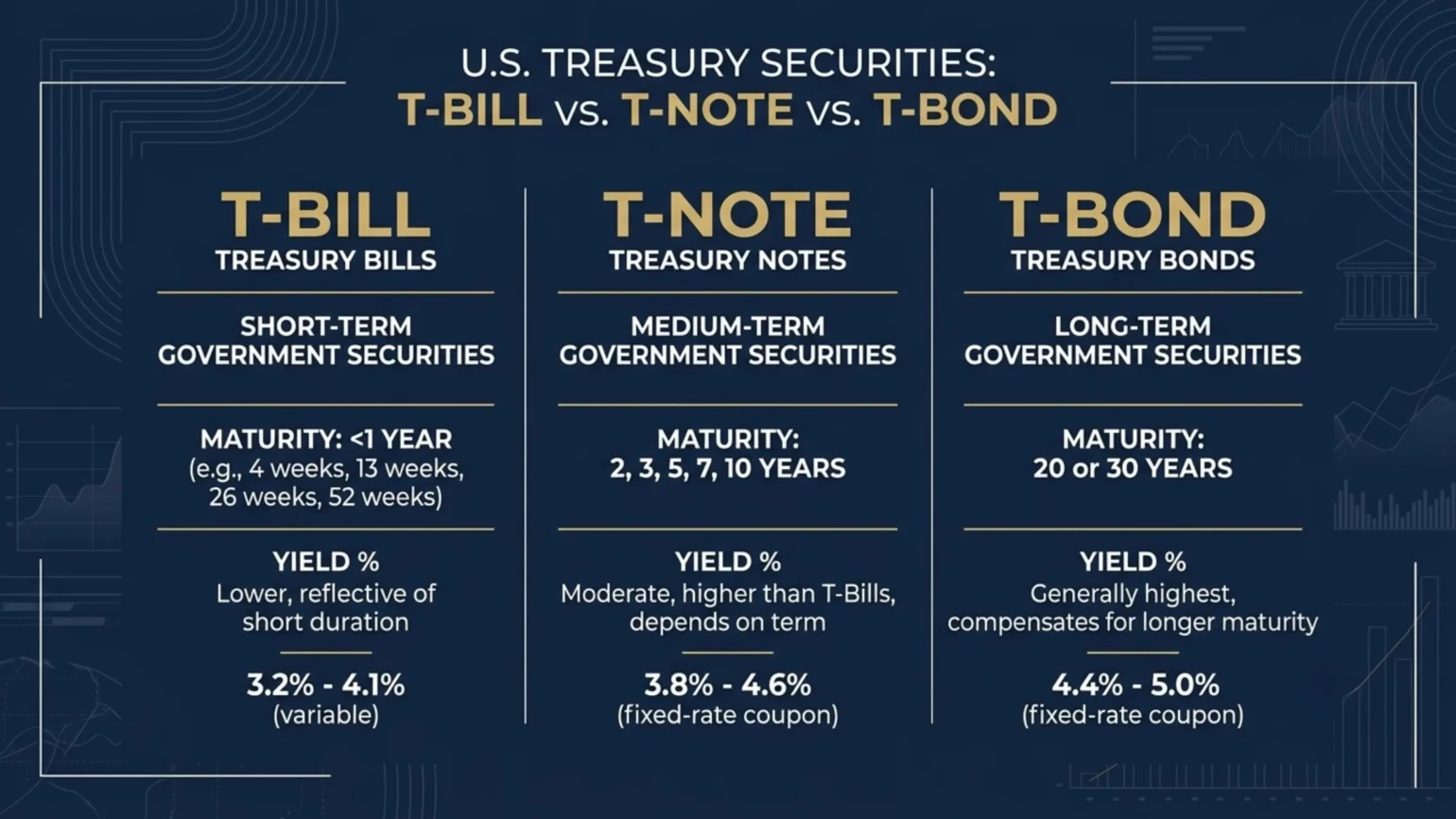
For readers unfamiliar with the structure, Investozora’s guide to how the U.S. Treasury borrows money explains how auctions and different maturities fit into federal financing, while its Treasury bills explainer covers how short-term bills differ from notes and bonds.
Short-term funding is also no longer exceptionally cheap. On September 18, Treasury’s official secondary-market data showed coupon-equivalent yields of 3.89% for four-week bills, 4.08% for 13-week bills, 4.27% for 26-week bills and 4.41% for 52-week bills. That means a larger bill portfolio also resets to prevailing interest rates relatively quickly as securities mature and are refinanced.
Demand remains an important counterweight. Treasury has previously said it is monitoring private demand for bills as well as Federal Reserve purchases, and primary dealers have repeatedly indicated that bills can absorb meaningful changes in financing needs.
The biggest unresolved question is therefore not whether Treasury will continue selling large amounts of debt, it already expects substantial borrowing but how much of the next year’s financing will ultimately be concentrated in bills versus longer-term securities.
Treasury’s next major official checkpoint will come with its next quarterly financing estimates on November 2, 2026, followed by the quarterly refunding announcement on November 4. Those releases should provide the next authoritative indication of whether Treasury intends to lean more heavily on bills or begin shifting more borrowing toward longer maturities.