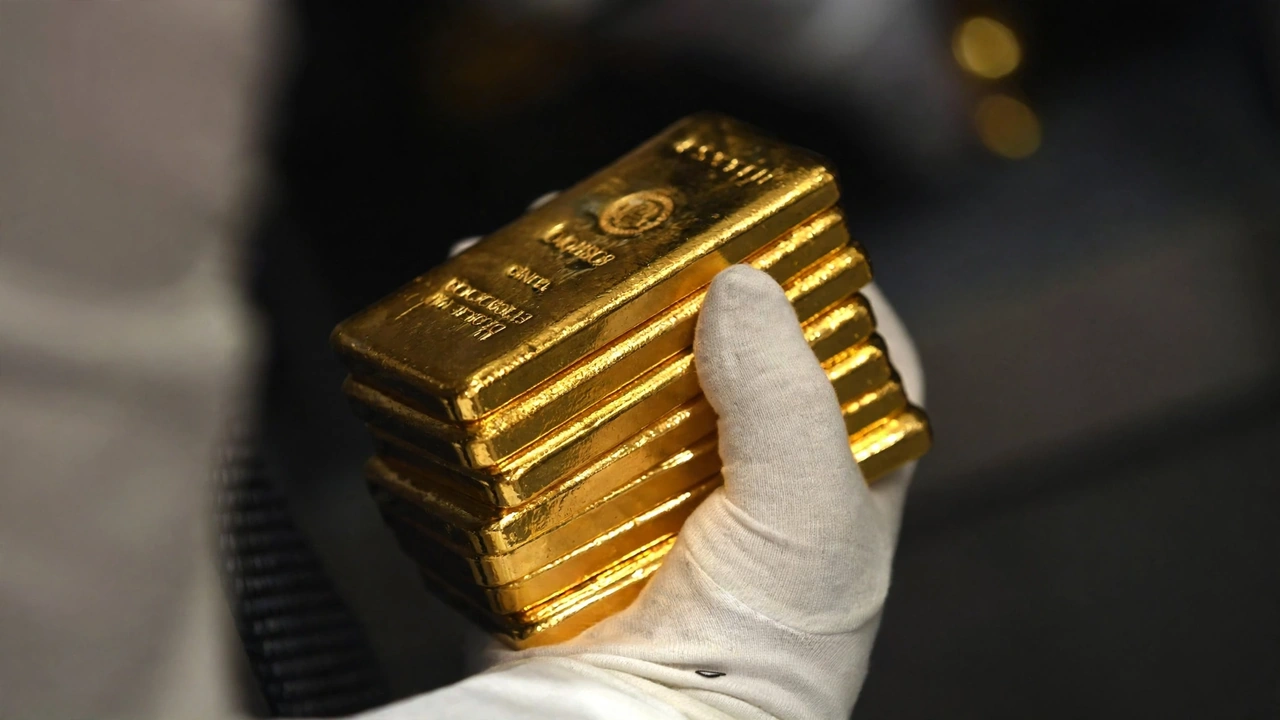

Gold prices ended a turbulent week near $3,880 per ounce on Friday, November 13, 2026, suffering a roughly 4.5% weekly decline as rising U.S. Treasury yields, persistent inflation and expectations of another Federal Reserve interest rate increase weighed on the precious metal.
Spot gold was last quoted at approximately $3,884.20 per troy ounce in Kitco’s Friday market report, leaving bullion below the psychologically important $4,000 level despite a modest late-week recovery. The quotation is a Friday market observation, not a new Saturday trading price.
The selloff raises an important question for investors and households: why is gold losing value when inflation and geopolitical uncertainty remain elevated? The answer lies partly in the difference between gold’s traditional reputation as a store of value and the immediate financial pressure created by rising interest rates.
My comparison of this week’s gold quotations with official U.S. Treasury data shows that both nominal and inflation-adjusted government bond yields climbed sharply as bullion retreated.
Gold’s $4,000 Reversal
The latest decline is particularly striking because gold had recently recovered above $4,100. On November 5, gold’s earlier rally carried spot prices to $4,124.89 per ounce at 07:52 UTC, while a subsequent weekly gold rebound suggested the market was regaining momentum ahead of important inflation figures.
That optimism faded after stronger-than-expected U.S. consumer inflation reshaped expectations for Federal Reserve policy. Gold subsequently broke below $4,000 before reaching approximately $3,852.10 during Thursday’s selloff.
The scale of the reversal becomes clearer when comparing the same spot-gold instrument across the week. Kitco reported gold beginning the trading week near $4,066.39 on Sunday evening and later trading at $3,884.20 on Friday, a difference of $182.19 per ounce.
My calculation, dividing that decline by the starting quotation, produces a 4.48% decrease, consistent with the approximately 4.5% weekly loss. These observations come from different trading sessions and measure the change between quoted prices rather than any individual investor’s realized return.
The contrast with November 5 is even more pronounced. Comparing that day’s $4,124.89 spot quotation with Friday’s $3,884.20 produces a $240.69 decline, equivalent to approximately 5.84%, although the two observations were recorded at different times.
The November 10 gold price and subsequent Thursday gold selloff show how rapidly the market changed as investors reassessed inflation and interest-rate expectations. Neither comparison establishes that the decline will continue next week.
Why Treasury Yields Matter
The U.S. bond market provides some of the strongest measurable evidence behind gold’s recent weakness. According to the Treasury Department’s official yield data, the 10-year Treasury par yield increased from 4.86% on November 6 to 5.15% on November 13, a rise of 29 basis points. Over the same period, the two-year yield climbed from 4.51% to 4.88%, an even larger increase of 37 basis points. These moves indicate a substantial repricing of government borrowing rates over the week.
Gold does not pay interest or generate contractual income, making rising bond yields an important competitive pressure. Investors who can earn higher returns from interest-bearing securities may become less willing to hold an asset whose returns depend primarily on changes in market price.
This helps explain the pressure associated with rising Treasury yields and the changing dollar’s influence on international bullion markets. However, higher yields and a stronger dollar do not automatically cause gold to fall in every market environment. An additional comparison strengthens that interpretation. The Treasury’s real yield series shows that the 10-year inflation-protected Treasury yield rose from 2.63% on November 6 to 2.91% on November 13, an increase of 28 basis points.
Real yields matter because they reflect market-based returns on inflation-protected government securities, rather than nominal interest rates alone. In my assessment, the simultaneous increase in nominal and real yields is more informative than simply attributing gold’s decline to inflation fears.
Inflation’s Double Effect
The immediate turning point came with Tuesday’s U.S. inflation figures. The Bureau of Labor Statistics reported in its October CPI release that consumer prices rose 0.4% on a seasonally adjusted monthly basis, following a 0.6% increase in September. Core consumer prices, excluding food and energy, rose 0.3% for a third consecutive month.
Although headline monthly inflation slowed, the readings reinforced concerns that underlying price pressures remained persistent. Friday’s producer-price data offered some relief without eliminating those concerns. The BLS October PPI report showed final-demand producer prices increasing 0.3% during the month, compared with September’s revised 1.4% increase.
Yet producer prices were still 6.5% higher over 12 months, while the index excluding food, energy and trade services rose 0.5% during October. Gold recovered modestly following the report, but the improvement was insufficient to reverse the week’s broader losses.
Federal Reserve Governor Christopher Waller had already explained why persistent inflation could lead to additional tightening. In his November 10 economic outlook speech, delivered before that day’s CPI release, Waller said a quarter-point December rate increase remained his preferred course under his expected inflation outlook. He also stated that a larger increase could be considered if inflation remained sufficiently strong.
His conditional warning, examined alongside Waller’s inflation test, helps explain why traders became particularly sensitive to the latest price data. The important distinction is that inflation can support gold demand over longer periods while simultaneously hurting its short-term price.
If investors believe persistent inflation will force the Federal Reserve to raise rates further, interest-bearing assets can become more attractive even as consumers worry about purchasing power. I regard this as the central contradiction of the current gold market: the economic conditions that traditionally encourage interest in bullion are also increasing the immediate cost of holding it.
What the Drop Means for Buyers
For an investor holding physical bullion, the weekly decline translates into a meaningful reduction in its indicative market value. Applying the $182.19 per-ounce difference to 10 troy ounces produces approximately $1,821.90 in lower benchmark value between the selected observations.
This is an illustrative mark-to-market calculation, not a verified loss experienced by an actual investor. Purchase premiums, dealer spreads, storage charges, taxes and the original acquisition price determine the financial outcome of any real transaction.
The picture is different for people buying jewelry, coins or small gold bars. A decline in the international spot price may reduce the underlying metal cost, but retail prices also incorporate manufacturing charges, seller margins, local taxes and currency conversion.
Someone purchasing gold outside the United States may therefore experience a smaller price reduction, no immediate reduction or even a higher local price if the domestic currency weakens. The $3,880 quotation should not be mistaken for the final retail price of a physical product.
Gold-backed exchange-traded funds and mining shares introduce additional distinctions. A physically backed fund generally provides exposure to bullion movements, subject to its structure, expenses and trading conditions, while mining companies also depend on production costs, financing, operating performance and management decisions.
Investors comparing these assets should distinguish direct gold-price exposure from the additional business and market risks involved. A lower bullion price alone cannot establish which investment will perform better.
Is Gold Still a Safe Haven?
Gold’s weakness does not necessarily mean its traditional role as a defensive asset has disappeared. It means that safe-haven demand is competing with other powerful influences, including interest rates, the dollar and expectations for monetary policy. Rising geopolitical tensions can sometimes strengthen bullion demand, but they can also increase energy prices and inflation fears, leading investors to anticipate higher interest rates. The same uncertainty can therefore create opposing pressures on gold.
Commodity strategist Ole Hansen, head of commodity strategy at Saxo Bank, highlighted that tension in comments published by Kitco on Friday. He pointed to continuing central-bank reserve diversification and resilient investment demand as potential longer-term sources of support, while warning that rising yields and the dollar could prolong short-term weakness.
Those observations describe an analyst’s assessment, not a guarantee that official demand will offset private-market selling. The historical relationship between gold and yields also shows why a defensive asset can experience substantial declines during uncertain periods.
What Happens Next?
The Federal Reserve remains one of the most important variables for gold’s near-term direction. At its October 28 meeting, policymakers held interest rates within a 3.75%–4.00% target range, with two officials favoring a quarter-point increase, according to the official FOMC statement.
The next scheduled policy meeting is December 8–9, making incoming inflation figures, economic activity and policymakers’ statements especially relevant. Expectations of another increase remain market forecasts rather than decisions already taken.
For the coming sessions, I would watch whether the 10-year real Treasury yield continues rising, whether the dollar remains strong and whether gold can sustain a recovery above $4,000. A retreat in yields could ease one source of pressure, while renewed inflation concerns could keep bullion vulnerable. Neither the weekly decline nor Friday’s modest rebound is sufficient to establish a reliable price direction for the next trading session.
Gold enters the weekend near $3,880 after a sharp reversal from its recent recovery above $4,100. The clearest lesson from this week’s data is that inflation does not automatically send gold higher when the prospect of tighter monetary policy is simultaneously pushing investment yields upward.
For investors, the crucial question is no longer simply whether inflation remains elevated, but whether the Federal Reserve’s response will continue making competing assets more attractive than gold.