Treasury continues to operate under the current statutory debt limit framework as of this article’s last review, with the Treasury General Account balance and auction calendar published daily and weekly, respectively.
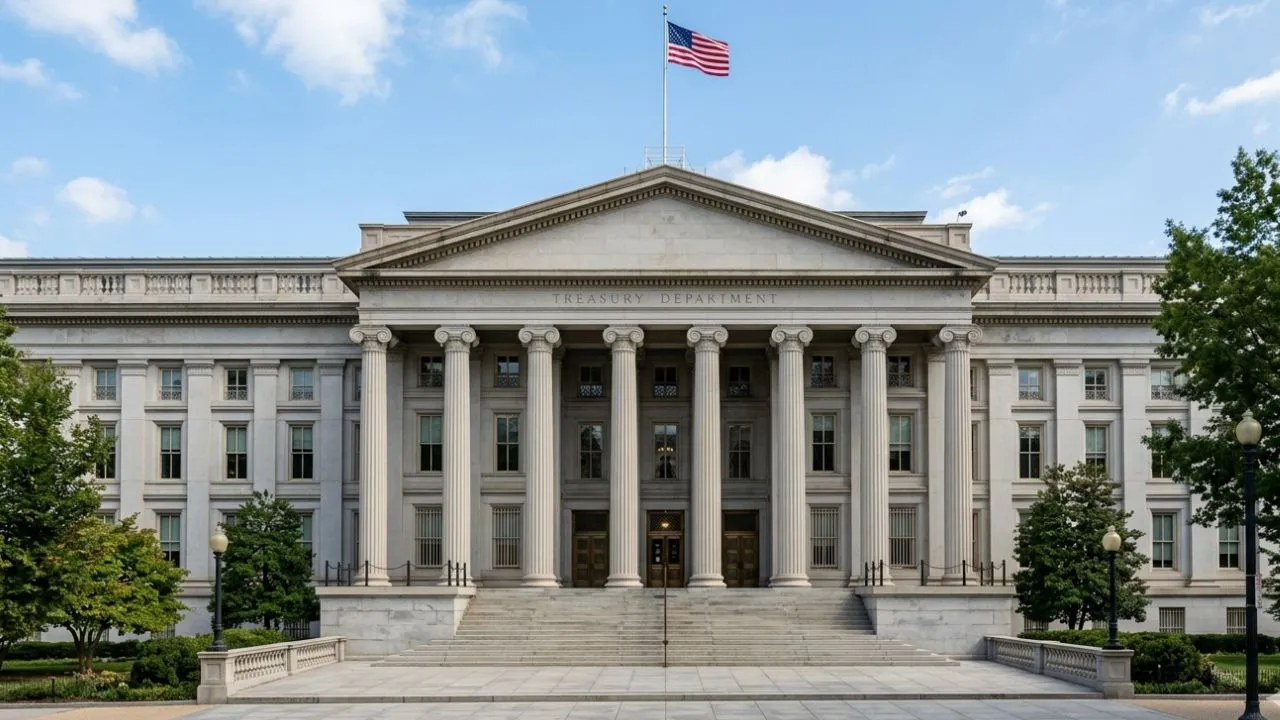
The U.S. Department of the Treasury is the federal agency responsible for managing the government’s finances, issuing federal debt, overseeing the nation’s currency and payment infrastructure, and housing the Internal Revenue Service as one of its bureaus.
Created in 1789, it functions as the government’s bank, accountant, and revenue collector all at once, touching nearly every dollar that moves through federal hands.
Where Treasury sits in government
Treasury is one of the original four executive departments created by Congress in 1789, shortly after the Constitution established the new federal government. It is led by the Secretary of the Treasury, who reports directly to the President and regularly testifies before Congress on fiscal and financial matters.
Unlike the Federal Reserve, which operates independently to set monetary policy, Treasury operates as part of the executive branch and carries out fiscal policy: taxing, spending, borrowing, and managing the government’s cash position day to day.
The Treasury General Account explained
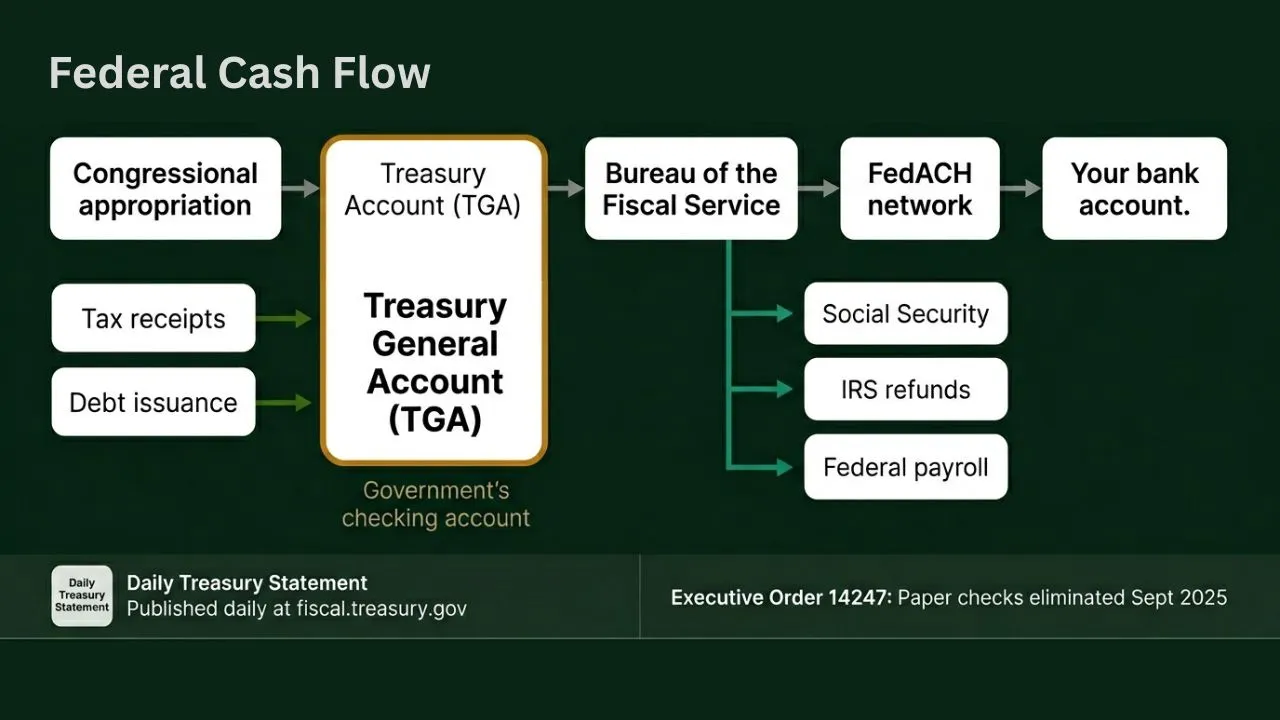
At the center of Treasury’s operations sits the Treasury General Account, the government’s primary checking account held at the Federal Reserve.
Federal tax receipts, proceeds from Treasury debt sales, and federal disbursements are reflected in the Treasury’s cash operations through this account, making its daily balance one of the most closely watched indicators of the government’s short-term cash position, especially during debt ceiling standoffs.
How Treasury collects revenue
Treasury doesn’t collect taxes directly. That job belongs to the IRS, a bureau within Treasury, which processes returns, issues refunds, and enforces the tax code on Treasury’s behalf.
Beyond individual and corporate income tax, federal receipts also include customs duties, excise taxes, and various fees, which contribute to the government’s overall cash position and help fund federal obligations.
How Treasury borrows money
When spending exceeds revenue, Treasury borrows the difference by issuing debt through regular Treasury auctions, selling bills, notes, bonds, and TIPS to investors ranging from individual savers to foreign central banks.
This borrowing operation is one of the largest and most closely watched debt markets in the world, since Treasury yields serve as the benchmark rate for nearly every other form of borrowing in the U.S. economy, from mortgages to corporate bonds.
The debt ceiling and extraordinary measures
Congress caps how much total debt Treasury may carry through the statutory debt limit. When that ceiling is reached before Congress raises it, Treasury turns to a defined set of extraordinary measures.
Accounting maneuvers that temporarily free up borrowing room without violating the law, buying time for a political resolution. These measures are finite and well documented, and Treasury publishes updates on how long they’re expected to last.
Treasury’s role in federal payments
Beyond debt and taxes, Treasury operates much of the financial infrastructure that moves federal money to individuals and institutions.
This includes coordinating with the Federal Reserve on payment settlement, overseeing the Bureau of the Fiscal Service, and providing the payment infrastructure through which programs such as Social Security and tax refunds are disbursed. Direct deposit has increasingly replaced paper checks as the federal government phases out most paper-based payments.
Treasury versus the Federal Reserve
These two institutions are frequently confused but serve different functions. Treasury manages the government’s finances: taxing, spending, and borrowing.
The Federal Reserve conducts monetary policy, including setting the target range for the federal funds rate and managing the banking system’s reserve environment, independently of any specific administration’s spending decisions.
Treasury issues debt; the Federal Reserve may buy or sell Treasury securities as part of monetary policy, but those decisions are made independently under the Fed’s separate legal mandate. This distinction becomes especially important during periods of debate over Federal Reserve independence.
The Daily Treasury Statement
Treasury publishes a Daily Treasury Statement every business day, detailing the prior day’s cash flows, including tax deposits, debt issuance, and federal spending.
This document offers the most granular public view available anywhere into how much money the government took in and paid out on a single day, and it’s the same data series analysts use to track the Treasury General Account balance during debt ceiling standoffs.
Treasury’s international role
Treasury also represents U.S. financial interests abroad, coordinating on sanctions policy, managing foreign exchange reserves, and representing the U.S. at international financial institutions like the IMF and World Bank.
This function has grown more visible in recent years as sanctions became a more frequently used foreign policy tool, requiring Treasury’s Office of Foreign Assets Control to enforce complex, fast-moving restrictions.
How individuals interact with Treasury directly
Most Americans encounter Treasury indirectly through the IRS, but individuals can also interact with Treasury directly. Programs like TreasuryDirect let individuals buy Treasury bills, notes, bonds, and I bonds directly from the government without a brokerage account.
And the Bureau of the Fiscal Service handles many of the payments the public receives directly, including some tax refunds and federal benefit payments.
Is Treasury the Fed?
No. The U.S. Department of the Treasury is part of the executive branch and manages the federal government’s finances, including taxation, spending, borrowing, and debt issuance. The Federal Reserve is an independent central bank that conducts monetary policy, including setting the target range for the federal funds rate.
The two institutions coordinate on certain financial operations but operate under separate legal authorities and have different responsibilities. Treasury manages the government’s fiscal operations, while the Federal Reserve manages monetary policy and the banking system’s reserve environment.
Does Treasury print money?
Yes, but only in the physical sense. The Bureau of Engraving and Printing, a Treasury bureau, produces U.S. paper currency, while the U.S. Mint produces coins.
However, printing currency is not the same as controlling the nation’s overall money supply. The Federal Reserve conducts monetary policy and manages the banking system’s reserves, while the physical production of cash is handled by Treasury agencies.
How does Treasury process refunds?
Once the IRS approves a tax refund, the payment instruction is processed through the Treasury Department’s Bureau of the Fiscal Service, which handles important federal payment operations and coordinates with the Federal Reserve and financial institutions.
Many tax refunds are delivered electronically through the ACH payment system, depending on the payment method selected by the taxpayer. This means the IRS determines that the refund is owed, while Treasury’s payment infrastructure helps deliver the money.
Why does the debt ceiling matter?
If Treasury exhausts its available extraordinary measures and Congress has not raised or suspended the debt limit, the government could face difficulty meeting some obligations on time.
The exact consequences would depend on the government’s available cash and other payment conditions. However, prolonged uncertainty could potentially affect federal payments, benefit checks, contractor payments, and financial markets.
Can I buy Treasury debt?
Yes. Individuals can use TreasuryDirect to buy certain Treasury securities directly from the U.S. government, including Treasury bills, notes, bonds, and Series I savings bonds.
TreasuryDirect allows eligible investors to purchase these securities without going through a bank or brokerage account and without paying a commission for the purchase. The specific terms, minimums, and purchase limits vary by security type.
Who leads the Treasury Department?
The Secretary of the Treasury leads the department. The Secretary is nominated by the President and must be confirmed by the Senate before taking office.
As a cabinet-level official, the Treasury Secretary serves as the President’s principal advisor on economic and financial policy and oversees a department responsible for federal revenue, borrowing, payments, currency production, and other major financial operations.
Methodology: Structural and procedural details in this article are drawn from Treasury’s own published organizational materials and the Bureau of the Fiscal Service’s public documentation.