
Federal Reserve officials expressed broad support for further interest-rate increases in the months ahead, according to official minutes released Wednesday, November 18, revealing a stronger consensus on the direction of monetary policy than the central bank’s October decision alone suggested.
Almost all participants considered additional tightening likely to be appropriate under their baseline outlooks for inflation and employment. That support emerged even though most officials preferred to leave rates unchanged at the October 27–28 meeting to assess incoming economic information.
The minutes show growing agreement about the likely need for higher rates, but not a commitment to raise them at the next meeting. The Federal Open Market Committee held its benchmark federal funds rate at 3.75%–4.00% in October by a 10–2 vote, as detailed in its policy statement. Governor Lisa D. Cook and Cleveland Fed President Beth M. Hammack dissented, favoring an immediate quarter-percentage-point increase.
The newly released record also reveals that a couple of participants thought an increase larger than 25 basis points might deserve consideration in December if subsequent inflation data were unfavorable. That possibility was discussed, not approved, and the existing target range remains in effect.
What Changed Since September
The most revealing finding comes from comparing the October minutes with the September meeting record. At the September 15–16 meeting, all 12 voting members approved a 25-basis-point increase, taking the target range to 3.75%–4.00%, while most participants expected another increase by year-end.
The October meeting produced a different immediate decision: a pause supported by ten voters, alongside an even broader assessment that further increases would probably be appropriate. The distinction adds important context to the earlier rate-hike outlook.
| Policy measure | September meeting | October meeting |
|---|---|---|
| Immediate decision | Raised rates 25 basis points | Held rates unchanged |
| Target range afterward | 3.75%–4.00% | 3.75%–4.00% |
| Committee vote | 12–0 | 10–2 |
| Outlook for further increases | Most participants expected another increase by year-end | Almost all participants expected additional tightening under their baseline outlooks |
| Larger near-term increase | Not identified as the central policy discussion | A couple raised the possibility of more than 25 basis points in December |
These descriptions require careful interpretation because the minutes use qualitative terms, not a published numerical forecast of how members will vote. September’s statement that most participants expected another increase concerned the period through year-end, while October’s broader language addressed the coming months.
The comparison therefore establishes a stronger expression of support for additional tightening, not a guaranteed December increase. Nor does it establish that every participant favors moving at the same speed.
The Fed’s September projections provide a numerical reference point. Their median forecast placed the federal funds rate at 4.1% at the end of both 2026 and 2027, measured using the midpoint of the projected target range and rounded to one decimal place.
From today’s 3.75%–4.00% range, a quarter-point increase would produce a 4.00%–4.25% range with a 4.125% midpoint, consistent with a displayed rate of approximately 4.1%. That is an illustrative calculation, not a newly announced decision or an updated October projection, and the dot-plot outlook represents individual assessments rather than binding commitments.
Why Officials Chose to Wait
Most October participants supported keeping rates steady because they wanted additional information about the economy and the effect of September’s increase. The minutes identify uncertainty surrounding artificial-intelligence investment, financing conditions and geopolitical developments as reasons for taking more time.
Some officials also believed a gradual approach would give households and businesses an opportunity to adjust to higher borrowing costs. Waiting, in their assessment, did not mean abandoning the central bank’s commitment to restoring inflation to 2%.
Other participants were less comfortable with the pause, arguing that inflation remained too high and policy was not sufficiently restrictive. Some favored raising rates immediately, while a few warned that delaying action could allow inflation to become entrenched and eventually require a more disruptive response.
Cook and Hammack were the two voting members who formally opposed the decision, each preferring a 25-basis-point increase. Their dissent, already documented in the October rate decision, is distinct from the broader expressions of concern recorded among meeting participants.
The Committee did not alter its operational interest-rate framework in October. Its directive, effective October 29, maintained the federal funds target range, while the Board kept interest on reserve balances at 3.90% and the primary credit rate at 4.00%.
These are institutional monetary-policy settings, not the interest rates directly offered to households. The distinction matters when examining the Federal Reserve’s tools and how official decisions pass through financial markets.
Inflation and the AI Economy
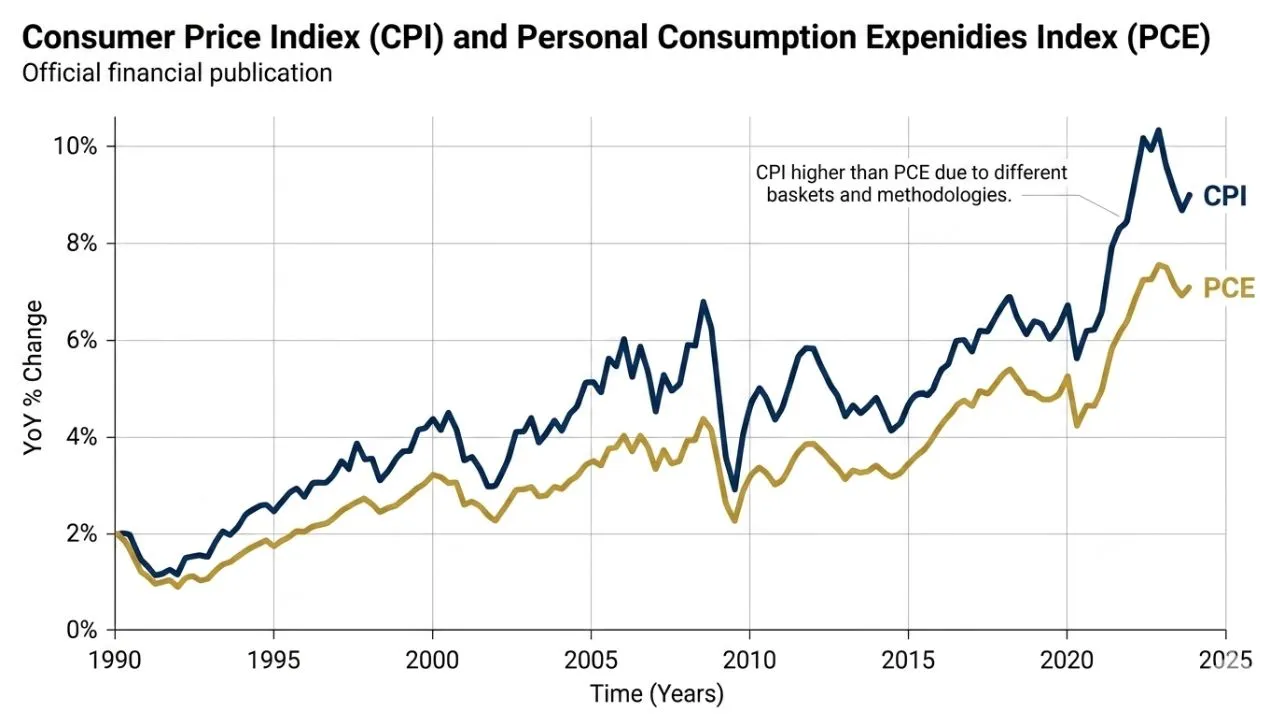
Inflation remained the dominant concern in the discussion, with officials pointing to higher energy costs, tariffs and demand associated with artificial-intelligence infrastructure. Federal Reserve staff estimated that annual headline personal consumption expenditures inflation had reached 3.6% in September, while core inflation stood at 3.1%.
The Bureau of Economic Analysis subsequently confirmed those figures in its September PCE release, published October 29, one day after the Committee’s meeting. The distinction between estimates available during the meeting and data confirmed afterward is important to reconstructing what policymakers knew.
The minutes also provide a more complicated view of the AI investment boom than a simple narrative about faster economic growth. Participants recognized that data-center investment and technology spending were supporting demand, while also raising concerns about equipment costs, skilled-labor shortages and financing risks.
Federal Reserve staff highlighted the possibility that disappointing AI investment returns could trigger asset-price declines amplified by leverage and complex financing arrangements. These were risk assessments and possible scenarios, not findings that a financial crisis or broad economic downturn had begun.
The staff nevertheless expected inflation to move closer to the central bank’s objective over time, with its forecast reaching approximately 2% in 2028. Some participants saw the potential for productivity improvements to expand supply and ultimately ease price pressure, although the timing and magnitude remained uncertain.
Others worried that persistent increases across a wider range of goods and services could influence longer-term inflation expectations. Those competing possibilities help explain why officials continued to emphasize the 2% inflation target without committing to a fixed sequence of rate increases.
Policymakers Differ on the Pace
Public remarks delivered after the October meeting show that agreement on the direction of policy does not eliminate disagreement about timing or size. On November 10, Federal Reserve Governor Christopher J. Waller argued that a quarter-point December increase would be appropriate under his baseline outlook, but warned that persistent core inflation could justify consideration of a larger move. His comments established a measurable condition for considering a half-point increase. They represented his individual assessment, not an agreed Committee policy.
I believe a 50 basis point hike in the policy rate should be considered at the December meeting.
The November 10 October CPI report showed that core consumer prices increased 0.3% from the preceding month, matching the approximate threshold Waller had identified in his remarks before the release. Headline consumer prices increased 0.4% over the month, but most annual October comparisons were unavailable because the corresponding October 2025 data had not been collected during a lapse in appropriations.
The result strengthened the relevance of his conditional argument without requiring other policymakers to agree with it. The distinction between a condition being met and a decision being made is central to the larger-hike debate. Hammack, who voted against the October pause, outlined a different preference in a November 5 address.
She considered more restrictive monetary policy necessary but favored smaller, more frequent adjustments when possible to reduce disruption. Her position illustrates why two policymakers can favor higher rates while disagreeing over how quickly to reach the desired level. Her subsequent remarks also expand upon the concerns reflected in her October vote.
I prefer getting to that stance through more frequent smaller adjustments when possible
St. Louis Fed President Alberto G. Musalem offered another assessment on November 17, arguing that persistent inflation was likely to require multiple additional increases before the spring of 2027. His comments addressed the trajectory of policy over several meetings, rather than the size of a single December move.
Musalem participated in the October discussion but was not among the twelve voting members listed for that decision. His forecast therefore adds institutional perspective without representing a Committee commitment.
The economy will likely require several interest rate increases before the spring of 2027 to achieve 2% inflation in a timely manner.
What Higher Rates Mean
The immediate consequence for households is that the October minutes themselves do not increase anyone’s loan rate. The federal funds rate influences financial conditions through banks, money markets, Treasury yields and expectations about future monetary policy.
Variable-rate credit products linked to short-term benchmarks can respond relatively directly when policy rates change, although individual contracts determine the timing and magnitude. Fixed-rate mortgages depend more heavily on longer-term financing conditions, as explained by the different mechanics of mortgage borrowing.
For borrowers, a further increase could add pressure to financing costs, especially where rates reset or debt must be refinanced. For depositors, higher policy rates can create opportunities for improved savings yields, but banks do not necessarily pass through increases fully or immediately.
The minutes already described weaker residential investment and more selective financing for certain riskier borrowers, even while overall economic activity remained resilient. Changes in anticipated policy can also move long-term borrowing costs before an official vote, making the Treasury yield relationship relevant to investors and homebuyers.
What Happens Next
The Fed’s next scheduled monetary-policy meeting is December 8–9, according to its official calendar. Before that meeting, the Bureau of Economic Analysis is scheduled to release October PCE inflation data on November 25, providing another measure of whether underlying price pressures are easing.
The November CPI report is scheduled for December 10, after the December meeting, and therefore would not be available to policymakers before that decision under the current timetable. Additional economic evidence and changes in financial conditions could still influence their judgment.
The central finding of the November 18 minutes is clear: most officials preferred to wait in October, but almost all anticipated that higher interest rates would likely be needed under their baseline outlooks.
That creates a stronger documentary basis for expecting further tightening than the 10–2 decision alone reveals, while leaving the timing and magnitude unresolved. The next decision will establish whether the central bank converts that broad inclination into another rate increase or chooses to gather more evidence first.