Last Updated: July 23, 2026: The U.S. money movement system is the end-to-end pipeline that delivers every federal payment, from congressional authorization to a recipient’s bank account. The process begins when Congress authorizes funding and a federal agency determines who should be paid and how much.
The U.S. Treasury’s Bureau of the Fiscal Service then validates and disburses the payment, the Federal Reserve settles the transfer between financial institutions, and the receiving bank posts the funds to the customer’s account.
Under normal conditions, most federal ACH payments complete this journey in one to three business days, although weekends, Federal Reserve holidays, agency processing, and bank posting schedules can extend the timeline.
Key Facts: The U.S. Money Movement System in 2026
The Bureau of the Fiscal Service, part of the U.S. Department of the Treasury, disburses every federal payment. No agency pays you directly. The Federal Reserve runs FedACH and Fedwire, the two networks that settle most federal payments between banks.
Standard FedACH payments settle at 8:30 a.m. Eastern Time the next business day. They do not settle on weekends or the 11 Federal Reserve holidays. The Treasury General Account, the government’s checking account at the Federal Reserve Bank of New York, closed at $738.3 billion on July 10, 2026, and $822.5 billion on July 16, 2026.
Nearly 71 million Americans receive Social Security benefits, and about 7.5 million more receive SSI, following a 2.8% cost-of-living adjustment for 2026. The Federal Reserve, under Chair Kevin Warsh, held its benchmark rate at 3.50%–3.75% at the June 17, 2026 meeting, his first as chair.
A new decision is scheduled for July 28–29, 2026. Regulation CC requires banks to make the first $275 of many check deposits available by the next business day, a threshold raised from $225 on July 1, 2025. “Sent” in an agency portal means the agency handed a payment file to Treasury. It does not mean the money reached your bank yet.
Four Operational Truths
Every federal payment leaves the Treasury General Account at the Federal Reserve Bank of New York before it reaches any commercial bank. FedACH, the Federal Reserve’s batch payment network, does not operate on Saturdays, Sundays, or federal holidays.
‘Sent’ by an agency means the payment file reached Treasury. It does not mean money reached your bank. Bank posting schedules vary by institution, which is why identical payments can appear in different accounts hours apart.
This guide explains how every layer of that system works, why delays happen at each stage, and what to do when a payment doesn’t arrive as expected.
What Is the U.S. Money Movement System?
The U.S. money movement system is the set of institutions and networks that carry federal payments from the Treasury to your bank account. It is not one system. It is six institutions working in sequence, each with its own rules, schedule, and failure points.
In plain terms: Congress decides how much money programs can spend. A federal agency, the IRS, the Social Security Administration (SSA), the Department of Veterans Affairs (VA), or a payroll office, decides who gets paid and how much.
The Treasury’s Bureau of the Fiscal Service sends the money. The Federal Reserve moves that money between banks. Your bank receives it and posts it to your account.
In technical terms, this is a disbursement architecture. The Bureau of the Fiscal Service acts as the government’s central paying agent. It uses the Automated Clearing House (ACH) network, mainly FedACH, the Federal Reserve’s version of it, to transmit standardized payment files to banks. Those transfers follow operating rules set by NACHA, the private association that governs the ACH network nationwide.
Every American who receives a tax refund, a Social Security payment, an SSI payment, a VA disability payment, or a federal paycheck touches this same pipeline. The agency and the amount differ.
The pipeline does not. In fiscal year 2025 alone, the federal government moved about $7.0 trillion in outlays through some version of this system, more than $19 billion a day, on average, across every program combined.
It helps to separate two things people often confuse: money movement and money creation. The Federal Reserve’s Federal Open Market Committee (FOMC) sets interest rate policy.
That’s money creation and monetary policy, covered in our Federal Reserve System guide. Separately, the Federal Reserve also operates the payment rails that move money physically between bank accounts, a completely different job done by a different part of the institution.
The Treasury decides which federal dollars move and when. Your bank decides when a posted payment shows up in your balance. These are three separate jobs, split across three different players, and mixing them up is the single most common misunderstanding in federal payment reporting.
For deeper background on the agencies involved, see our guides to federal payments and the U.S. Treasury. For the Bureau’s own description of its role, see fiscal.treasury.gov/about.
What Are the Six Layers of the Federal Payment Pipeline?
Every federal payment passes through the same six-stage pipeline before money reaches a recipient’s bank account. Although the specific agency and payment program may differ, the underlying process always follows the same sequence: funding is authorized, the payment is calculated, the U.S. Treasury prepares and disburses it, the Federal Reserve moves it through the banking system, and the receiving bank posts the funds to the customer’s account.
Understanding these six layers makes it easier to identify where a payment is in the process and where delays are most likely to occur. Each layer is managed by a different institution with its own legal responsibilities and operational role.
A payment can only move to the next stage after the previous one is completed, which is why issues at any layer, from congressional funding to bank posting schedules can affect when funds ultimately become available.
Layer 1: Congressional Authorization
Congress must authorize spending before any agency can pay anyone. The Constitution requires that appropriations be made by law before money leaves the Treasury.
Federal spending splits into two categories, and knowing which one applies to your payment tells you whether a fight in Washington puts your money at risk.
Mandatory spending, Social Security, Medicare, Medicaid, and SSI, runs on permanent law that doesn’t expire each year. It keeps paying out even when Congress fails to pass new appropriations.
Discretionary spending, federal salaries, most agency operating budgets, and military spending, needs a fresh appropriation every year and can be interrupted by a shutdown.
That split explains a genuinely unusual stretch of recent history. Fiscal year 2026 opened with a shutdown running from October 1 through November 12, 2025, 43 days, the longest full government shutdown on record.
A second, brief funding lapse followed at the end of January 2026, resolved within days. Then a narrower, agency-specific shutdown hit the Department of Homeland Security starting February 14, 2026, and ran until it was resolved on April 30, 2026, 76 days, the longest partial shutdown in U.S. history, though it did not touch the rest of the government.
Through all three episodes, the Social Security Administration confirmed that benefit and SSI payments continued on schedule. Federal employee pay in the affected agencies, by contrast, was the category actually disrupted.
For more on how these dynamics play out, see our guides to the federal budget process, debt ceiling mechanics, and the 2026 Homeland Security shutdown.
Layer 2: Agency Payment Processing
Once funding is authorized, each agency calculates who gets paid, how much, and when. The IRS calculates refunds. The SSA calculates monthly benefits. The VA rates disability compensation.
Each agency then builds a payment file: name, Social Security number, routing number, account number, amount, and effective date. This file is an instruction, not money. The agency never touches your bank account directly.
For IRS refunds, the moment that matters is Transaction Code 846 on your account transcript. That’s the only code confirming a refund is authorized and scheduled for disbursement.
Codes like 150 (return filed) or 806 (withholding applied) mean the return is in process, not that a refund is coming. See our IRS Code 846 guide and the 21-day refund clock explainer for the full timeline.
For Social Security, the SSA transmits monthly payment files to Treasury about a week ahead of the scheduled payment date. That head start is why Social Security payments land reliably on the correct Wednesday. See Social Security payment dates and the Social Security Administration guide for the full 2026 calendar.
Layer 3: Treasury Disbursement
Every payment file, from every agency, arrives at the Bureau of the Fiscal Service, the single chokepoint through which all federal money flows before it reaches a bank.
The Bureau validates routing and account numbers against bank directories. It cross-checks payee information against fraud-prevention records, including death-match screening designed to stop payments from continuing after a recipient has died.
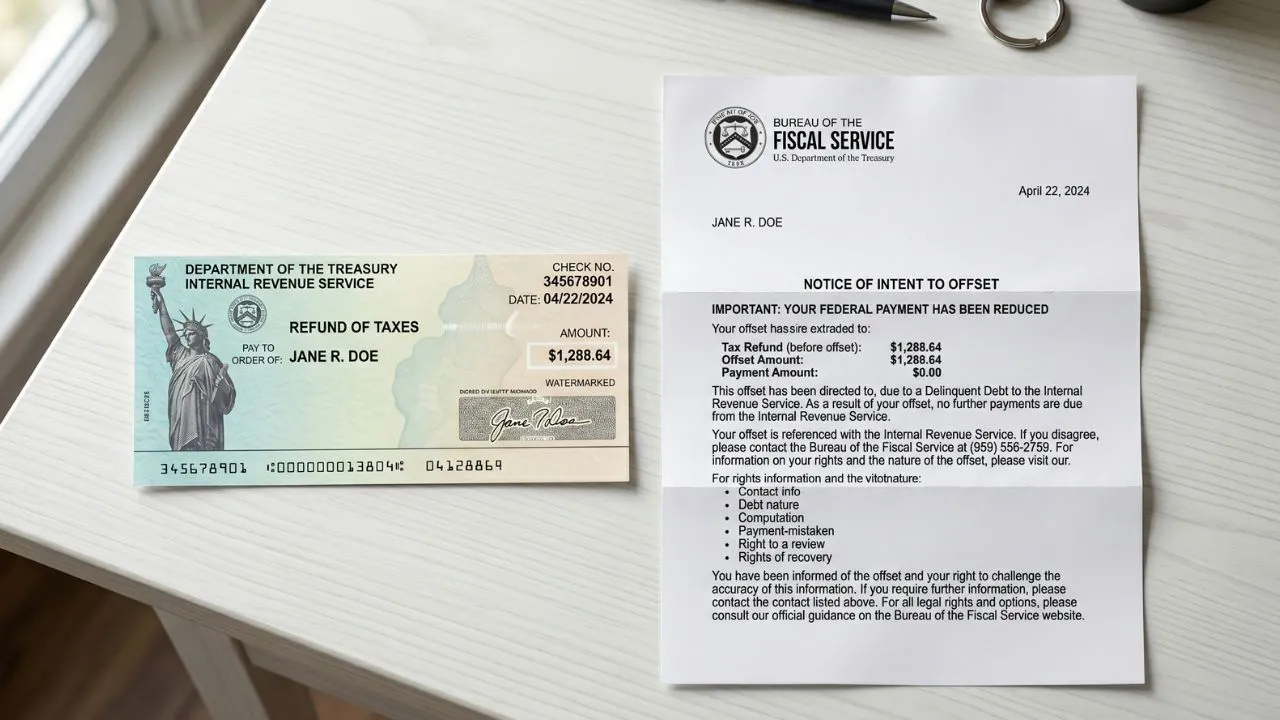
It applies the Treasury Offset Program (TOP), which intercepts payments to cover debts like unpaid taxes or defaulted student loans. It assigns an ACH effective date based on the agency’s request and the FedACH processing calendar. Then it submits the batch to FedACH for delivery to banks.
All of this draws on the Treasury General Account, the government’s operating checking account, held at the Federal Reserve Bank of New York, not at any commercial bank. Every tax dollar collected flows in. Every federal dollar spent flows out.
The balance publishes daily. See our TGA balance tracker, the Daily Treasury Statement explainer, and the Treasury Offset Program rules for more.
Layer 4: ACH Network Transmission
After Treasury submits a file, it enters the Automated Clearing House (ACH) network, a batch-processing system for direct deposits and electronic transfers across the U.S. banking system.
Two operators run it: FedACH, run by the Federal Reserve, and the Electronic Payments Network (EPN), run by The Clearing House, a private company owned by major commercial banks. Nearly all federal payments travel through FedACH.
Here’s the part worth getting exactly right, because it’s widely misstated: standard ACH items, the kind used for most recurring federal payments, settle at 8:30 a.m.
Eastern Time on the next banking day after Treasury submits the file, per the Federal Reserve’s published FedACH processing schedule. Separately, NACHA also operates Same Day ACH, a faster optional service with three same-day submission windows, settling at 1:00 p.m., 5:00 p.m., and 6:00 p.m. ET.
Same Day ACH exists for transactions chosen for faster handling; most routine federal benefit payments still move on the standard next-day cycle. FedACH does not run on weekends or on any of the 11 Federal Reserve holidays.
A file submitted Friday afternoon does not settle until Monday morning. Underneath all of this sits a specific legal framework: Treasury’s ACH payments operate under 31 CFR Part 210, the federal regulation governing government payments through the ACH network, while NACHA’s operating rules set the technical standards every bank in the network agrees to follow.
See what is FedACH, ACH settlement windows, Federal Reserve settlement windows, same-day ACH timing, Federal Reserve holidays, and Fedwire and ACH liquidity timing for full detail.
Layer 5: Bank Receipt and Verification
When your bank receives the ACH credit file, the payment is in the bank’s hands but not yet in your visible balance. The bank matches the routing and account numbers, confirms the account is open and in good standing, and queues the credit for posting, typically in an overnight batch run between roughly 11 p.m. and 4 a.m. Eastern.
Under Regulation CC, the first $275 of many direct deposits and check deposits must be available by the next business day, a threshold the Federal Reserve Board and the Consumer Financial Protection Bureau (CFPB) raised from $225, effective July 1, 2025, as part of a mandatory five-year inflation adjustment tied to the Consumer Price Index.
The related threshold for new-account and large-deposit holds rose at the same time, from $5,525 to $6,725. See direct deposit overnight processing, early direct deposit risk, and ACH electronic payments for more.
Layer 6: Bank Posting to Your Account
The final layer is your bank’s own posting schedule, the moment a queued deposit becomes visible balance. This is why two people who get the same payment on the same day can see it appear hours apart.
Large national banks commonly post overnight batches in the early-morning hours. Regional banks and credit unions often post later in the morning.
Fintech apps including Chime, Varo, and Cash App sometimes credit accounts a day or two early, when they receive an advance pre-notification file from FedACH, that’s the bank’s own policy choice, not an ACH requirement. See direct deposit posting times, bank posting times, Chime direct deposit time, Varo deposit times, and Cash App deposit time.
U.S. Money Movement System
Flow of funds and instructions — swipe to follow the exact path

Who Is Legally Responsible at Each Stage?
A federal payment passes through several different institutions before it reaches your bank account, and each organization has a specific legal responsibility. No single agency controls the entire payment process.
Instead, Congress authorizes funding, federal agencies determine who should be paid, the U.S. Treasury issues the payment, the Federal Reserve moves the money between banks, and your financial institution credits the funds to your account.
Understanding which institution is responsible at each stage makes it much easier to identify where a payment issue may have occurred. It also helps avoid contacting the wrong organization, since each institution can only resolve problems that fall within its legal authority.
The table below summarizes the primary responsibilities, operational roles, and limitations of every major participant in the federal payment system.
| Institution | Legal Authority | Operational Role | Controls | Does Not Control |
|---|---|---|---|---|
| U.S. Congress | Constitutional power of the purse | Passes appropriations and program law | Whether a program is funded at all | Payment amounts, timing, or eligibility for individuals |
| Sending agency (IRS, SSA, VA, DFAS) | Program statutes (Internal Revenue Code, Social Security Act, Title 38) | Calculates eligibility and amount; builds the payment file | Amount, eligibility, status codes | Bank settlement timing or bank posting |
| Bureau of the Fiscal Service (Treasury) | 31 U.S.C. and 31 CFR Part 210 | Validates, offsets, and disburses every federal payment | Effective dates, Treasury Offset Program, ACH submission | Individual eligibility or the receiving bank’s posting time |
| Federal Reserve (FedACH/Fedwire) | Federal Reserve Act | Settles interbank transfers | Settlement timing, holiday calendar | Payment amounts or agency eligibility decisions |
| NACHA / The Clearing House (EPN) | Private ACH operating rules | Sets ACH network rules; EPN operates a second ACH rail | Same-day ACH rules, network operating standards | Treasury disbursement decisions |
| Receiving bank | Regulation CC, Regulation E | Posts the deposit to your account | Posting time, holds, pending status | FedACH’s settlement schedule |
Notice what each institution explicitly does not control. Treasury disburses money but doesn’t decide your eligibility. The Federal Reserve settles the transfer but doesn’t decide who gets paid.
Your bank posts the deposit but doesn’t control when FedACH releases it. Calling the wrong institution about a missing payment wastes time, because no single institution can see the whole pipeline.
The legal layer underneath. A handful of rules hold this entire structure together. 31 CFR Part 210 governs how federal agencies pay people through the ACH network. Regulation CC (funds availability) and Regulation E (electronic transfers) govern what your bank owes you once a payment lands.
Article 4A of the Uniform Commercial Code governs the legal treatment of wholesale funds transfers like Fedwire. NACHA’s operating rules bind every bank in the ACH network to a common technical standard. None of these rules overlap with each other’s jobs, that separation is exactly why the responsibility table above holds up in practice, not just on paper.
For background on the routing infrastructure banks use to identify each other, see routing number structure, Federal Reserve independence, and the Federal Reserve System.
What’s the Difference Between the Money Flow and the Data Flow?
A federal payment does not move through a single process. Instead, it follows two parallel tracks that operate independently: the data flow, which records and authorizes the payment, and the money flow, which actually transfers funds through the banking system.
Because these two processes move at different speeds, a payment can appear as approved, issued, or sent before any money has actually reached your bank account. This difference is the main reason many people see an IRS refund marked as issued while their bank balance still shows no deposit.
The data flow is the information pathway that tracks the payment’s status from start to finish. It typically follows this sequence:
Return filed → IRS processes the return → Processing codes appear on the transcript → Code 846 authorizes the refund → Payment file is created → Bureau of the Fiscal Service validates the payment → ACH file is generated → Receiving bank verifies the account information.
The money flow begins only after the payment file is ready and follows a separate financial pathway:
Treasury General Account is debited → FedACH settles the ACH transfer → Receiving bank’s Federal Reserve account is credited → Bank posts the deposit to your account balance.
Because these two tracks operate independently, they are often at different stages at the same time. For example, Code 846 may appear on a Monday, confirming in the data flow that the IRS has authorized the refund.
What’s the Difference Between the Money Flow and the Data Flow?
Two parallel tracks move at different speeds. Your portal shows data. FedACH moves money. “Sent” means data handed to Treasury — not money in your bank yet.
The Bureau of the Fiscal Service may submit the ACH file on Tuesday, but the actual funds do not leave the Treasury General Account until the scheduled ACH processing window.
The payment then settles through FedACH at 8:30 a.m. ET on Wednesday, after which your bank posts the deposit during its normal processing cycle.
In other words, the data showed the payment was approved two days before the money actually arrived and both were correct because they described two different parts of the federal payment system.
Understanding that payment status information (data flow) and actual transfer of funds (money flow) are separate processes helps explain many common questions about federal payments.
A payment can be fully approved in government systems while still moving through the banking network, making a short gap between “payment sent” and “money received” completely normal.
What Networks Actually Move U.S. Payments: FedACH, Fedwire, RTP, and FedNow?
The U.S. payment system is not a single network. Instead, it consists of several separate payment rails, each designed for a specific purpose, operating schedule, and type of transaction.
While all of them move money electronically between financial institutions, they differ significantly in how quickly payments settle, the types of transactions they handle, and whether they operate only on business days or around the clock.
For federal benefit payments such as IRS tax refunds, Social Security benefits, SSI, and most Treasury disbursements, FedACH remains the primary payment network.
By contrast, Fedwire Funds Service is used for large-value, time-critical transfers between banks, while RTP and FedNow provide real-time payments that operate 24 hours a day, 365 days a year.
Understanding the role of each network helps explain why most federal payments are not instant, even though real-time payment technology already exists.
The table below compares the major U.S. payment networks, including who operates them, when they were introduced, how quickly they settle transactions, the types of payments they typically process, and recent activity across each system.
| Rail | Operator | Launched | Speed | Typical Use | Recent Activity |
|---|---|---|---|---|---|
| FedACH (standard) | Federal Reserve | 1970s | Settles next business day, 8:30 a.m. ET | Nearly all federal benefit payments, payroll, tax refunds | Runs alongside EPN on a combined ACH Network that moved 35.2 billion payments worth $93 trillion in 2025. |
| Same Day ACH | NACHA / FedACH & EPN | Phased in 2016–2021 | Same business day, in 3 windows | Business payroll, bill payments, limited federal use | 1.4 billion payments worth $3.9 trillion in 2025, up 16.7% in volume year over year. |
| Fedwire Funds Service | Federal Reserve | 1918 (modernized since) | Real-time, gross settlement, high value | Large-value bank-to-bank transfers, securities settlement | About 210 million transfers worth roughly $1.13 quadrillion in 2024 (most recent full-year data), averaging $5.4 million per transfer. |
| EPN | The Clearing House | 1970s | Same as FedACH | Private-sector ACH volume | Second-largest ACH operator by volume, sharing in the network total above. |
| RTP | The Clearing House | 2017 | Instant, 24/7/365 | Bank-to-bank instant payments | More than $1.3 trillion processed in 2025; 1,135+ institutions enrolled; $10 million transaction cap. |
| FedNow | Federal Reserve | July 2023 | Instant, 24/7/365 | Bank-to-bank instant payments | $853.4 billion processed in 2025; average payment $101,435; up 460% year over year; more than 1,600 participating institutions. |
The government overwhelmingly still uses standard FedACH for benefit payments, not the newer instant rails. That’s a cost-and-reach decision, not a technology gap.
FedACH’s batch design means the marginal cost of adding one more payment to a file is small, priced in fractions of a cent under the Federal Reserve’s fee schedule for high-volume batch processing.
Fedwire, built for real-time, payment-by-payment settlement of large sums, carries a materially higher per-transfer cost, since every transfer is settled and guaranteed individually rather than bundled with millions of others.
What Networks Actually Move U.S. Payments
FedACH vs Same Day ACH vs Fedwire vs RTP vs FedNow — operator, speed, cost and use-case. Why federal benefits still run on standard FedACH.
| Rail | Operator | Speed | Cost Model | Typical Use | 2025 Activity |
|---|---|---|---|---|---|
|
FedACH (Standard) |
Federal Reserve | Next business day • 8:30 a.m. ET | Fractions of a cent • batch | Nearly all federal benefits, payroll, tax refunds | 35.2B ACH payments • $93T combined network volume |
|
Same Day ACH |
NACHA / FedACH & EPN | Same day • 1pm / 5pm / 6pm ET | Low • same-day premium | Business payroll, bill pay, limited federal | 1.4B payments • $3.9T • +16.7% YoY volume |
|
Fedwire Funds |
Federal Reserve | Real-time • gross settlement | Materially higher • per transfer | Large-value bank-to-bank, securities settlement | ~210M transfers • ~$1.13 quadrillion (2024) • Avg $5.4M |
|
RTP® |
The Clearing House | Instant • 24/7/365 | Bank-priced • instant | Bank-to-bank instant payments | $1.3T+ in 2025 • 1,135+ institutions • $10M cap |
|
FedNow® |
Federal Reserve | Instant • 24/7/365 | Bank-priced • instant | Bank-to-bank instant payments | $853.4B in 2025 • Avg $101,435 • +460% YoY • 1,600+ banks |
That cost gap is exactly why Social Security, IRS refunds, and payroll, tens of millions of small, non-urgent payments every month, run on FedACH, while Fedwire handles the comparatively small number of very large, time-critical transfers.
Reach matters just as much as cost. FedACH connects to essentially all of the roughly 9,000 federally insured banks and credit unions nationwide. FedNow and RTP participation, though growing fast, FedNow alone added 500 institutions in a single year, still covers a smaller share of that universe.
See ACH vs FedNow comparison, wire vs ACH vs RTP, ACH electronic payments, Fed payment rails and fintech access, and the Fed payment account for more, and federalreserve.gov/paymentsystems for the Fed’s own service pages.
What Time of Day Does Each Step of a Federal Payment Happen?
Federal payments do not move continuously throughout the day. Instead, they follow a predictable daily processing schedule based on the operating hours of the U.S. Treasury, the Federal Reserve’s payment services, and individual financial institutions.
Each stage from Treasury transmitting a payment file to the Federal Reserve settling the transaction and banks posting the deposit, occurs during established processing windows that repeat on nearly every business day.
Although the exact time a payment appears in your account varies by bank, the underlying payment infrastructure operates on a consistent timetable. Large banks often post ACH deposits shortly after completing their overnight processing batches, while regional banks and credit unions may finish posting later in the morning.
Same Day ACH payments follow separate settlement windows, and high-value Fedwire transfers operate under an extended daily schedule. Understanding this routine helps explain why a payment may be issued by the government but still not appear in your account until several hours later.
The table below outlines the typical daily sequence of events for standard federal ACH payments and related payment systems. While individual banks may have slightly different posting practices, the overall processing rhythm changes very little from one business day to the next.
| Approximate Time (ET) | Event |
|---|---|
| ~11:00 p.m. – 4:00 a.m. | Receiving banks run their overnight processing batch on files already delivered. |
| Early morning (varies by bank) | Large national banks typically post overnight-batch deposits. |
| 8:30 a.m. | Standard (non-same-day) FedACH items settle. |
| Mid-morning | Regional banks and credit unions typically finish posting. |
| Midday–afternoon | The prior day’s Daily Treasury Statement publishes on fiscaldata.treasury.gov. |
| 1:00 p.m., 5:00 p.m., 6:00 p.m. | Same Day ACH windows settle for eligible items. |
| 9:00 p.m. – 7:00 p.m. next day | Fedwire’s extended operating window runs for large-value transfers. |
If the U.S. Treasury submits a standard ACH payment file after the Federal Reserve’s processing cutoff on a Friday, the payment normally cannot settle until 8:30 a.m. on the following Monday because standard FedACH processing does not occur over the weekend.
This timing explains why many recipients do not see federal direct deposits arrive on Saturdays or Sundays, even when a payment has already been authorized. See federal payment status meaning, settlement window timing, federal holiday pauses, and weekend banking slowdown for more.
24-Hour Federal Payment Clock — 9 p.m. to 9 p.m. ET
Exact daily rhythm of FedACH, Fedwire, Same Day ACH and bank posting — why weekends freeze and Monday 8:30 a.m. matters.
Where Does the Money Actually Sit: The Treasury General Account?
The Treasury General Account (TGA) is the U.S. government’s operating checking account, held at the Federal Reserve Bank of New York rather than at a commercial bank. Every federal payment leaves this account. Every tax dollar and Treasury bond sale deposits into it.
Through July 2026, the Daily Treasury Statement showed the TGA moving in a wide band day to day. It closed at $738.3 billion on July 10, at $770.6 billion on July 2, and at $822.5 billion on July 16, swings driven by ordinary daily traffic like debt issuance and redemption, tax deposits, and benefit outlays.
On July 2, for instance, roughly $270 billion in maturing debt was redeemed the same day Social Security paid out about $26.5 billion in benefits, both flowing through the same account within hours of each other.
Historically, the balance has ranged far more widely than that. Federal Reserve research tracking the account from 2008 through 2025 found it as low as roughly $3 billion during acute debt-ceiling standoffs and as high as nearly $1.8 trillion in calmer periods.
When the TGA runs low, usually tied to a debt-ceiling standoff and Treasury’s use of so-called “extraordinary measures”, payment timing risk rises across the whole system, because Treasury is drawing down its own operating cash rather than replenishing it through normal borrowing.
See our TGA balance tracker, Daily Treasury Statement timing, Treasury extraordinary measures guide, Treasury auction schedule, and debt ceiling mechanics, plus the government’s own Daily Treasury Statement and FRED TGA series.
Treasury General Account: Daily Closing Balance
July 2025 to July 2026 • FRED WTREGEN / Daily Treasury Statement • The government’s checking account at the Federal Reserve Bank of New York
How Much Money Moves Through This System Each Year?
Total federal outlays reached about $7.0 trillion in fiscal year 2025, per the Congressional Budget Office (CBO), up 4%, or $275 billion, from FY2024. Mandatory spending, the category that includes Social Security, Medicare, Medicaid, and other entitlements that keep paying during a shutdown, totaled about $4.2 trillion, more than half the entire federal budget.
Discretionary spending, which requires annual appropriation and is what actually gets disrupted in a shutdown, totaled roughly $1.9 trillion. Revenues came in at about $5.2 trillion, leaving a deficit of $1.8 trillion, or 5.8% of GDP.
Net interest on the federal debt surpassed $1 trillion for the first time in FY2025, now the second-largest line item in the federal budget after Social Security.
| Category | Approximate FY2025 Amount | Spending Type |
|---|---|---|
| Social Security (all benefits) | ~$1.6 trillion | Mandatory |
| Medicare | ~$987 billion | Mandatory |
| Medicaid | Included in ~$4.2T mandatory total | Mandatory |
| IRS individual refunds | ~$265 billion (through mid-April 2026 filing season) | Refund of prior collections |
| VA disability compensation | ~$150 billion | Mandatory (advance-appropriated) |
| Federal civilian and military payroll | ~$200 billion | Discretionary |
| Net interest on the debt | >$1.0 trillion | Mandatory |
| Everything else (defense, other programs) | Remainder of $7.0T | Mixed |
Within the 2026 tax filing season specifically, the IRS reported an average refund of $3,571 as of mid-March, rising to a fuller-season average of $3,275 by Tax Day, April 17, up 11.3% from $2,942 the year before.
Over 98% of individual refunds are now issued electronically, a share Executive Order 14247 is pushing higher by phasing out most federal paper checks after September 30, 2025. See IRS refund delays, paper check phase-out, federal deposit eligibility, and Treasury’s payment system for related detail.
Why Do Federal Payments Get Delayed?
Federal payments can be delayed for many different reasons, but not every delay has the same cause. In practice, delays fall into two completely different categories: system timing delays and exception delays.
Understanding which type of delay applies to your payment is important because it helps you know whether the payment is simply following the normal federal payment process or whether there is an issue that may require you to take action.
System timing delays are part of how the U.S. payment infrastructure operates. These are normal processing delays built into the federal payment system and affect millions of payments every year.
They occur because Treasury payments move through the Federal Reserve and the ACH network according to scheduled processing windows, settlement cycles, banking hours, weekends, and federal holidays. These delays do not indicate that your payment has been lost or rejected, they simply reflect how the payment system is designed to work.
Exception delays, by contrast, affect only specific payments. These delays occur when there is an issue with the payment itself rather than with the payment system.
Why Do Federal Payments Get Delayed? — Decision Tree
Start at top. Follow in order. Is it system timing (wait) or exception (act)? Covers weekend, pending, offset, verification, routing and Reg CC hold.
Examples include incorrect bank account information, Treasury Offset Program collections, IRS refund reviews, identity verification requirements, or bank-specific holds after the payment is received. Unlike routine system timing, exception delays may require action by the payment recipient or another agency before the funds can be released or reissued.
System Timing Delays
System timing delays are the normal waiting periods built into the federal payment process. Even after the U.S. Treasury authorizes a payment, the money does not move instantly from the government to a recipient’s bank account. Instead, it travels through the Federal Reserve’s payment infrastructure and the ACH network according to scheduled processing cycles.
These timing rules apply to virtually every ACH-based federal payment, including IRS tax refunds, Social Security benefits, SSI, VA benefits, and many other Treasury disbursements.
One of the most common examples is the overnight ACH settlement cycle, which typically creates a one-business-day gap between Treasury submitting the payment and the receiving bank settling and posting the funds.
Weekends also create predictable pauses because the FedACH service generally does not process standard ACH payments on Saturdays or Sundays. Likewise, each of the 11 Federal Reserve holidays is a non-processing day, and when a holiday falls next to a weekend, multiple non-processing days can combine to create a longer wait.
Even after settlement occurs, individual banks have their own posting schedules, meaning two customers receiving the same Treasury payment may see the deposit appear at different times on the same day.
Exception Delays
Exception delays occur when a particular payment cannot move through the normal federal payment process because of an issue affecting that individual transaction. Unlike system timing delays, these are not expected parts of the payment infrastructure and typically involve a specific problem that must be resolved before the payment can be completed.
Depending on the cause, the recipient may need to contact the relevant agency, update account information, respond to verification requests, or wait for a review to be completed.
Common examples include incorrect routing or account information, which can cause an ACH payment to be returned to the U.S. Treasury and, in some cases, result in the payment being reissued as a paper check weeks later.
A Treasury Offset Program collection may reduce or intercept part of a payment before it ever enters the ACH network, meaning the issue is not a processing delay but a legally authorized reduction that must be disputed with the collecting agency. IRS refunds may also be delayed by PATH Act holds, identity verification requests, or math-error reviews, preventing the refund from being sent to Treasury until the review is complete.
Finally, some banks may place a Regulation CC funds availability hold on a deposit after it has posted, particularly for new accounts or unusually large deposits, delaying when the recipient can access the money even though the payment has already reached the bank.
Plain-English decision logic: If your portal shows Code 846 or “payment issued” but nothing has posted, first check whether the effective date fell on a weekend or holiday, then check your bank for a pending transaction, then check for a Treasury Offset Program notice, and only then contact the agency.
| Problem Category | What You See | Where It Actually Lives | What to Do |
|---|---|---|---|
| Administrative (still processing) | No status change for weeks | Agency hasn’t finished its own review | Wait, check the agency portal |
| Timing (weekend/holiday) | “Issued” but nothing posted | Effective date fell on a non-processing day | Wait one business day |
| Data/routing error | Refund converts to paper check | Bank rejected the ACH credit | Contact the agency after 5+ business days |
| Offset | Amount is lower than expected | Treasury Offset Program intercepted it | Dispute with the collecting agency |
| Identity/verification | Refund frozen, notice received | IRS review (5071C, PATH Act, etc.) | Respond to the specific notice |
| Bank-side hold | Posted but not available | Regulation CC hold on the account | Contact your bank directly |
See Where’s My Refund not updating, CP05 notice, refund freeze Code 810, CP53E notice, tax refund offset guide, PATH Act freeze, the February PATH freeze, Social Security sent but zero, Social Security missing-payment alerts, FedACH settlement delays, and refund sent but no deposit.
How Does Each Type of Federal Payment Move Differently?
Although most federal payments ultimately travel through the U.S. Treasury and the Federal Reserve’s payment infrastructure, each program follows its own authorization process, payment schedule, and funding rules before money reaches a recipient’s bank account.
Understanding these differences helps explain why tax refunds, Social Security benefits, VA payments, federal payroll, and SSI often arrive on different dates even though they use many of the same payment systems.
IRS tax refunds
IRS tax refunds follow a multi-agency process before money reaches your bank account. After the IRS finishes processing a tax return and approves the refund, it assigns Transaction Code 846 to the taxpayer’s account transcript, indicating that the refund has been authorized for issuance.
The IRS then prepares an electronic payment file and generally submits it to the Bureau of the Fiscal Service within one to two business days. From there, the Bureau sends the payment through the Federal Reserve’s FedACH system, where it enters the standard ACH settlement process before the receiving bank credits the taxpayer’s account.
Most direct deposit refunds appear one to three business days after Code 846 is posted, although weekends, Federal Reserve holidays, and individual bank posting schedules can extend the timeline slightly.
For example, a return accepted in late January may complete IRS processing in mid-February, at which point Code 846 appears on the taxpayer’s transcript. The Bureau of the Fiscal Service typically forwards the payment to FedACH within a day or two, and the receiving bank generally posts the deposit during the next ACH settlement cycle.
Under normal conditions, taxpayers often receive the refund about three to five days after the Code 846 date, assuming there are no processing interruptions, bank delays, or non-business days in between. See IRS refund timing and IRS refund schedule 2026.
Social Security retirement and SSDI
Social Security retirement and Social Security Disability Insurance (SSDI) benefits are paid according to a fixed monthly schedule based primarily on the beneficiary’s birth date.
People born between the 1st and 10th receive payments on the second Wednesday, those born between the 11th and 20th are paid on the third Wednesday, and those born between the 21st and 31st receive benefits on the fourth Wednesday of each month.
This predictable schedule allows the Social Security Administration to distribute payments evenly throughout the month while managing millions of monthly benefit payments.
To keep payments arriving on schedule, the Social Security Administration (SSA) typically transmits payment files to the U.S. Treasury about a week before the official payment date. Treasury then routes the payments through the Federal Reserve’s ACH system so banks can credit beneficiary accounts on the scheduled Wednesday.
Following the 2.8% Cost-of-Living Adjustment (COLA) that became effective in January 2026, the average retired-worker benefit is approximately $2,071 per month.
For example, someone born on the 15th will normally receive their benefit on the third Wednesday of every month, because the payment file is prepared and transmitted well in advance, even when holidays occur during the processing period. See August payment schedule and September payment schedule.
VA disability compensation
VA disability compensation generally reaches beneficiaries between the 1st and 3rd of each month, depending on weekends, federal holidays, and individual bank posting schedules.
Payments are administered by the Department of Veterans Affairs but are disbursed through the Bureau of the Fiscal Service using the same federal payment infrastructure that supports other Treasury-issued benefits.
Unlike many other federal programs, VA disability compensation is funded through advance appropriations, meaning Congress authorizes funding a full fiscal year ahead under existing law.
This funding structure makes VA disability payments among the most reliable federal benefit payments because they are largely insulated from short-term government funding interruptions.
During all three FY2026 federal funding lapses, disability compensation continued to be issued without interruption because funding had already been appropriated before the fiscal year began. See VA disability payment schedule.
Federal employee payroll
Federal employee payroll follows a different process because it is employment compensation rather than a federal benefit payment. Payroll for most civilian agencies is administered by the National Finance Center (NFC), while payroll for Department of Defense civilian employees and military personnel is managed by the Defense Finance and Accounting Service (DFAS).
Most federal employees are paid on a biweekly payroll cycle, with agencies preparing payroll files before Treasury distributes funds through the ACH network.
Unlike Social Security, SSI, or VA disability benefits, federal employee salaries are funded through discretionary appropriations, meaning Congress must authorize funding through annual appropriations legislation.
As a result, payroll can be affected during government shutdowns if agencies experience funding lapses. During the FY2026 shutdowns, furloughed employees at affected agencies generally did not receive scheduled pay until Congress restored funding, making federal payroll much more sensitive to appropriations delays than mandatory federal benefit programs. See SSDI/SSI schedule.
SSI
Supplemental Security Income (SSI) follows one of the simplest payment schedules in the federal government. Benefits are normally paid on the 1st day of each month.
However, if the 1st falls on a weekend or a federal holiday, the Treasury issues the payment on the last business day before the scheduled date so recipients receive their benefits before the month begins.
This scheduling rule often creates the appearance of a “double payment” in one calendar month when the following month’s benefit is paid early, while the next calendar month may appear to have no payment at all. In reality, neither situation represents an extra payment or a missed payment.
The recipient is simply receiving the same monthly benefit on an adjusted business-day schedule required by federal payment rules.
Shutdown Resistance at a Glance
| Program | Funding Type | Continued Through FY2026 Shutdowns? |
|---|---|---|
| Social Security retirement/SSDI | Mandatory | Yes |
| SSI | Mandatory | Yes |
| Medicare | Mandatory | Yes |
| Medicaid | Mandatory | Yes |
| VA disability compensation | Mandatory, advance-appropriated | Yes |
| Federal employee payroll | Discretionary | No — paused for furloughed staff at affected agencies |
| Most agency operations | Discretionary | No — reduced or paused |
How Did This System Come to Look the Way It Does?
Fedwire dates to 1918, originally built to move funds between Federal Reserve Banks by telegraph. The ACH network grew out of the early-1970s push to automate paper check distribution, with the Federal Reserve becoming a central ACH operator through that decade, a shift Social Security’s own paper-check volume helped drive.
Treasury centralized disbursement operations under what’s now the Bureau of the Fiscal Service across the same period. Same Day ACH phased in between 2016 and 2021, adding progressively more same-day settlement windows.
The Clearing House launched RTP in 2017 as the first new core payment rail in decades. The Federal Reserve launched FedNow in July 2023, starting with just 35 participating institutions.
Batch ACH still dominates federal payments today for a simple reason: reach. FedACH connects to nearly every bank and credit union in the country, while the newer instant rails, despite fast growth, are still expanding toward that same universal coverage. See how the Fed controls interest rates, the Federal Reserve balance sheet, and what is the Federal Reserve for related background.
What’s Next: Faster Federal Payments?
FedNow’s growth has been steep: from 35 participating institutions at launch in July 2023, to more than 300 by year-end 2023, to over 1,600 by early 2026, with 2025 transaction value up 460% year over year to $853.4 billion.
RTP, the older private-sector instant rail, processed over $1.3 trillion in 2025 across more than 1,135 institutions, after both networks raised their per-transaction caps to $10 million during 2025.
Executive Order 14247’s paper-check phase-out is pushing the last holdouts among federal payment recipients toward electronic delivery. Even so, a full shift of routine federal benefit payments onto instant rails isn’t close.
Thousands of smaller banks and credit unions still aren’t connected to FedNow or RTP, and Social Security, IRS refunds, and VA disability all still run on standard next-day FedACH.
The realistic path is incremental: broader instant-rail adoption among banks, continued paper-check elimination, and over a longer horizon, not on any confirmed timeline, same-day or instant settlement for at least some federal payment categories.
This is a reasonable direction based on current trends, not a scheduled change; no agency has set a firm date for moving benefit payments onto instant rails. See Fed payment rails and fintech access and the Fed payment account.
What Should You Do If a Federal Payment Is Missing?
Verify the scheduled payment date. Before assuming a payment is late, confirm its official issue date. IRS taxpayers should check Transaction Code 846 on their tax transcript, while Social Security recipients should verify their scheduled Wednesday payment based on their birth date.
Check for a weekend or federal holiday. If the scheduled payment date falls on a weekend or a Federal Reserve holiday, processing may shift to the nearest eligible business day according to the agency’s payment schedule.
Check your bank for a pending transaction. A pending ACH credit usually means the payment has already reached your bank and is waiting for the institution’s next posting cycle rather than being delayed by the U.S. Treasury.
Check the agency’s payment portal. Review your payment status using the appropriate government tool, such as the IRS refund tracker, your Social Security account, or the VA payment portal, to confirm whether the payment has been issued.
Wait until the end of the business day. Many banks post ACH deposits at different times throughout the day, so a payment that has not appeared in the morning may still be credited before the bank’s daily posting cycle ends.
Contact your bank first. Ask whether an incoming ACH credit has been received, is pending, or has been placed on hold. Your bank can often determine whether the payment has already entered its processing system.
Contact the sending agency if necessary. If your bank has not received the payment after completing the previous steps, contact the appropriate federal agency so it can investigate the payment’s status and determine whether further action is required.
If your bank itself has failed or merged recently, the rules for what happens to a pending direct deposit are different from an ordinary posting delay, see FDIC bank failure and direct deposit and bank merger and direct deposit.
For Direct Express cardholders, see Direct Express fees. For general deposit protection, see FDIC insurance coverage. If you’re wondering whether a file submitted after 4 p.m. will post that night, see direct deposit pending after 4pm, and for how payroll files specifically move through Fed settlement, see payroll file settlement.
How long does a federal payment take to reach my bank account?
Usually one to three business days after the Bureau of the Fiscal Service receives the payment file, not after the agency says sent. For IRS refunds, count from Transaction Code 846 on your transcript – most post one to three business days after 846 appears, landing about three to five days after that date if a weekend falls in between.
For Social Security, there is no wait – it arrives on your birth-date Wednesday – 1st to 10th on second Wednesday, 11th to 20th on third Wednesday, 21st to 31st on fourth Wednesday – because SSA transmits files a week early.
For VA disability, 1st to 3rd of month. If effective date falls on Saturday, Sunday, or one of 11 Federal Reserve holidays, add one business day. See IRS refund timing and Social Security payment dates for exact 2026 calendars.
Why did my neighbor’s deposit post before mine when we have same payment date?
The payment reached both banks at same 8:30 AM ET FedACH settlement. The difference is bank posting schedule. Large national banks like Chase, Bank of America, Wells Fargo post overnight batch between 3 AM and 6 AM ET.
Regional banks and credit unions post 8 AM to 11 AM. Fintech apps Chime, Varo, Cash App sometimes post one to two days early using pre-notification files they receive before effective date – that is bank’s marketing choice, not ACH requirement.
Also check pending – if your bank shows pending, money arrived but queued for next batch 11 PM to 4 AM. No need to call Treasury. See direct deposit posting times and bank posting times.
Does FedACH process payments on weekends?
No. FedACH does not run Saturdays, Sundays, or 11 Federal Reserve holidays – New Year’s, MLK Day, Presidents Day, Memorial Day, Juneteenth, Independence Day, Labor Day, Columbus Day, Veterans Day, Thanksgiving, Christmas.
A file submitted Friday afternoon after cutoff does not settle until Monday 8:30 AM ET. Same Day ACH also does not settle weekends – its 3 windows 1PM 5PM 6PM ET are business days only.
This is single most common delay. If your IRS refund shows sent Friday, it will not post until Monday night or Tuesday morning. See Federal Reserve holidays 2026 deposit schedule and weekend banking slowdown.
What does sent mean in an agency portal?
Sent does not mean money reached your bank. It means agency handed payment file to Treasury BFS. After sent, file must still pass BFS validation against routing directories and death-match fraud screening, TOP offset check, ACH effective date assignment, FedACH settlement at 8:30 AM next business day, and bank overnight batch 11 PM to 4 AM.
Typically one to two more business days after sent. For IRS, sent equals Code 846 posted – file to BFS within 1-2 days. For SSA, sent means file transmitted a week early for Wednesday delivery. Check Treasury General Account tracker and Daily Treasury Statement explainer for where money sits after sent.
Will a government shutdown stop my Social Security payment?
No. Social Security retirement, SSDI, SSI, Medicare, Medicaid, and VA disability compensation are mandatory spending funded by permanent law, plus VA disability is advance-appropriated a year ahead.
They continued through all three FY2026 lapses – 43-day full shutdown Oct 1-Nov 12 2025 longest on record, brief lapse Jan 30-Feb 3 2026, and 76-day DHS partial Feb 14-Apr 30 2026 longest partial. SSA confirmed benefits paid on schedule.
What stops is discretionary – federal employee paychecks for furloughed staff at affected agencies, National Finance Center and DFAS payroll processing delays, new claims processing slower. See federal budget process and DHS shutdown 2026 payment freeze.
What is the Treasury Offset Program?
TOP is automated intercept at Layer 3 Treasury disbursement before money enters ACH network. BFS matches payee SSN against debt database – unpaid federal taxes, defaulted federal student loans, past-due child support enforced by states, state tax debts, federal agency overpayments.
If match, BFS reduces payment by amount owed and sends remainder via FedACH. This is permanent reduction, not delay. You receive notice from BFS.
Dispute not with IRS or SSA who sent payment, but with collecting agency listed on notice – IRS for tax debt, Education for student loans, state child support office for child support. Check fiscal.treasury.gov/top/ and Treasury Offset Program rules.
What is current Fed funds rate and does it affect my refund timing?
As of June 17 2026 FOMC meeting – first chaired by Kevin Warsh – target range 3.50% to 3.75% held, next decision July 28-29 2026. Rate affects borrowing costs, mortgage rates, savings yields, and Treasury financing, not mechanical timing of federal payments.
Your IRS refund timing is driven by Code 846 date plus FedACH 8:30 AM settlement plus bank posting window, not Fed funds rate. TGA balance $738B to $822B in July fluctuates with tax collections and debt ceiling extraordinary measures, not with rate. For rate impact on your money see Federal Reserve policy explained and federal funds rate history.
How much of a check deposit must my bank make available next day?
Under Regulation CC, at least first $275 of many check deposits and direct deposits must be available by next business day, threshold raised from $225 effective July 1 2025 as mandatory five-year inflation adjustment per Federal Reserve Board and CFPB. Large-deposit and new-account hold threshold raised from $5,525 to $6,725 same date.
Federal direct deposits – Social Security, IRS refunds, VA – are generally exempt from extended holds and must be made available next business day, but banks may still hold unusually large amounts or new accounts at discretion. See Regulation CC official text federalreserve.gov/boarddocs/supmanual/cch/funds.pdf and direct deposit overnight processing
Sources and Methodology
Figures in this guide are drawn from primary sources wherever possible: the Bureau of the Fiscal Service’s Daily Treasury Statement; the Federal Reserve’s FedNow participant data and Fedwire annual statistics; the FRED WTREGEN series for TGA history; the Federal Reserve’s June 17, 2026 FOMC statement; IRS filing season statistics; the SSA’s 2026 COLA fact sheet; the CBO’s mandatory and discretionary FY2025 spending infographics; Nacha’s ACH Network volume and value statistics; and the Federal Reserve/CFPB’s Regulation CC threshold notice.
Additional structural references, carried forward from Investozora’s existing reporting and standard for this beat: fiscal.treasury.gov/ for Treasury payment operations; federalreserve.gov/paymentsystems/fedach_about.htm and federalreserve.gov/paymentsystems/fedwire_about.htm for network descriptions; ecfr.gov for the 31 CFR Part 210 text; and achrules.nacha.org and theclearinghouse.org/payment-systems for network operating rules.
TGA balances, ACH and Fedwire volumes, and refund averages are point-in-time figures that change daily, monthly, or annually. Treat every dated snapshot above as current-status information to refresh on your normal review cycle, not as a permanent constant.
Fedwire’s volume and value figures reflect 2024, the most recent full year with confirmed annual totals at time of writing; 2025 annual figures should be checked against the Fed’s own annual-statistics page before republishing, since that page updates on its own schedule.